





 Portuguese
  English
  Spanish
  4 min of reading
  0 comments


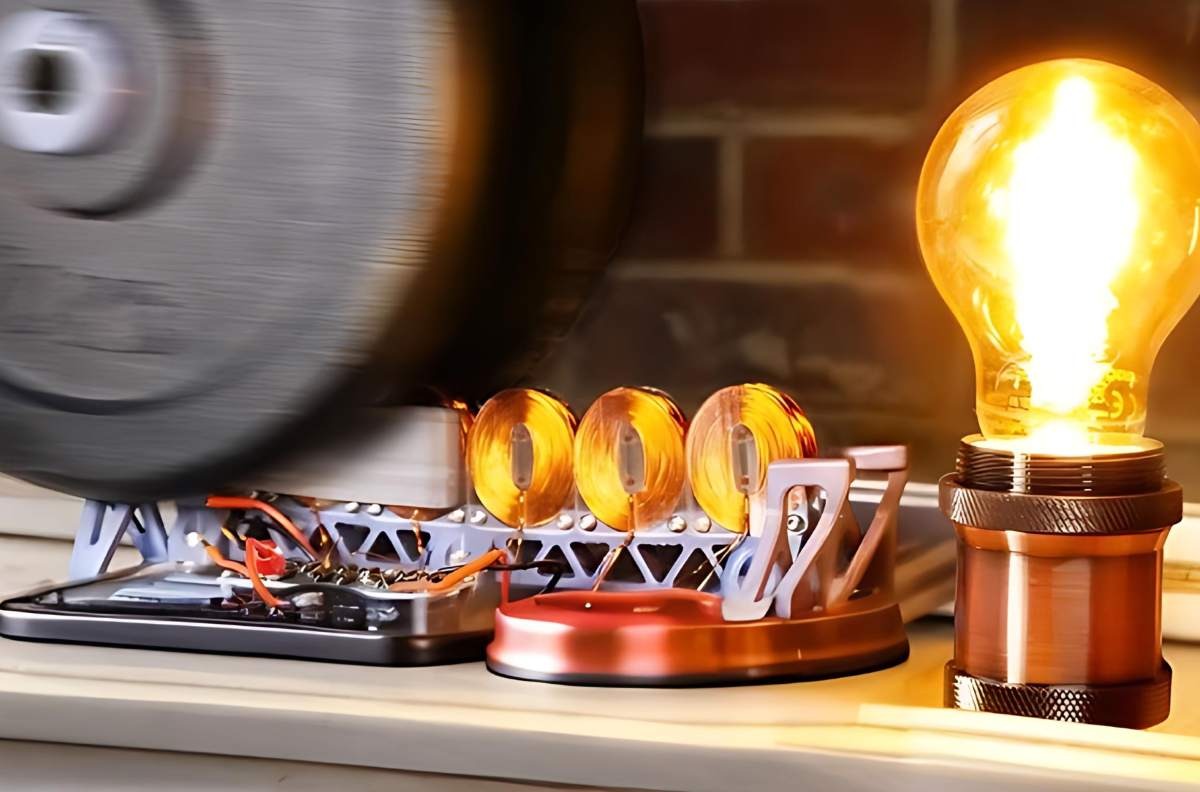
With a Mass of 40 kg and Controlled Fall of 13 cm, the Pendulum Generates About 51 Joules Over Several Minutes, Reaches an Average Power of 0.28 W, Powers Up to Six LED Bulbs and Demonstrates How Electromagnetic Induction and Capacitor Storage Can Recover Energy Previously Dissipated as Heat
A British engineer developed a 40 kg pendulum capable of releasing about 51 joules when falling 13 cm, generating an average power of 0.28 W for several minutes and powering up to six LED bulbs through electromagnetic induction and capacitor storage.
Pendulum Transforms Oscillating Mechanical Energy into Recoverable Electricity
The project demonstrates how the oscillating mechanical energy of a pendulum can be converted into usable electricity. By harnessing principles of electromagnetic induction, eddy currents, and capacitor storage, the system transforms motion that was previously dissipated as heat into recoverable energy.
When a suspended magnet oscillates above a block of copper, it slows down without physical contact. Copper is not magnetic but is conductive. The variable magnetic field induces internal currents, known as eddy currents, which create an opposing field to the original motion.
-
Motorola launched the Signature with a gold seal from DxOMark, tying with the iPhone 17 Pro in camera performance, Snapdragon 8 Gen 5 that surpassed 3 million in benchmarks, and a zoom that impresses even at night.

-
Satellites reveal beneath the Sahara a giant river buried for thousands of kilometers: study shows that the largest hot desert on the planet was once traversed by a river system comparable to the largest on Earth.

-
Scientists have captured something never seen in space: newly born stars are creating gigantic rings of light a thousand times larger than the distance between the Earth and the Sun, and this changes everything we knew about stellar birth.

-
Geologists find traces of a continent that disappeared 155 million years ago after separating from Australia and reveal that it did not sink, but broke into fragments scattered across Southeast Asia.

As a result, some kinetic energy is converted into heat within the metal. This phenomenon is applied in electromagnetic braking, high-speed trains, and industrial systems. The central question of the project was how to reclaim this energy that would normally be wasted.
From Invisible Brake to Real Generator with Coils and Rectification
The conceptual leap occurred when replacing the solid copper block with coils. The physical principle remains the same, but the induced current now has an electrical output. When magnets pass through copper coils, alternating current is generated, varying in direction and intensity.
Simple devices, such as LEDs, require direct current. The adopted solution involves rectifier bridges with diodes, allowing flow in one direction, and capacitors, which smooth and store energy between each oscillation of the pendulum.
The initial result is modest but concrete. Small successive flashes demonstrate direct generation of electrical energy. What was once just thermal dissipation is now converted into temporarily stored electricity.
Pendulum as a Low Consumption Physical Battery
The pendulum acts as a physical battery based on gravitational potential energy. By raising the mass and releasing it, the energy is gradually released in a relatively steady manner, as long as friction losses are minimized.
Unlike chemical batteries, there are no internal reactions or significant degradation. Storage depends on mass, height, and time. The greater the weight, the more energy is accumulated. The longer the arm, the more stable the motion.
Converting this mechanical equilibrium into electricity requires control and efficiency in the coupled generator. The concept demonstrates that low-power systems can be powered by energy recovered from simple movements.
Magnetic Geometry and Induction Enhancement
The system’s performance depends on the arrangement of the magnets. In a Halbach arrangement, the magnetic field is concentrated on one side and weakened on the opposite side. The precise orientation increases intensity where induction is needed.
The inclusion of a back iron plate reinforces the effect. Iron provides an efficient path to close magnetic field lines, increasing intensity in front of the coils. This reduces losses and improves the efficiency of the compact generator.
This optimization is relevant when working with low power levels. Enhanced induction allows for better utilization of the pendulum’s energy without increasing mass or fall height.
Voltage Control and Stability with Multiple Coils
Each coil generates voltage as the magnets pass through it. However, the pendulum’s speed varies along the arc, causing irregular voltage spikes. The sum of the aligned coils is not uniform.
The adopted solution was to divide the system into pairs of coils, each with its own rectifier. This strategy reduces peak voltage and improves stability. It is a simple engineering decision, but crucial for continuous operation.
With capacitors around 100,000 microfarads, the system begins operating as a small continuous source. The storage compensates for the pendulum’s natural oscillations and ensures a more stable supply.
Available Energy: 51 Joules and Average Power of 0.28 W
With a mass of 40 kg and a height reduction of 13 cm, the pendulum releases approximately 51 joules over several minutes. This corresponds to an average power of 0.28 W.
The value is low when compared to lithium batteries. Still, it represents energy recovered from motion that was previously wasted. The generation is sufficient to power up to six LED bulbs for a few minutes.
The system was not designed to charge phones efficiently. It operates better with brief pulses accumulated slowly and released quickly, as in sparks, actuators, or small electromagnetic launchers.
At this point, the pendulum stops seeming like a school experiment and starts representing a practical solution for energy recovery. Even with limitations, it demonstrates technical feasibility.
Integration Potential and Recovery Mindset
The main value lies not only in the pendulum itself but in the idea of reclaiming underutilized mechanical energy. Similar systems could be incorporated into bridges, buildings, industrial elevators, agricultural equipment, or port facilities.
In these environments, the movement is constant but energetically underexplored. The application does not aim to power electrical grids but to supply sensors, emergency lighting, autonomous electronics, or control systems.
In an energy transition scenario, reclaiming each watt where there was once only thermal loss represents a shift in mindset. Not every advancement needs to be large or spectacular.
Sometimes, sustainability starts with simple and controlled solutions. The 40 kg pendulum highlights that oscillating mechanical energy, when properly directed, can stop being a waste and become a recoverable resource.








Seja o primeiro a reagir!