





 Portuguese
  English
  Spanish
  5 min of reading
  0 comments


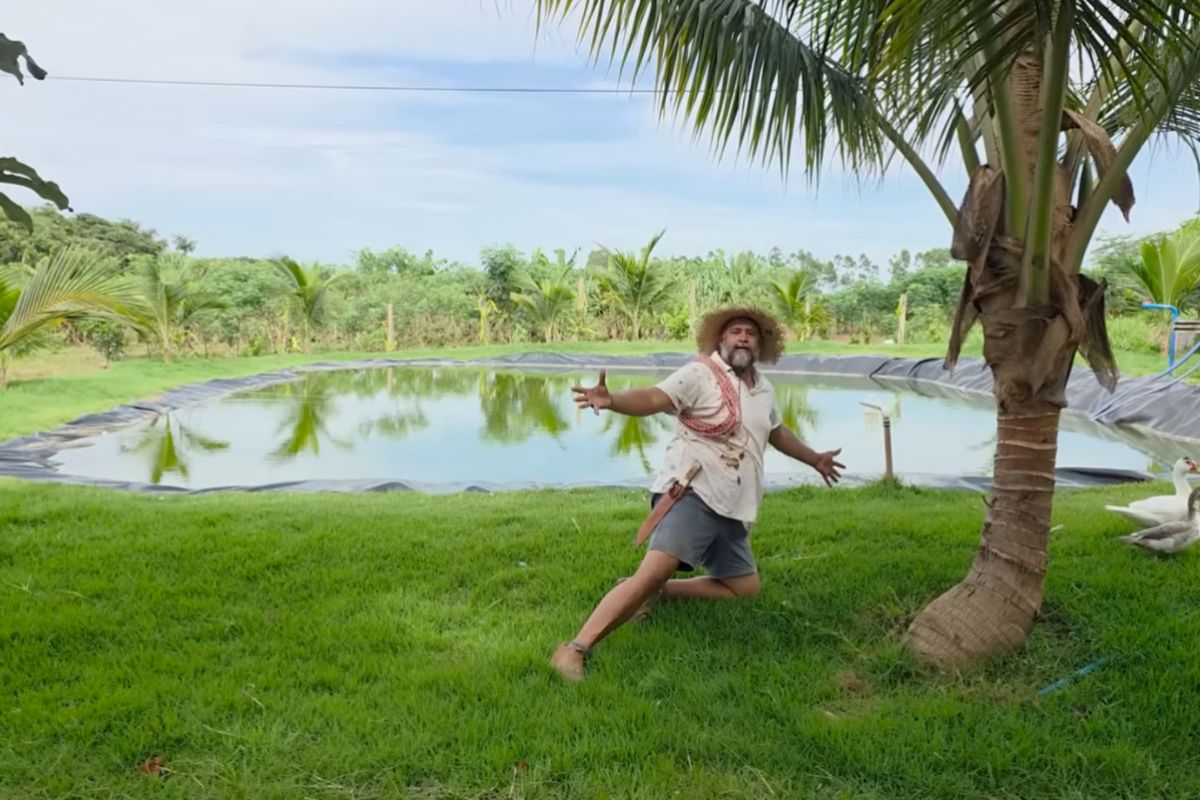
When Detailing Measures With Rope, Depth, Margin for Fixing the Canvas, Recommended Thickness and Costs With Machine, Grass and Coconut Seedlings, Agronomist Isnael Transforms the Ready Reservoir With Canvas Into a Step-by-Step Calculation That Helps to Avoid Loss and Improvisation in the Purchase and Local Execution.
The ready reservoir with canvas presented by the producer is based on a simple logic, but often ignored in small and medium rural works: before buying material, it is necessary to measure the tank as it actually is after excavation, with descent, bottom, and ascent, and not just the view from above.
In the explanation, he shows the complete path, from the dirt hole to the final reservoir, and provides numbers directly, including machine hours, canvas cost, grass cost, and even coconut seedlings. The central point is not just how much it costs, but why so many people make mistakes precisely at the stage that seems easiest.
Measuring the Right Tank Changes the Whole Work

The first alert is technical and practical at the same time. Those who only measure width and length in a straight line often buy a smaller canvas than needed.
-
Friends have been building a small “town” for 30 years to grow old together, with compact houses, a common area, nature surrounding it, and a collective life project designed for friendship, coexistence, and simplicity.

-
This small town in Germany created its own currency 24 years ago, today it circulates millions per year, is accepted in over 300 stores, and the German government allowed all of this to happen under one condition.

-
Curitiba is shrinking and is expected to lose 97,000 residents by 2050, while inland cities in Paraná such as Sarandi, Araucária, and Toledo are experiencing accelerated growth that is changing the entire state’s map.

-
Tourists were poisoned on Everest in a million-dollar fraud scheme involving helicopters that diverted over $19 million and shocked international authorities.


In the shown tank, the guidance is to measure with rope following the undulations, the curve of the sides, and the depth, because the canvas needs to go down, cross the bottom, and rise again.
He uses a 24-meter rope to carry out this process in the middle of the tank, both in width and length.
The rope needs to be loose enough to respect the internal relief, without stretching as if the ground were flat. This difference, which seems small at the edge, translates into extra meters in the final canvas order.
The Margin for Fixing Is Not a Detail

Another important point is the edge margin. During the measurement, he leaves room to dig a groove around the tank and bury the canvas, preventing it from returning inside over time.
In practice, this enters the calculations before the purchase and cannot be remembered only on the day of installation.
In width, the reasoning presented includes the rope, additional meters measured beyond the initial limit, and an extra safety margin. The noted result was 27 meters.
This margin is treated as protection against costly mistakes, because lacking one meter in a large canvas can compromise the entire job and require a new purchase.
Length and Area Calculation of the Canvas
In length, the logic repeats itself, but with a detail that stands out. As the rope was 24 meters long, the measurement was done in stages, summing two complete ropes and an additional stretch.
The final noted result for purchase was 51 meters, already considering the margins for fixing and safety.
With the two measurements in hand, he multiplies 51 by 27 and arrives at 1,377 m² of canvas for that specific tank. The calculation is simple, but the preparation of the measure is what defines accuracy.
The message is clear: anyone can do the multiplication, the difficult part is to obtain the correct measurement of the actual tank.
Thickness of the Canvas and the Risk of Choosing the Cheap Option


In the materials section, the toughest alert is about thickness. He reports having seen canvas tear just from being opened at the bottom of the tank when a thickness of 200 microns was used.
Therefore, he recommends not to buy below 500 microns for this type of reservoir.
In his case, the choice was 800-micron canvas, presented as an option to reduce headaches and increase durability. He also cites that there are thicker options, such as 1,000 microns.
The savings on the canvas, according to the explanation, is precisely where many producers turn a viable project into rework.
What Enters the Account and Why the Final Value Varies
The financial part is shown with objective numbers. For the already executed tank covered with canvas, he reports five hours of machine time at R$ 350 per hour, totaling R$ 1,750.
The canvas cost R$ 12,000. The surrounding grass cost R$ 4,000. The coconut seedlings, 14 units at R$ 70, were rounded to R$ 1,000.
Adding these items, the presented total comes to R$ 18,750.
This total is not treated as a universal rule, but as a reference for his region, with the producer himself highlighting that freight, distance from the property, and local prices for machines and materials can raise or lower the costs in other cities.
The Surroundings Also Part of the Ready Reservoir With Canvas
An aspect that stands out as a differentiator in the project is the use of the surroundings.
Instead of leaving only exposed soil at the edges, he plants grass to contain erosion, reduce mud, and prevent rain from carrying dirt into the water. This also helps those who circulate near the tank, especially in rainy periods.
Additionally, he plants coconut trees around, spaced about 3 meters apart, with the idea of transforming an area that would only incur costs into a productive area.
The proposal is to use the tank for fish and irrigation, and the surroundings to generate returns with coconuts. The work ceases to be just a reservoir and becomes part of the production system.
Water for Irrigation and Choice of Canvas
The justification for using canvas is also linked to the use of water. He states that he needed water for irrigation and didn’t want to wait for the natural sealing of the excavated tank.
In his view, leaving it without canvas could fail to hold water and still generate mud and sediment, which complicates especially drip irrigation systems.
At this point, the ready reservoir with canvas is presented as a solution to reduce clogging in hoses and avoid frequent maintenance.
The argument is based on functionality, not just aesthetics. For those who depend on water regularly, the choice of lining acts as an investment to mitigate future problems.
Transparency in Numbers and Practical Lessons
The value of the content lies in the transparency of the steps. He shows where he made mistakes at the beginning, explains why common measurement fails, and details how anyone can request a quote more securely, informing the company of the width and length already corrected with curves and margins.
It also becomes evident that the work requires prior decisions about depth, tank size, and water purpose. Without this definition, the risk is to buy material outside of real needs, either by excess, raising costs, or by lack, hindering installation and increasing total expenses.
The ready reservoir with canvas shown by him not only draws attention for its visual result. What truly weighs is the combination of correct measurement, adequate thickness choice, and clear accounting for each stage. When these three points are integrated into planning, the producer reduces improvisation and gains predictability.
If you were to set up a reservoir on your property, at which stage would you have the most doubt today: measuring the canvas, choosing the thickness, or calculating the total cost with the machine and finishing around?










-

-

3 pessoas reagiram a isso.