





 Portuguese
  English
  Spanish
  12 min of reading
  12 comments


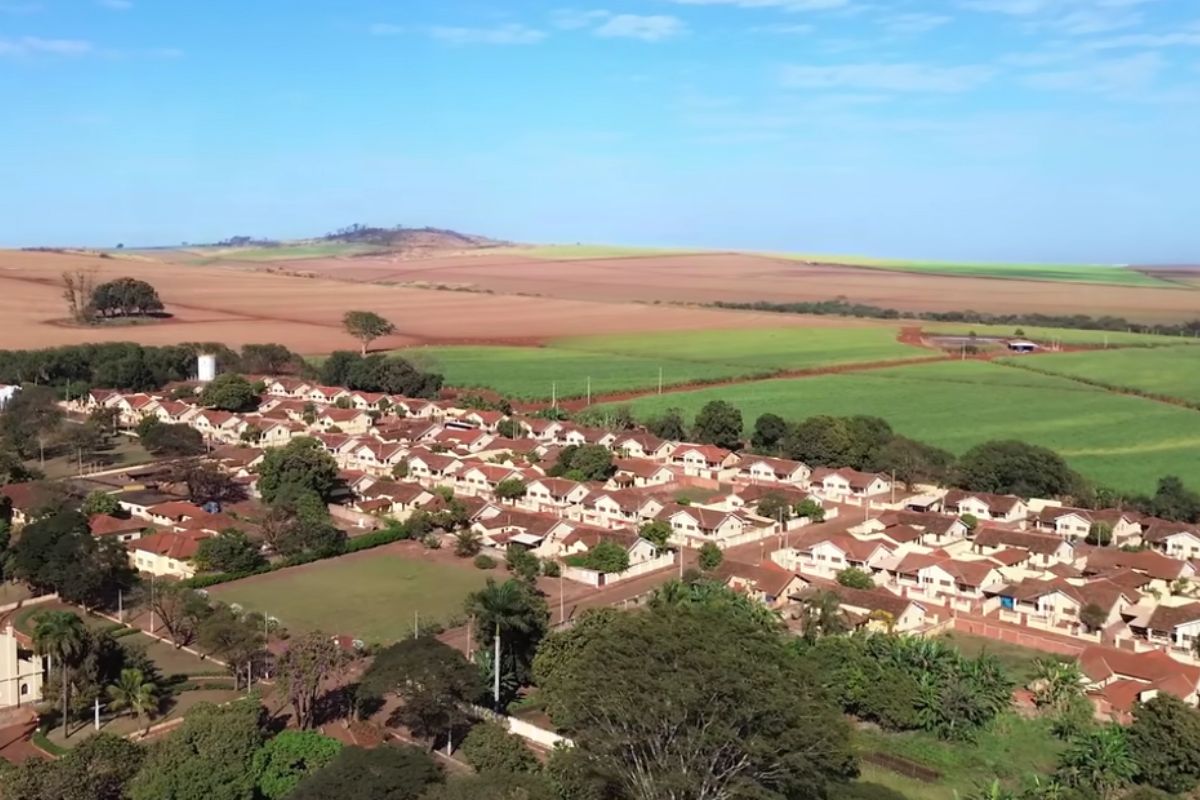


In The Village With More Than 200 Houses, Created For Workers Of The Junqueira Plant, There Are Stone Streets, A Central Square With A Statue Of Colonel Quito, And An Active Church On Special Dates. Reforms Since 2016 Allowed Rentals From R$ 500 To R$ 800, With Many Units Empty For Years In The Interior Of São Paulo.
The village with more than 200 houses was created as a workers’ village, also called a colony, to house workers from the Junqueira plant in the municipality of Garapava, on the border between São Paulo and Minas Gerais. Today, the village with more than 200 houses maintains stone streets, a preserved central square, and renovated houses that can be rented for R$ 500 to R$ 800.
The contrast that marks the village with more than 200 houses is in what remains and what has emptied: the homes that once housed over 1,000 people, including employees and families, now coexist with properties that have been closed for years, locked doors, and backyards without continuous use. At the same time, social administration has migrated to a foundation linked to the Junqueira family, while the Junqueira plant continues to operate as a separate entity.
Where Is The Village With More Than 200 Houses And Why Does The Landscape Stand Out

The village with more than 200 houses is located in the interior of São Paulo, near the city of Garapava, in an area described as the border between the states of São Paulo and Minas Gerais.
-
A couple buys an old chalet, breaks the kitchen floor for renovation, and finds over a thousand coins of gold and silver hidden since the English Civil War over 4 centuries ago.
-
Rigid bags with their days numbered: new trend prioritizes comfort in 2026.
-
YouTuber creates an excavator equipped with a giant 4.5-meter sword to challenge his brother to a rematch, and the invention quickly goes viral on social media.
-
The U.S. Army surprises the world by presenting the UH-60MX Black Hawk helicopter capable of flying without pilots, controlled by a tablet, featuring the MATRIX system, smart sensors, and full autonomy in real combat and rescue missions.


The place is known as the village of the Junqueira plant and was structured to house workers, forming its own urban set, with streets, a square, and community facilities.
The feature that stands out during the stroll is the pavement of the streets. There are stone streets throughout the road network, without asphalt and no dirt roads, which creates a continuous and uniform design.
The result is an environment where movement seems slower and quieter, reinforcing the idea that time has stood still in the village with more than 200 houses, even with signs of recent renovations.
Central Square, Statue, And Current Routine: Where The Village Concentrates

In the center of the urban layout, the spatial reference is the central square. In the center of the square stands the statue of Colonel Quito, indicated as a symbol of the beginning of the venture in 1910.
The square is described as relatively well-kept, with employees working on the maintenance of common areas.
The very conservation has a climatic context cited in the area: a dry season in the São Paulo winter, when it stops raining and the grass dries, with leaves accumulating.
Still, the central square remains the visual and social nucleus of the village with more than 200 houses, concentrating circulation, meetings, and the movement of those who use the few services around.
The Origin Of The Village With More Than 200 Houses: Decade Of 1910, Coffee, And Formation Of The Complex


The village with more than 200 houses was built to accommodate the workers of the Junqueira plant, established in the 1910s in the municipality of Garapava.
The narrative about the origin mentions Colonel Maximiliano Quito, linked to the Ribeirão Preto region and cited as one of the largest coffee producers before the beginning of the 20th century.
The historical sequence presented indicates 1910 as the starting point of the venture and 1916 as the year Quito bought into the partnership.
Initially, he had two other partners; later, he bought their shares and became the sole owner. He managed the complex until 1938, when he died.
Subsequently, the administration passed to his wife, Teolina Junqueira, known as Siná Junqueira.
Foundation And Separation With The Junqueira Plant: Who Takes Care Of What
The current management is presented as divided. The Junqueira plant still exists and continues to operate, but no longer takes care of the village with more than 200 houses.
The village with more than 200 houses has come under the responsibility of a foundation associated with the name of Siná Junqueira, described as responsible for the square and part of the social structures.
There is an important institutional detail: the account mentions that there were no direct heirs and that, after Teolina Junqueira’s death, indicated as occurring in 1956, everything would have gone to the foundation.
The practical consequence is the separation between production and housing: the Junqueira plant as an operation and the village with more than 200 houses as a residential and patrimonial space.
A Neighborhood Within The Neighborhood: Entry, Limits, And Support Buildings
The transition between areas is described as perceptible.
At the entrance of the village with more than 200 houses are the few businesses, and further ahead, begins the part linked to the foundation.
The description includes buildings with different uses, some associated with the foundation and others with the Junqueira plant.
Among the references cited, there is a white building indicating the reception of new employees and a gate that provides access to the internal area of the Junqueira plant.
This type of landmark materializes the division: the village with more than 200 houses lives from the civil daily life, while the Junqueira plant maintains industrial operation in its own area.
Emptying And Recovery: 2016 As A Turning Point
The village with more than 200 houses appears as an example of decline followed by recovery.
There was a phase when many houses were in ruins, and the village with more than 200 houses was described as almost a ghost town.
In 2016, some units needed to be demolished due to structural problems.
From then on, the recovery of other residences began. The most repeated evidence is simple and sensory: the smell of paint, signs of renovation, and spaces that have returned to regular use.
The rehabilitation changes the landscape of the stone streets, but does not erase the mark of emptiness: there are still many empty houses in the village with more than 200 houses, some closed for years.
Worker Architecture: Joined Houses, Repeated Color, And Backyard Differences
A recurring feature of the village with more than 200 houses is the repetition of typologies. The houses are described as very similar, with yellow facades and small variations at the entrance.
In some stretches, there are joined houses, divided in half, reinforcing the workers’ village pattern.
The external uniformity contrasts with what changes behind the gates. The backyards vary, with different sizes and extensions that do not always repeat.
There are houses with covered garages in front, narrow side corridors, and wider back areas.
In others, there are annexes, extensions, and even roofless small rooms, suggesting renovations and improvisations made by residents over more than 100 years.
Open Gates, Locked Doors, And The View Inside The Houses
On several stone streets, gates appear open, allowing a view of the backyards, but doors are often locked. In some cases, there were open houses, which allowed observing the internal configuration.
The description includes a small and functional kitchen, a living room next to it, and two bedrooms. In some points, the bedrooms are described as dark but with orderly paint.
Renovation signs appear in objective details. Ceilings look new, and toilets and sinks have been described with labels still present.
In one house, the bathroom had paper in the toilet, suggesting the unit was ready but still without daily use.
There are also signs of adaptation: plastic under tiles to avoid leaks, an improvised wood stove, and old windows coexisting with newer ones, including mentions of steel shutters.
Rent And Occupation Rules: Who Can Live There And How Much It Costs
The current occupation is supported by rent. The cited information is that the rent ranges from R$ 500 to R$ 600 and can reach R$ 800, varying according to the condition and size of the property.
The rent is treated as a financial axis for maintenance, and the key is kept by the institution that controls access and leasing.
There are two practical rules that are repeated. The first is that anyone can live in the village with more than 200 houses. There is no need to have worked at the Junqueira plant.
The second is that many current residents come from outside. The account points out little presence of people from the old days, as children sought their parents and many left, leaving empty houses and a more dispersed residential profile.
Why Charge Rent: Maintenance And Social Destination Of The Money
The rent charge has a justification presented on-site. The explanation is that rent money is reverted to the institution, used for actions aimed at underprivileged children, as well as covering employees and maintaining the space.
In practice, this connects rent, renovation, and preservation: rent becomes a tool to sustain the village with more than 200 houses in operation.
This arrangement is coherent with what is observed in the central square and the renovated houses. The presence of workers taking care of the common areas and the recovery of units indicate a management model that depends on revenue.
At the same time, rent coexists with the landscape of stone streets and empty houses, showing that reoccupation occurs at a gradual pace.
Safety And Memory: When The Village Was Full And There Was Almost No Crime
The testimony of older residents describes a past of movement and trust. The village with more than 200 houses is said to have been much more lively, with intense coexistence and a feeling that everyone was like siblings.
The account includes a routine where cars were left with unlocked doors, bicycles on the sidewalk, and motorcycles outside, with no recorded theft problems at that time.
This memory helps explain why the emptying is narrated as a loss of community, not just of residents.
The comparison is direct: in the past, it was too good. Today, the village with more than 200 houses still looks well-kept but coexists with fewer people, less activity, and more silence on the stone streets.
What Existed Before: Store, Club, Cinema, And Carnival With Shows
The village with more than 200 houses once had an internal infrastructure described as complete. There was a market, called a store, and a purchase system with paper: the worker received an order, bought, and the amount was deducted from their salary.
This model reinforces the colony logic linked to the Junqueira plant.
In leisure, the account mentions a club, dances, cinema, and a carnival considered very lively. Shows and the presence of singers such as Agnaldo Timóteo, Agnaldo Rayol, and Francisco Petrônio are also mentioned. Later, a leisure center was created, with a pool, gym, and games.
These elements compose the image of a place that functioned as an autonomous city.
Old Benefits: Housing Without Rent, Water, And 50% Discount On Energy
The past of the village with more than 200 houses includes benefits described as part of social well-being. People did not pay rent, did not pay for water, and had a 50% discount on energy.
This package reduced the cost of living and reinforced permanence close to work, with the Junqueira plant as its axis.
The change occurs when the structure ceases to be funded as before and starts to rely on a model of rent and management by a foundation.
The narrative mentions the expansion of the sugar trade throughout Brazil, attracting companies and selling off a large part of the complex.
The social effect appears in the exit of families and the increase in empty houses.
Leadership Near The Square: Larger Houses And Separation By Function
The work hierarchy also appears in geography. The account mentions that leadership lived around the square, near the Catholic church and the garden associated with Colonel Quito.
These houses would be larger. The housing for employees appears in more distant streets, with similar typologies and greater repetition.
This separation helps interpret the symbolic weight of the central square. Around it are the marks of power, administration, and representation.
For those who walk through the stone streets, the urban design becomes a social document of the time when the Junqueira plant organized the village with more than 200 houses as a direct extension of work.
Municipal School: 6 To 7 Km From The City, Waiting List And Bus
There is still a school in the village with more than 200 houses from the time when the village was linked to the Junqueira plant.
Today, it is a municipal school and, therefore, under the management of the Garapava city hall. The account highlights that the education provided would be differentiated compared to the city standard, generating competition for vacancies and a waiting list.
The logistics show the regional scale. The city is about 6 to 7 km away, and there are vans and school buses that bring in students.
There is also mention of students coming from Garapava and from locations cited as Aramina, Brejão, and Rifanina.
The administration is described as someone who makes an effort to accommodate children, especially when the family begins to live in the village with more than 200 houses.
Church, Chapel, And Playing Field: Faith With Reduced Agenda And Heritage Needing Reform
The Catholic church is still present, but with less frequent masses. The account indicates celebrations on some special dates, few times a month, compatible with the smaller population.
There is also an evangelical church, cited as a Congregation, with services at specific times, also with reduced frequency.
Behind the church, there is a small soccer field and an old chapel, described as small, with a low door and triangular windows.
The chapel has been pointed out as one of the few structures that are not so well cared for, with a sagging ceiling and accumulated leaves, suggesting the need for repairs to avoid the risk of collapse.
Current Commerce: The Minimum To Operate, With The Square As A Meeting Point
The entrance of the village with more than 200 houses concentrates the little commerce available: a single restaurant, a snack bar, a small grocery store, and a bakery.
After the entrance, the flow directs towards the square, which gathers more cars and greater circulation.
The relationship with the Junqueira plant appears in the routine. Workers still pass through the region to buy something, use services, and circulate between the social side and the industrial side.
During business hours, there is reference to conduct rules, which helps explain why the environment, despite being active in certain points, remains moderate and quiet on the stone streets.
Locomotives And Transport: From 1910 To The 1970s, With A Historical Piece In The Square
The Junqueira plant is said to have used locomotives to transport raw materials and also the finished sugar from the 1910s to the 1970s.
In 1974, trains ceased to be the main means of transport, and trucks began to dominate. There were seven locomotives in total, and six were sold.
Locomotive number 5 remained in operation for another four years, and in 1978, after retiring, it was placed in a square as a tourist and photo spot.
It was restored for exhibition. It is not allowed to enter it, but its presence serves as a physical memory of the village with more than 200 houses and the Junqueira plant.
New Residents, Empty Houses, And The Argument Of Tranquility
Despite the emptying, there are signs of reoccupation. The account mentions families coming from outside, including families from Campinas and one neighbor linked to Santa Catarina.
The declared motivation is tranquility, reinforced by the standard of the stone streets, the slow pace, and the sense of security associated with the past.
At the same time, the village with more than 200 houses still has many empty houses. There are closed doors, streets with unoccupied properties, and a partial occupation that does not erase the character of a preserved place.
The combination of rent, renovation, and emptiness is what sustains the image of living where time has stopped.
What It Means To Live In The Village With More Than 200 Houses Today
Living in the village with more than 200 houses means residing in an old set, with recent renovations in some units, and a routine structured by rent.
It means coexisting with stone streets, a well-kept central square, a contested municipal school, and churches with reduced agendas due to the lack of residents.
And it means accepting that alongside houses ready for use, there are still many empty houses.
For those considering rental, the practical step is to contact the institution that holds the keys and manages leases, checking availability, price, and conditions of each unit.
The village with more than 200 houses does not require prior ties to the Junqueira plant, and the variations in backyard, annexes, and extensions change the profile of each property, even within a repeated urban standard.
Would You Live In The Village With More Than 200 Houses, Paying Rent Of R$ 500 To R$ 800 To Live Among Stone Streets And So Many Empty Houses?






Sim eu tenho interesse
Sim… eu tenho interesse…
I am interested to occupy a empty house