





 Portuguese
  English
  Spanish
  7 min of reading
  3 comments


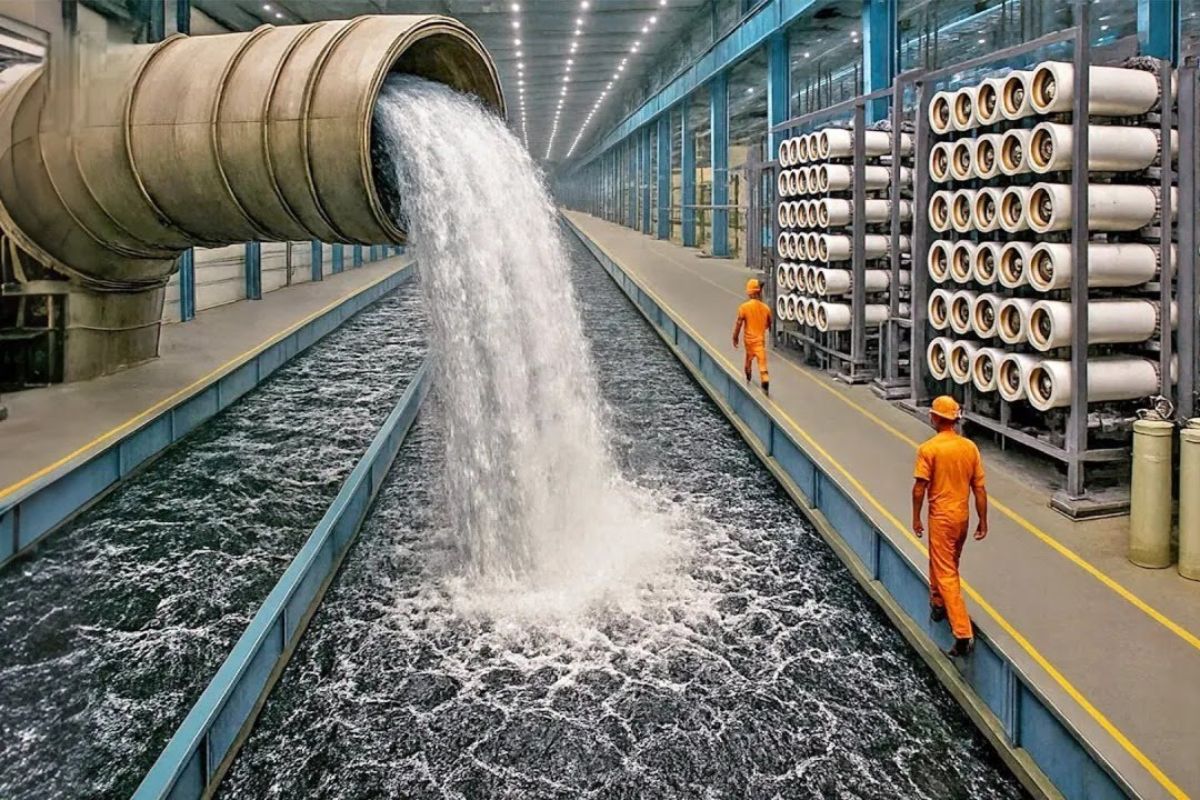


From Sewage Treatment Plants to Desalination Plants, Water Passes Through Grates, Bacteria, Membranes, and Ultraviolet Light Before Returning to Taps as Safe Drinking Water, Supporting Millions of People and Industries Silently Every Day in Arid Cities, Coastal Regions, and Industrial Areas of the Entire Modern World
Since the late 20th century, when water treatment began to be seen as one of the most invested infrastructure sectors on the planet, the industry has learned to transform water from toilets, sinks, urban sewage, and even seawater into reusable resources, rather than treating it merely as worthless waste.
Today, specialized facilities in countries like the United States, Israel, Singapore, and Brazil recycle wastewater and seawater on an industrial scale, using metal grates, sedimentation tanks, microorganisms, membranes, and reverse osmosis to produce crystal-clear drinking water that flows silently from the taps of millions of people every day.
First Barrier: When Dirty Water Meets Metal Grates

The journey of reclaimed water begins in the sewage network, where each toilet flush, each sink, and each shower drain converge into large underground collectors.
-
New CCR concrete paving technology promises roads up to 3x more durable, less maintenance, and cost reduction in Brazil.
-
Made from recycled plastic, plastic wood is gaining space in the construction industry because it does not rot, resists moisture, and reduces maintenance costs over the years.

-
Florianópolis will receive a million-dollar BRT that will begin construction in 2026 with nearly 400 million in funding from the federal government and the Inter-American Development Bank, and the map already shows the routes for the exclusive bus corridors.

-
Without a blueprint, without an engineer, and using scrap from the dump, a father spends 15 years building an 18-room castle for his daughter, featuring tram tracks, 13 fireplaces, and over 700 m², which may now be demolished.

This flow of mixed water carries paper, plastic, sand, grease, textile fibers, and other solid waste that could damage pumps and pipes if they reached the machines intact.
At the treatment plants, water first passes through rows of stainless steel bars that function as giant sieves, retaining plastic bags, branches, pieces of fabric, and other larger objects.
Next, the water enters sand chambers, where the flow is intentionally reduced.
At this point, gravity itself does the work: sand, gravel, and glass fragments settle at the bottom, while the water continues to flow cleaner to the subsequent stages.
At the same time, surface scrapers remove the layer of grease and foam that floats on top of the tanks.
The result is still dirty water, but free from the coarser elements that could block pumps, clog valves, and damage delicate membranes in the advanced stages.
Without this initial screening, no sophisticated water treatment technology would last very long.
Primary Sedimentation: Water Slows Down, and Sludge Takes Center Stage

After mechanical filtration, the water enters enormous sedimentation tanks, circular or rectangular structures with thousands of cubic meters of capacity.
There, the flow is deliberately slowed down so that the water stops behaving like turbulent current and instead behaves like a temporary lake.
As the speed of the water decreases, heavier organic particles, such as fecal matter, food scraps, and shredded paper, slowly sink, forming a dense layer called primary sludge.
On the surface, removal devices sweep fat and floating fragments out of the system.
What remains in the middle of the tank is visibly clearer water, but still full of microscopic contaminants.
This stage is vital for any water treatment system.
By removing up to half of the suspended solids and a significant portion of the organic load at once, primary sedimentation prevents subsequent biological tanks from becoming overloaded.
It acts like a coarse sieve that prepares the water for much finer processes, ensuring operational stability and energy efficiency in the following stages.
Aeration Tanks: Water Becomes a Workplace for Microorganisms

After sedimentation, the water moves to deep aeration tanks, where the protagonist shifts from mechanics to biology.
At the bottom of these tanks, thousands of diffusers inject very fine air bubbles, which continuously rise through the column of water, mixing the liquid and providing oxygen.
In this oxygen-rich environment, billions of aerobic microorganisms begin to consume the organic matter dissolved in the water, breaking complex molecules down into simpler byproducts.
This activated sludge, filled with beneficial bacteria, forms small flakes that aggregate microscopic particles.
When the water leaves the aeration tank and enters the secondary clarifiers, these flakes sink slowly, dragging along the last remnants of organic pollutants.
Part of the activated sludge returns to the system to maintain the population of microorganisms in balance, while the excess goes to another treatment chain.
The water that exits this stage is already visibly clean, although it still contains dissolved substances, salts, traces of metals, remnants of pharmaceutical products, and microorganisms that require even finer technologies to be removed.
Membranes, Reverse Osmosis, and Final Disinfection: Water Passes Through the Invisible Funnel
When the water reaches the advanced filtration modules, a set of membranes with pores so small they cannot be seen with the naked eye comes into play.
First, the water passes through microfiltration membranes that combat bacteria, parasites, and tiny particles, serving as a safety filter before the most critical stage.
Next, the water is pumped under high pressure into cylindrical tubes filled with reverse osmosis membranes.
Each pore in these membranes is hundreds of times smaller than the width of a human hair, allowing virtually only the passage of H₂O molecules.
Excess minerals, heavy metals, pharmaceutical residues, and chemical compounds remain on the concentrated side, while an extremely pure, almost distilled water flow emerges on the other side.
Despite all this purity, the water still undergoes a final polishing: reacquisition of minerals like calcium and magnesium to correct taste and pH, followed by disinfection with ultraviolet light or small doses of chlorine to eliminate any remaining microorganisms.
Sensors continuously monitor turbidity, pH, and disinfectant, ensuring that the water meets or exceeds international drinking standards before heading to reservoirs and ultimately to the tap.
From the Bathroom to the Billion-Dollar Recycled Water Industry
The process of converting wastewater into crystal-clear drinking water is not just an engineering feat.
According to global estimates, the water treatment and recycling market generates tens of billions of dollars annually, establishing itself as one of the most invested infrastructure sectors of the 20th century.
In countries that embraced this technology early, advanced recycling systems generate hundreds of millions of gallons of purified water per day, enough to supply millions of urban residents, hospital equipment, industrial parks, and even high-tech hubs.
Water, once seen only as a limited natural resource, begins to circulate in an industrial cycle where every drop is reused multiple times before returning to the environment.
This reuse model reduces pressure on rivers, aquifers, and reservoirs, especially in arid or densely populated regions.
At the same time, it opens space for entire productive chains dedicated to membranes, high-pressure pumps, sensors, automation systems, and quality control laboratories, solidifying water as an economic pillar just as much as an environmental one.
Desalination: Turning Seawater into Drinking Water Every Day
In addition to wastewater recycling, a second technological front expands the global supply of drinking water: desalination of seawater.
Large-diameter pipes capture water in open seas and bring it to the coast, where the pre-treatment stages begin.
In this phase, metal screens retain algae, plastics, and shells, while special tanks separate sand, sediments, and oil.
Next, hollow fiber membranes perform fine filtration that removes microscopic organisms, preparing seawater for reverse osmosis.
Generally speaking, the principle is the same as the systems that treat sewage, but here the main target is the salt in very high concentrations.
Under extremely high pressure, seawater passes through semi-permeable membranes that block salt ions and other contaminants, producing almost pure water.
Then, as in wastewater reuse, small doses of minerals are added to correct taste, and the water undergoes final disinfection with ultraviolet light, ozone, or chlorine.
Only then does this seawater converted into drinking water enter reservoirs and urban distribution networks.
Energy, Sludge, and Biosolids: What Else Treated Water Generates
As water progresses toward its drinking form, the sludge removed in various stages follows a parallel path.
In many systems, this sludge is sent to anaerobic digesters, large sealed tanks where microorganisms decompose organic matter without the presence of oxygen.
One of the byproducts is methane, a gas that can generate electricity and heat for the treatment plant itself, reducing external energy consumption.
After digestion, the sludge undergoes dehydration, additional pathogen removal, and stabilization.
In many cases, the result is a nutrient-rich biosolid that can be used as a soil conditioner in agricultural or reforestation activities, completing the cycle in which clean water, energy, and nutrients emerge from what was previously seen only as problematic sewage.
At the end of the chain, laboratories test water samples for clarity, mineral content, and presence of contaminants, while sensors installed along the network monitor quality in real time.
The water that reaches the consumer’s tap, whether originally from a toilet, sink, or seawater, is the result of this continuous chain of invisible industrial processes.
Knowing that the water coming from your tap may have gone through this entire cycle of sewage, membranes, and desalination, do you think cities should inform more transparently when the distributed water is recycled or does that not change your trust in what you drink?









A ciência, sabiamente, buscou na hidrologia, mecanismos de reprodução em escala industrial, o reprocessamento e revitalização auferidos pela natureza, pra transformar esses recursos tão vitais quanto imprescindíveis para sobrevivência de qualquer ser biológico. Pois sem água, não há vida , desenvolvimento e evolução, compatíveis com os anseios humanos. Megalopoles não existiriam sem água..A matéria é muito oportuna pra trazer ao público leigo, um assunto tão importante como esse .Excelente explanação científica, técnica e tecnológica além de econômica..
Deveria sim isso e muito importante por quer o desperdício de água e muito grande aqui no Rio de Janeiro.
E a maioria das pessoas não saber de nada disso
O que importante para as pessoas é que elas tenha água da onde vem ou deixa de vir isso não importa.
E as pessoas quer vai sofrer são as pessoas quer paga pelo água quer não tem isso e um absurdo você paga e não tem em quanto pessoas quer não pagar e tem água de sobra isso e uma secagem
Nós confiamos na Copasa pública, na Copasa do povo mineiro.