





 Portuguese
  English
  Spanish
  4 min of reading
  0 comments


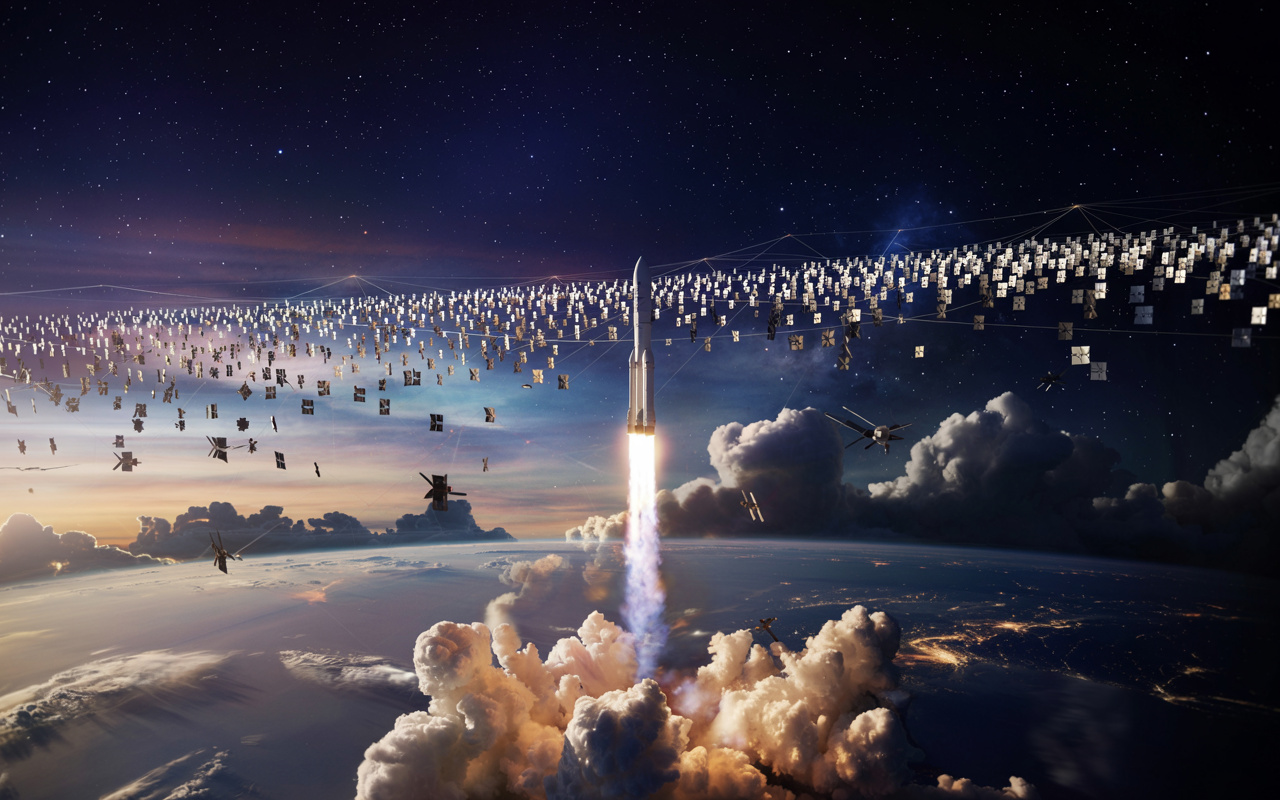
Elon Musk Accuses AST SpaceMobile of Saturating Earth’s Orbit, But SpaceX Has Already Put 9,000 Satellites in Space and Plans 30,000. Understand the Dispute and the Risks to Spatial Sustainability.
The tension in space is growing — and it’s not just because of the thousands of satellites in orbit. Elon Musk, CEO of SpaceX, has strongly criticized rival AST SpaceMobile, accusing it of “cluttering Earth’s orbit” with excessive launches and underestimating the risks of collisions between satellites. The accusation was officially sent in a document to the U.S. Federal Communications Commission (FCC), where SpaceX requests an investigation into the alleged dangers to “spatial sustainability” and human life during the reentry of deactivated satellites into the atmosphere.
What stands out, however, is that Musk’s SpaceX has already put over 9,000 satellites in orbit, becoming responsible for about 60% of all objects currently in space. This scenario fuels a controversial debate: is Musk’s criticism a legitimate warning or a strategy to weaken the competition and protect his leadership?
Elon Musk Criticizes Rival While SpaceX Dominates Space
SpaceX has built, in record time, the largest satellite constellation in the world, driven by the Starlink project, which aims to provide global internet coverage. However, this success has brought a side effect: congestion in orbit. Experts have been warning for years about the risk of collisions and the space pollution caused by the enormous number of launched equipment.
-
Motorola launched the Signature with a gold seal from DxOMark, tying with the iPhone 17 Pro in camera performance, Snapdragon 8 Gen 5 that surpassed 3 million in benchmarks, and a zoom that impresses even at night.

-
Satellites reveal beneath the Sahara a giant river buried for thousands of kilometers: study shows that the largest hot desert on the planet was once traversed by a river system comparable to the largest on Earth.

-
Scientists have captured something never seen in space: newly born stars are creating gigantic rings of light a thousand times larger than the distance between the Earth and the Sun, and this changes everything we knew about stellar birth.

-
Geologists find traces of a continent that disappeared 155 million years ago after separating from Australia and reveal that it did not sink, but broke into fragments scattered across Southeast Asia.

Even so, Musk turned his attention to AST SpaceMobile, saying the company “underestimates the collision risks” and assumes that “its deactivated satellites will remain in their ideal orientation” — something considered impossible by space engineers.
This criticism takes on market dispute contours, as AST is also working to provide internet directly to smartphones via satellite, a segment that could compete with Starlink itself.
SpaceX Congestion: The Paradox of 9,000 Satellites
The number is impressive: 9,000 satellites have already been launched by SpaceX, and the company has ambitious plans to reach 30,000 in the coming years. Today, six out of ten satellites orbiting Earth belong to Musk’s company.
But this dominance raises questions. Jonathan McDowell, an astronomer at the Harvard-Smithsonian Center for Astrophysics, revealed that SpaceX satellites are reentering the atmosphere at a record rate. And this reentry has a concerning environmental impact: each satellite releases about 30 kg of aluminum oxide, a substance harmful to the ozone layer.
Even though most of these satellites burn up before hitting the ground, the amount of material released into the atmosphere has been the subject of studies and criticism from scientists, who fear long-term effects on the planet’s chemical balance.
AST SpaceMobile in the Crosshairs: Collision Risk and Market Dispute
In the document sent to the FCC, SpaceX argues that AST SpaceMobile’s satellites could pose a “risk to human life” during reentry and questions the safety protocols of its competitor. The argument is technical, but the backdrop is clearly commercial.
AST is one of the few companies daring to challenge SpaceX in the satellite communication segment, with the proposal to connect regular smartphones directly to the network, without relying on traditional antennas.
If successful, the technology could compete with Starlink, making Musk’s criticisms not only a concern for safety but also a move to limit the rival’s expansion.
Space Collision Risk: Real Alert or Rhetoric?
The fear of collisions in orbit is not an exaggeration. The space around Earth is becoming increasingly congested, and the loss of control of a single satellite can trigger a cascade effect known as Kessler Syndrome — a series of collisions that creates a cloud of debris, threatening other satellites and even manned missions.
With thousands of satellites in operation, each launch increases the complexity of “orbital traffic management.” Companies, space agencies, and governments are in a constant struggle over the creation of stricter international rules to prevent accidents.
9,000 Satellites, 30,000 Planned: The Future of Space Under Musk
Despite criticizing AST SpaceMobile, SpaceX does not hide its own aggressive plan to launch up to 30,000 satellites. For this, the company relies on authorizations from governments worldwide, and criticisms of rivals may, in part, serve to reinforce its image as a company concerned with safety and sustainability in space.
The paradox is evident: Musk points the finger at “orbital congestion,” but his own constellation is the largest responsible for this scenario.
Environmental and Political Pressure Mounts
As the number of satellites grows, so does the pressure from scientists, governments, and environmentalists. The aluminum oxide released during reentry and the risks of collisions have become central themes in conferences and studies about the future of low Earth orbit.
If there is no international coordination, space could become a “dumping ground” — a problem that threatens everything from scientific research to the use of satellites for communication, navigation, and weather forecasting.
Musk’s criticisms of AST SpaceMobile raise a necessary debate about congestion and risks in space. However, SpaceX’s position, with its 9,000 satellites already in orbit and plans to triple that number, makes it clear that commercial interests are at stake.
The episode illustrates how the dispute for dominance in space is not only technological but also political, environmental, and regulatory. If projections are confirmed, the future of Earth’s orbit will be defined by both advancements and tensions like this — and the way companies and governments handle this balance will be crucial for the sustainability of space.








-

Uma pessoa reagiu a isso.