





 Português
  Inglês
  Espanhol
  3 min de leitura
  3 comentários


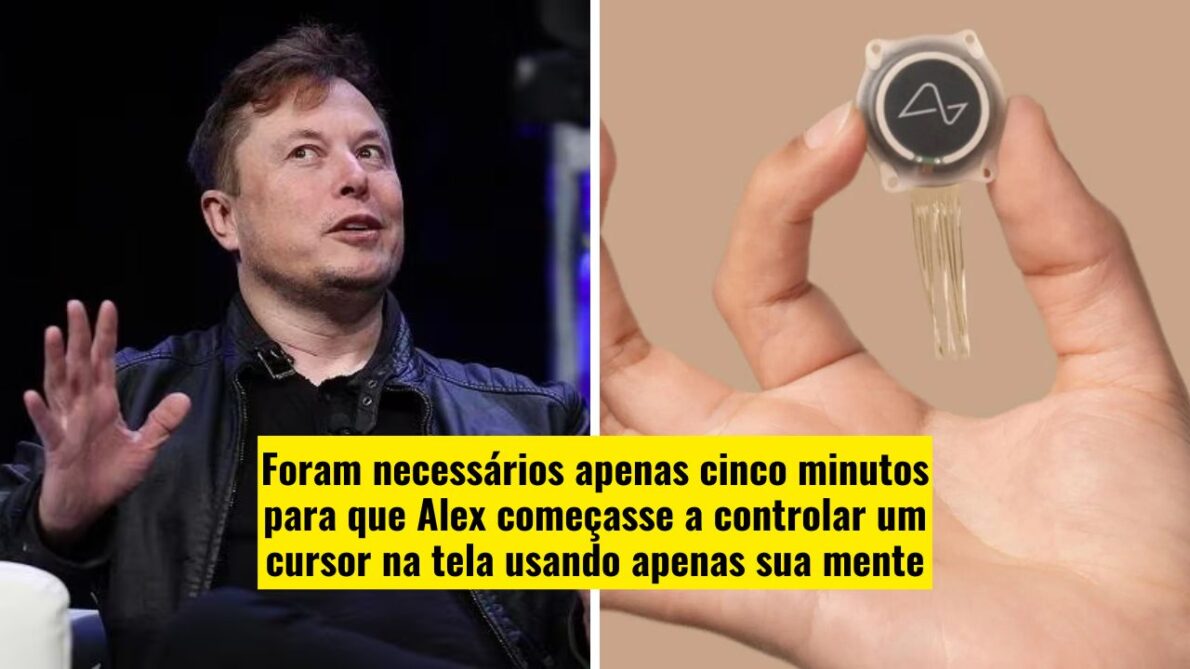

Alex, Second Patient With Neuralink Implant, Now Uses Device to Project in 3D and Even Play ‘Counter-Strike 2’, Showing Notable Advances.
Elon Musk, CEO of Neuralink, recently revealed the surprising progress of Alex, the second patient to receive a brain implant from the company. The device, which was implanted a few weeks ago, already allows Alex to play ‘Counter-Strike 2’ and use 3D design programs, indicating a significant advance in the technology that promises to change the lives of people with spinal cord injuries.
At the end of January, Elon Musk announced the installation of the first human brain implant by Neuralink, a milestone that grabbed worldwide attention. Now, with Alex being the second patient to receive the implant, the results are becoming increasingly impressive. Alex, who suffers from a spinal cord injury similar to the first patient, Noland Arbaugh, was discharged just one day after surgery, and his recovery was described as “smooth” by the Neuralink team.
Neuralink Claims Patient Had Rapid Adaptation
According to Neuralink, it took only five minutes for Alex to begin controlling a cursor on the screen using just his mind. Within a few hours, he was already surpassing the speed and accuracy of any other assistive technology available on the market, using the game Webgrid to measure his skill. This rapid progress highlights the potential of the implant to revolutionize how we interact with the digital world.
-
A bright yellow mushroom imported from Asia escaped from a cultivation farm in the United States in 2010 and is now aggressively spreading across 25 states, destroying entire communities of native fungi in American forests.

-
Buried under China, a colossal machine weighing 20,000 tons began operating as the largest neutrino detector on the planet and, in just 59 days, surpassed results that science took half a century to achieve.

-
Iran enters the center of a climate alert after the war emitted 5.6 million tons of CO2 in two weeks, surpassing the annual pollution of entire countries.

-
Lunar exploration may change after a Chinese probe finds a “cavity” of radiation that reduces the impact on astronauts by up to 20% at certain times on the Moon.


Before his injury, Alex worked as an auto mechanic and had experience with design programs such as Fusion 360. Just two days after surgery, he was able to use the software to create a custom support for the implant charger, which was later 3D printed and integrated into his equipment. This achievement is particularly significant, as it demonstrates Neuralink’s ability to perform complex tasks that would normally require the use of a mouse and keyboard.
Able to Play ‘Counter-Strike 2’ Using a Quadstick
In the realm of video games, Alex also showed remarkable advances. He was already able to play ‘Counter-Strike 2’ using a Quadstick, an adapted controller operated by the mouth and lips. However, this controller limited his ability to move the cursor and character simultaneously. With the Neuralink implant, Alex can now combine the use of the Quadstick with his mind, allowing for much smoother and more precise gameplay.
Preventive Measures at Elon Musk’s Company
One of the challenges faced by Neuralink’s first patient, Noland, was the retraction of the wires connected to the brain chip, caused by an air pocket inside the skull (a phenomenon known as pneumocephalus). This issue affected the connectivity and performance of the implant. In Alex’s case, the Neuralink team took preventive measures during the surgery, including reducing brain movement and minimizing the space between the implant and the brain. As a result, there was no retraction of the wires, and the performance of the device remained stable.
Elon Musk and Neuralink Are Working on Decoding Multiple Clicks and Motion Intentions
Elon Musk and his team at Neuralink are now focused on the next steps to further enhance the technology. They are working on decoding multiple clicks and motion intentions, which should allow Alex and other patients to perform tasks such as text input more quickly. The company is developing ways for users to interact with the physical world, controlling, for example, robotic arms or wheelchairs, which would provide even greater autonomy for people with physical limitations.
With each new advance, Elon Musk demonstrates the transformative potential of Neuralink, paving the way for a future where physical limitations can be overcome by technology. Alex’s case is just the beginning of a revolution that promises to redefine the boundaries between mind and machine.
Comment below and share your thoughts on Neuralink’s advances and the implications of this technology. Are we on the right path to revolutionizing the treatment of spinal cord injuries?






Gostaria tanto que usassem o poder da tecnologia para fazer uma vacina contra o câncer. Ou um tratamento que levasse à cura definitiva. Diante de tantos avanços não sei como deixam andando a passos de tartaruga tudo que diz respeito ao câncer.
Assim como muitos que passaram pela história, Elon Musk é um visionário necessário para a evolução da humanidade, sem essas pessoas fora de série a humanidade estaria andando a cavalo.
Admirável Elon Musk