





 Português
  Inglês
  Espanhol
  3 min de leitura
  0 comentários


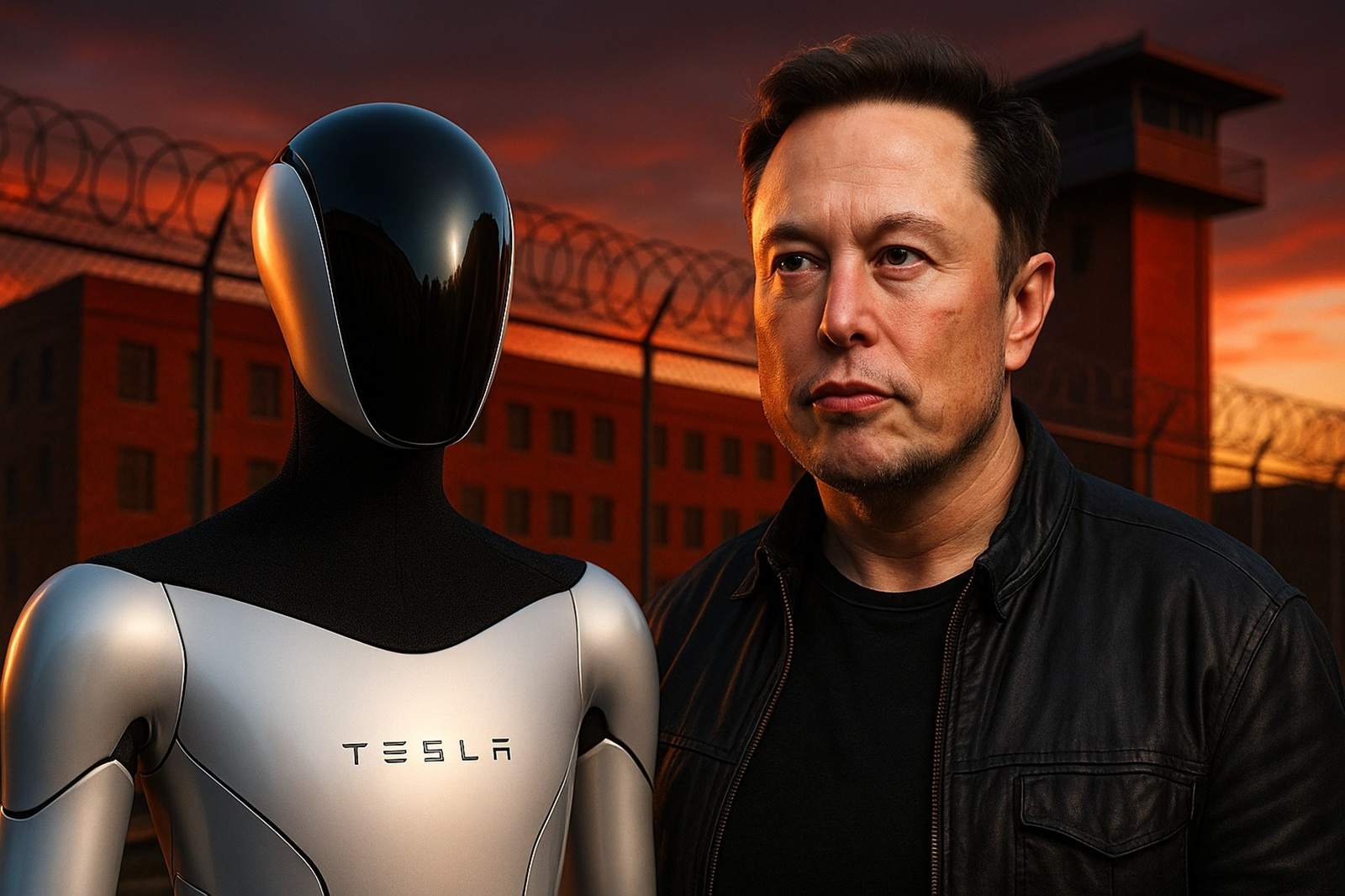
During Tesla Assembly, Elon Musk Suggested Eliminating The Prison System And Replacing It With Humanoid Robots Capable Of Following And Containing Former Inmates To Prevent Recidivism
During the Tesla annual shareholder meeting, Elon Musk made a proposal that sparked intense debate: end prisons and replace them with surveillance robots.
The entrepreneur suggested that former inmates could receive a Optimus Prime robot, developed by Tesla, to accompany them and prevent them from committing crimes again.
“We could offer a more humane way to prevent crime. If someone committed a crime, we could give them a free Optimus Prime to follow them and prevent them from committing another crime,” Musk stated.
-
A bright yellow mushroom imported from Asia escaped from a cultivation farm in the United States in 2010 and is now aggressively spreading across 25 states, destroying entire communities of native fungi in American forests.

-
Buried under China, a colossal machine weighing 20,000 tons began operating as the largest neutrino detector on the planet and, in just 59 days, surpassed results that science took half a century to achieve.

-
Iran enters the center of a climate alert after the war emitted 5.6 million tons of CO2 in two weeks, surpassing the annual pollution of entire countries.

-
Lunar exploration may change after a Chinese probe finds a “cavity” of radiation that reduces the impact on astronauts by up to 20% at certain times on the Moon.


He added that with this, “there would be no need for prisons.”
From Factory To Personal Surveillance
The proposal reinforces Musk’s provocative style, which often blends technological innovation with controversial ideas.
The entrepreneur stated that the Optimus Prime could become the world’s most valuable product, with potential to generate a market capitalization between US$ 25 billion and US$ 30 billion. On other occasions, he mentioned the creation of an “army of robots” operated by Tesla.
During the meeting, Musk claimed that using robots would be a more humane and cost-effective way to deal with the penal system. However, he did not explain how the model would be implemented or who would bear the costs, since each unit of the Optimus Prime would exceed US$ 20,000. The billionaire also did not detail how the robot would physically prevent recidivism.
Technical Obstacles And Ethical Dilemmas
The proposal faces significant technical and ethical challenges. To continuously track and monitor an individual, the Optimus would need to anticipate human behavior, transmit data in real time, physically intervene, and remain operational while recharging autonomously.
Currently, Tesla’s robot still demonstrates limited capabilities, relying on remote control during its public presentations.
Technology and ethics experts warn that the concept of a “prison robot” raises discussions about privacy, surveillance, and the role of corporations in the justice system. The idea of permanent monitoring by a machine would create an environment of extreme surveillance, incompatible with individual liberties.
Power, Privacy And Social Control
Musk’s statements also expose contradictions with his political positions. The entrepreneur defines himself as a libertarian, but the proposal for a robotic surveillance system controlled by a private company would imply an expansion of state and corporate control.
Analysts observe that while he advocates for individual freedom, Musk frequently adopts authoritarian and centralized rhetoric.
The debate has rekindled concerns about the power of large technology companies and their influence on sensitive social issues such as public safety and punishment. For many, Musk’s idea crosses the line between innovation and social control.
Meanwhile, Tesla continues to direct efforts to consolidate its presence in robotics, trying to convince investors that this will be its next big revolution, after electric vehicles and autonomous driving.






-

Uma pessoa reagiu a isso.