





 Portuguese
  English
  Spanish
  4 min of reading
  0 comments



UK Scientists Unravel Blue Sun Mystery: Blue Sun Mystery with Almost 200 Years Was Solved and the Reason Is Really Surprising, check it out!
In 1831, a rare and intriguing event caught the attention of researchers and observers around the world. For several months, the sun appeared in shades of blue, accompanied by hues of purple and green, creating an impressive visual phenomenon. For more than a century, the blue sun mystery remained unexplained, sparking theories and speculation. However, recent studies, including analyses conducted by NASA scientists and meteorological institutions, indicate that the phenomenon was caused by the eruption of the Krakatoa volcano in Indonesia, whose ash released into the atmosphere filtered sunlight in an unusual manner. This discovery finally clarifies one of the rarest atmospheric phenomena ever recorded.
Understand the Blue Sun Phenomenon That Occurred in 1831
The phenomenon, which puzzled experts at the time, remained unexplained for almost 200 years until technological advances finally allowed for a concrete response to the blue sun mystery. During the summer of 1831, reports of unusually cold temperatures and severe weather conditions were recorded in various parts of the world.
Historical records indicate that crops were severely impacted due to the Blue Sun, causing famine and economic difficulties, especially in the Northern Hemisphere. Scientists of the time raised a thesis that a volcanic eruption was behind this episode; however, the lack of precise records prevented this confirmation.
-
Man builds functional 5-meter submarine in his garage using gas cylinders, PVC pipes, and a refrigerator motor, and navigates with the vessel on a lake in Colombia.

-
Millions of people have been eating yam for centuries without knowing that this humble tuber contains a compound called diosgenin, which scientists have now discovered can improve memory and help control blood sugar levels.

-
Scientists from an international project drill 1,800 meters of ice in Antarctica using hot water and discover details about one of the most intriguing places on planet Earth.

-
Seen from space, a colossal volcano nearly 5,000 meters high in Russia has released 1,600 km of smoke over the Pacific, forming “devil’s horns” of lava and revealing the brutal force of the Ring of Fire.
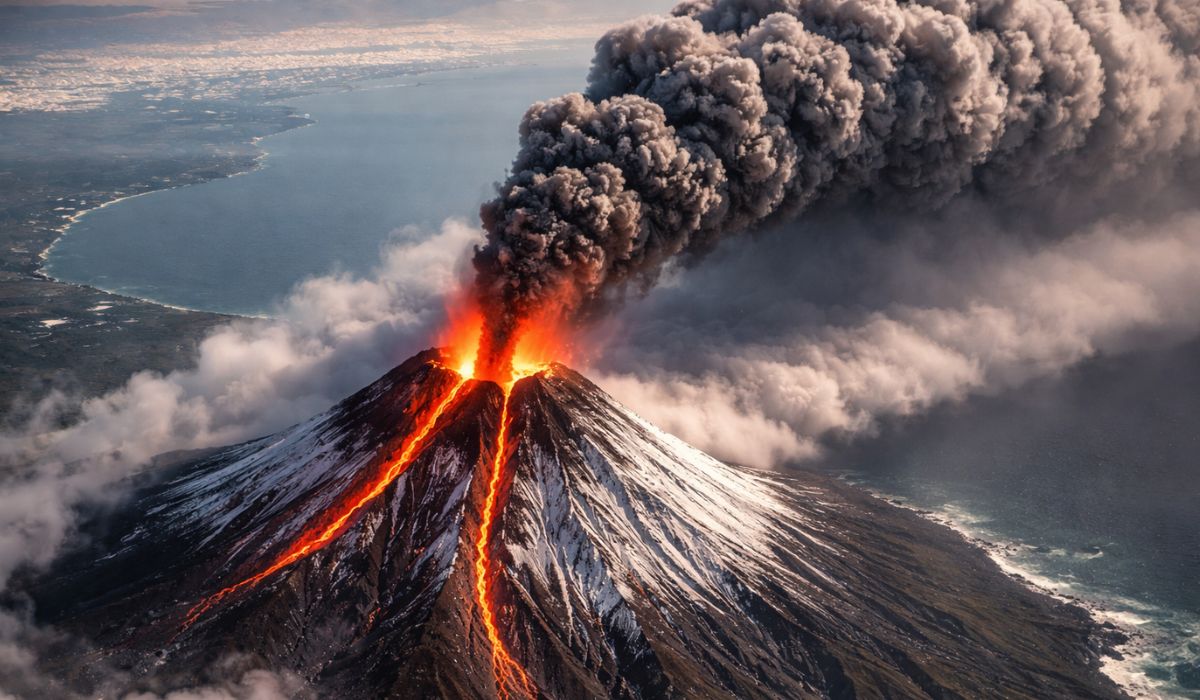

Recently, scientists from the University of St. Andrews in the UK finally managed to identify the origin of the phenomenon that left the sun in shades of blue. Using modern technology to analyze microfragments of ash and polar ice samples, the team discovered a direct link between the found ash and the eruption of a volcano located in the Kuril Islands, known as Zavaritskii, currently part of Russian territory.
According to the study leader, Dr. William Hutchison, the timing of the resolution of this secular mystery was simply incredible. The analyses showed that the potassium level of the samples matched exactly with the ash from the Russian volcano, confirming its responsibility for the blue sun.
Understand Why the Volcano Left the Sun in Shades of Blue
The eruption of the volcano, discovered by scientists, released a large amount of sulfur dioxide into the atmosphere, generating layers and aerosols that reflected sunlight differently, leaving the sun blue and reducing global temperatures.
Similar phenomena have occurred in other years, such as the eruption of Mount Tambora in 1815, which generated the famous “year without a summer.” Although the event of 1831 has finally been explained, scientists warn that large magnitude volcanic eruptions still pose a significant risk to the global climate.
According to Hutchison, it is essential to have a coordinated plan to respond to future events of this magnitude, given that their occurrence can have drastic impacts on the economy, daily life, and agriculture in various regions of the world.
The discovery not only clarifies one of the great scientific mysteries of the past but also highlights the importance of monitoring volcanoes and studying climate change for the future of humanity.
Know Why the Blue Sun Mystery Remained for So Long
The author of the study also mentions that finding the correspondence of the blue sun took quite a long time and required extensive assistance from other scientists in Russia and Japan, who sent samples from remote volcanoes decades ago.
According to the scientists, the centuries-long delay in discovering the phenomenon that left the sun with shades of blue occurred because the Kuril Islands are a region with little-studied volcanoes but extremely productive. The volcano responsible for the eruption in 1831 was very remote; however, it had a significant global impact on the climate and severe consequences for human populations.
Dr. Hutchison also concludes by stating that there are many volcanoes like this, showing how difficult it will be to predict when or where the next large magnitude eruption might occur.
Source: Olhar Digital








Seja o primeiro a reagir!