





 Portuguese
  English
  Spanish
  4 min of reading
  2 comments


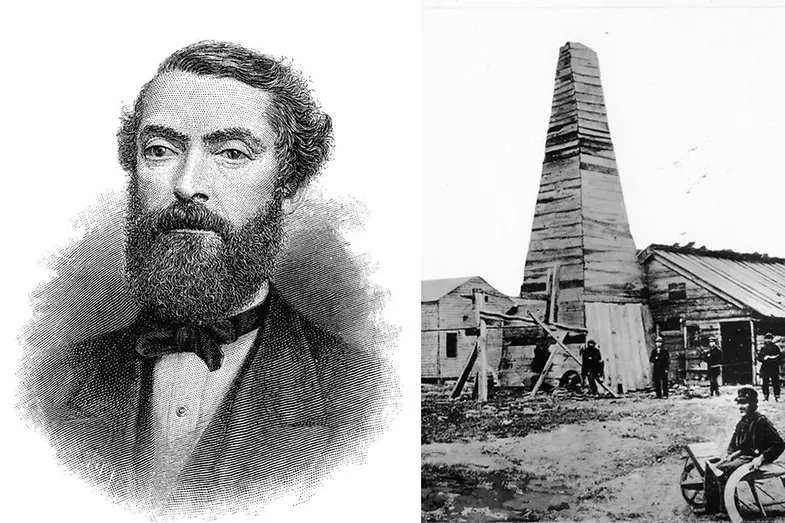


The Discovery of Oil by This Man in 1858 Was a Milestone, But His Lack of Recognition Led Him to a Tragic Destiny. Learn More.
In the second half of the 19th century, a resource that was still little explored began to emerge as a protagonist in transforming the modern world: oil.
Previously relegated to curiosities and minor uses, it gained ground as a promising energy source, replacing traditional methods for lighting and offering broader possibilities for the industrial future.
At the center of this story was Edwin Drake, a man whose vision and determination paved the way for the modern oil industry.
-
Petrobras evaluates suspension of sales to distributors and considers canceling the cooking gas auction following guidelines from the Federal Government.

-
Lula reveals a masterstroke by Petrobras to undo a deal made by Bolsonaro, which involves the return of an important refinery that currently produces less than half of what was expected and makes Brazil dependent on international diesel.

-
A study confirms that the natural gas sector will reduce greenhouse gas emissions in Brazil by 0.5% and accelerate the energy transition by 2026.

-
Petrobras implements a severe adjustment and confirms a 55% increase in the price of aviation kerosene with a proposal for installment payments for the companies.


Despite his unprecedented economic impact, Drake’s life was marked by uncertainties, hardships, and ultimately, a death in extreme poverty.
This narrative seeks to explore Drake’s legacy, the innovations he brought to oil extraction, and the contrast between his historical impact and the adversities he faced.
Drake, an unemployed former railroad worker, was the key player in the first large-scale oil extraction operation.
The First Oil Operation and the Seneca Oil
It all began in 1858, when Edwin Drake was hired by the Pennsylvania Rock Oil Company to lead an exploration in Titusville, Pennsylvania.
Before that, oil was collected in small quantities, extracted rudimentarily from natural leaks or manually dug wells.
Drake was sent to the region with a clear mission: to find oil in significant volumes. However, the first months were far from promising.
He faced resistance from local residents, lost the company’s funding, and suffered financial losses that threatened the progress of his endeavor.
Persistent, Drake decided to bet on a different approach. Inspired by drilling techniques used in salt wells, he began adapting these practices for oil exploration.
The method involved driving iron pipes into the ground to stabilize the well and prevent debris from obstructing the process.
This innovation was essential to overcome the challenges of the terrain, such as unstable soil and loose rock that hindered drilling.
After months of trial and error, on August 27, 1859, Drake struck an oil deposit at a depth of 21 meters. It was the moment that changed the history of energy.
The Impact of the Discovery
Drake’s discovery revolutionized not only oil extraction but also economically transformed the region of Titusville and its surroundings.
His methodology was widely adopted, and nearby towns began to prosper with the increase in economic activity.
This revolution was compared to the gold rush of the previous decade, with entrepreneurs eager to tap into the potential of the new resource.
From an initial production of 2,000 barrels in 1859, the American oil industry reached an impressive 4 million barrels in just a decade.
Although Drake’s method was innovative, he himself did not achieve great financial success from his discovery. The industry flourished rapidly, but Drake was unable to protect his invention with patents or capitalize on his work.
Steam-powered drills, derived from his ideas, became standard in the industry, but the profits and recognition slipped from the hands of the man who introduced them.
Growth and Crises of the Oil Industry
With increased production came economic instability. In 1861, overproduction led to a plummeting price of oil, from US$ 10 a barrel to a mere 10 cents.
To cope with the crisis, oil companies formed associations to regulate production levels and stabilize prices.
This phase of adjustments demonstrated the impact that the emerging industry would have on the global economy, connecting the American market to growing European demands.
Although Pennsylvania was the birthplace of the industry, its importance began to decline in the late 19th century, with new oil discoveries in California, Texas, and other states.
The region ceased to be the largest producer but maintained a special place in history as the location where it all began. Drake’s original well, now a historical landmark, symbolizes that legacy.
A Tragic End for Edwin Drake
Despite initiating an industrial revolution, Edwin Drake did not reap the rewards of his genius. He faced years of financial difficulties, compounded by health issues that rendered him disabled.
After being dismissed from the Seneca Oil Company in 1860, he came to depend on the goodwill of friends and a small pension granted by the state of Pennsylvania in 1873.
This pension was a belated acknowledgment of the immense contribution that his technique made to the state and national economy.
Drake lived his last years in extreme poverty. His wife supported the family by sewing dresses and hosting travelers.
Friends occasionally raised money to help him survive. In a letter from 1866, Drake wrote requesting financial help, highlighting his desperate situation. “I sadly need this and I am ill,” he wrote.
He died in 1880 at the age of 61 in Bethlehem, Pennsylvania. His tomb, now located in the museum dedicated to his memory, serves as a reminder of both his impact and the lack of personal rewards for his innovation.
The Enduring Legacy of Edwin Drake
Edwin Drake’s work paved the way for the transformation of energy in the modern world.
His drilling technique marked the beginning of an industry that would become the backbone of the global economy in the 20th century.
Although his personal journey was tragic, the impact of his contribution is undeniable. The original well in Titusville is not only a historical landmark but also a symbol of the human spirit of innovation and perseverance.
Though Drake was not rewarded for his work in life, his story continues to inspire reflections on the complex dynamics of innovation, recognition, and reward.
He transformed oil from a curiosity into an indispensable commodity, forever altering the course of industrial and energy history.










mas les vale q este bien, porque tengo q presentar esto, y aguante carre y spreen wacho
Petróleo já era produzido em Baku, no Azerbaijão, quando Drake perfurou o primeiro poço nos Estados Unidos. Aliás, o Azerbaijão foi o maior produtor mundial de petróleo no século XIX. “In 1846, under the supervision of state advisor V.N. Semyonov an engineer Nikolay Matveyevich Alekseev drilled a 21 m deep well using a primitive percussion drilling mechanism, in Bibiheybət to explore for oil, with positive results. More than a decade later, on August 27, 1859, “Colonel” Edwin L. Drake struck oil on American soil for the first time.”