





 Português
  Inglês
  Espanhol
  4 min de leitura
  3 comentários


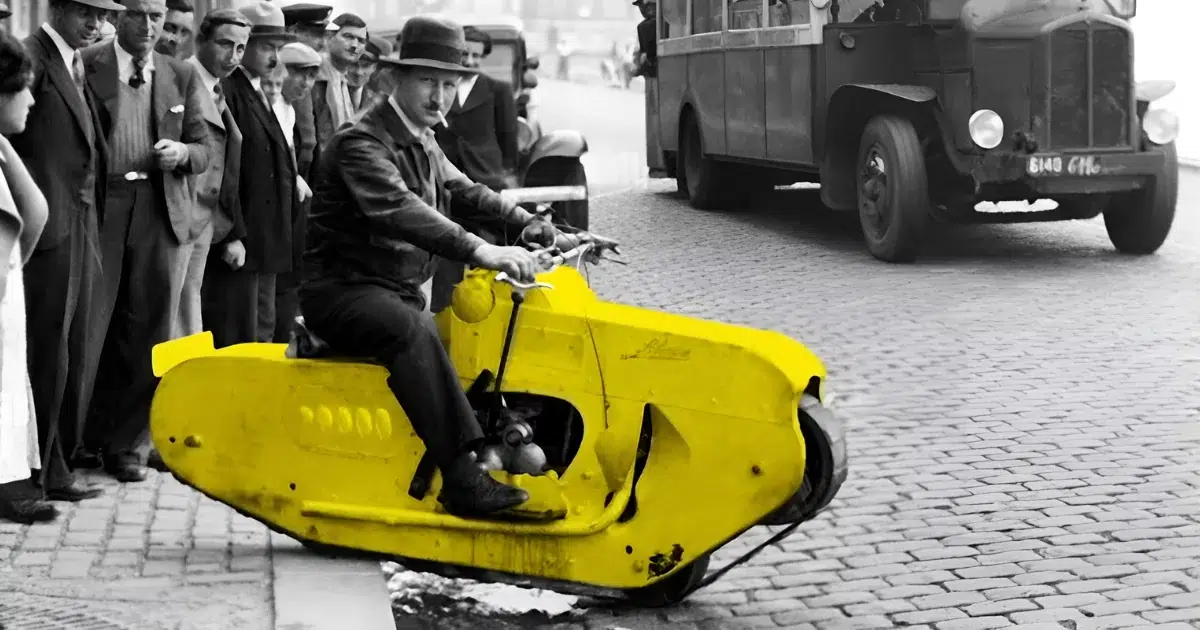


In 1938, a Man Combined a Motorcycle with a Tractor, Resulting in a Curious Hybrid Vehicle That Mixed Urban Mobility and Agricultural Power.
At the turn of the 1930s, the world was about to experience a series of technological advancements in transportation, including a motorcycle. It was a period when engineers and inventors sought innovative solutions to everyday challenges, especially in terms of mobility.
It was in this context that the Tractor-Cycle emerged, an invention by French engineer J. Lehaitre, who challenged the traditional standards of motorcycles at the time.
Introduced in 1938, the vehicle stood out for combining the practicality of a motorcycle with the robustness of a tractor, creating a unique hybrid solution for navigating challenging terrains.
-
A bright yellow mushroom imported from Asia escaped from a cultivation farm in the United States in 2010 and is now aggressively spreading across 25 states, destroying entire communities of native fungi in American forests.

-
Buried under China, a colossal machine weighing 20,000 tons began operating as the largest neutrino detector on the planet and, in just 59 days, surpassed results that science took half a century to achieve.

-
Iran enters the center of a climate alert after the war emitted 5.6 million tons of CO2 in two weeks, surpassing the annual pollution of entire countries.

-
Lunar exploration may change after a Chinese probe finds a “cavity” of radiation that reduces the impact on astronauts by up to 20% at certain times on the Moon.

Lehaitre’s idea went beyond conventional transportation. He dreamed of a vehicle capable of traversing rugged, sandy, and muddy terrains, where traditional motorcycles could not go.
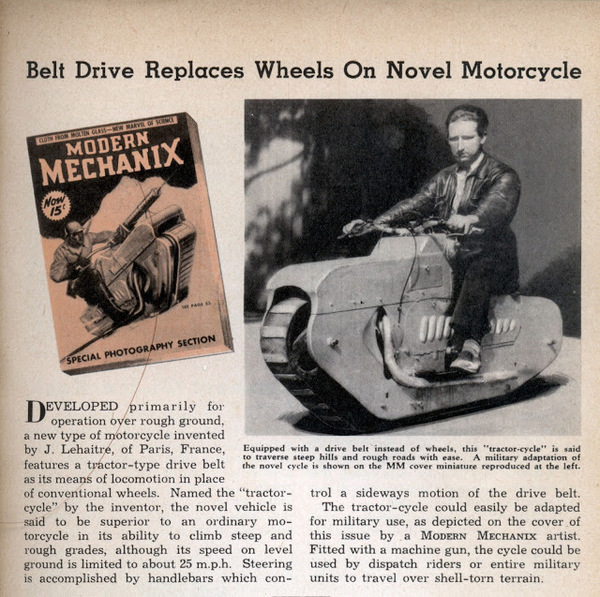
The Tractor-Cycle was his answer to these challenges, featuring a tractor-type belt drive system that ensured superior traction and stability.
This innovation made the vehicle suitable for facing the harshest conditions, with a top speed of 40 km/h. More than just a means of transportation, it represented a new vision of mobility, both for civilian and military use.
The Vision Behind the Tractor-Cycle
During the 1930s, the quest for more efficient and adaptable vehicles was on the rise. Poor roads, especially in rural areas, made access to many regions difficult. J. Lehaitre identified this gap and believed that the solution lay in uniting concepts from motorcycling and agriculture.
Inspired by the performance of tractors in difficult terrains, he applied a similar belt drive system, creating a vehicle capable of excelling where others failed.
This approach was both practical and visionary. In a world where efficiency was increasingly valued, especially with the looming World War II, a vehicle with off-road capabilities presented enormous potential.
Lehaitre envisioned a multifunctional vehicle that could serve farmers and, at the same time, have military applications. This made the Tractor-Cycle an interesting proposition in a time of great technological and social changes.
Innovative Mechanics and Design
The standout feature of the Tractor-Cycle was its unique mechanics. The tractor-type belt drive system replaced traditional rear wheels, distributing weight evenly.
This characteristic prevented the vehicle from sinking in soft terrains and provided better traction on uneven surfaces.
This design, inspired by agricultural tractors, was a revolution for motorcycles of the time, allowing enhanced mobility in environments where other motorcycles could not operate.
Despite its advantages, the design of the Tractor-Cycle presented challenges. The belt drive, although effective, made maintenance more complex and could require frequent repairs due to wear.
Additionally, maneuvering the vehicle in tight spaces was more difficult, limiting its usability in urban areas or environments where agility was essential.
Another important aspect of the design was its maximum speed of 40 km/h. While respectable, especially for a vehicle with such robustness, this speed was still inferior to that of traditional motorcycles, which may have limited its commercial and military appeal.
Potential Uses and Impacts of the Motorcycle
The Tractor-Cycle had promising applications in various fields. One of the most notable was military use. The possibility of equipping the vehicle with a machine gun made it ideal for reconnaissance missions in difficult terrains.
Its ability to navigate rugged environments offered a tactical advantage, especially in operations where swift and versatile mobility was crucial.
However, its limited speed compared to other military motorcycles of the time may have been a factor that restricted its adoption.
Beyond the military context, the Tractor-Cycle could have played a significant role in agriculture and rural transportation.
In areas where the terrain hindered the use of conventional motorcycles, it presented an efficient alternative. For farmers and rural workers, it offered a practical solution for short trips, with the advantage of being more compact and agile than traditional tractors.
Another significant impact was on motorcycle design innovation. Although the Tractor-Cycle did not achieve mass production, it paved the way for future adventure motorcycles and off-road vehicles.
Its proposal for adaptability to various terrains influenced the development of technologies and designs that are common in modern motorcycles designed for use on rough terrain.
Why Did This Motorcycle Fail?
Despite its innovative design and promising applications, the Tractor-Cycle never surpassed the prototype phase. Various factors contributed to this limitation.
Firstly, its maximum speed of 40 km/h was insufficient compared to military and civilian motorcycles of the time, which required greater speed for efficient travel.
Another determining factor was the complexity of the belt drive system. While effective, it required constant maintenance, which raised operational costs and reduced the vehicle’s practicality.
In an era where efficiency and low cost were crucial, especially with the approaching World War II, these disadvantages weighed against the success of the Tractor-Cycle.
Manufacturing costs also represented an obstacle. Producing the Tractor-Cycle would likely require significant investments, making it unviable for widespread adoption.
With resources being directed toward more conventional and efficient military vehicles, Lehaitre’s proposal ultimately faded into the background.
With information from engineerine.






Se a foto é em branco e preto, porque o veículo é colorido? Está parecendo montagem!
Bem curioso mas uma ótima ideia
Hoje existem triciclos com motor e estrutura de moto, com caixa de marchas e eixo traseiro com rodas menores, com pneus para pisos de barro.