





 Portuguese
  English
  Spanish
  4 min of reading
  3 comments





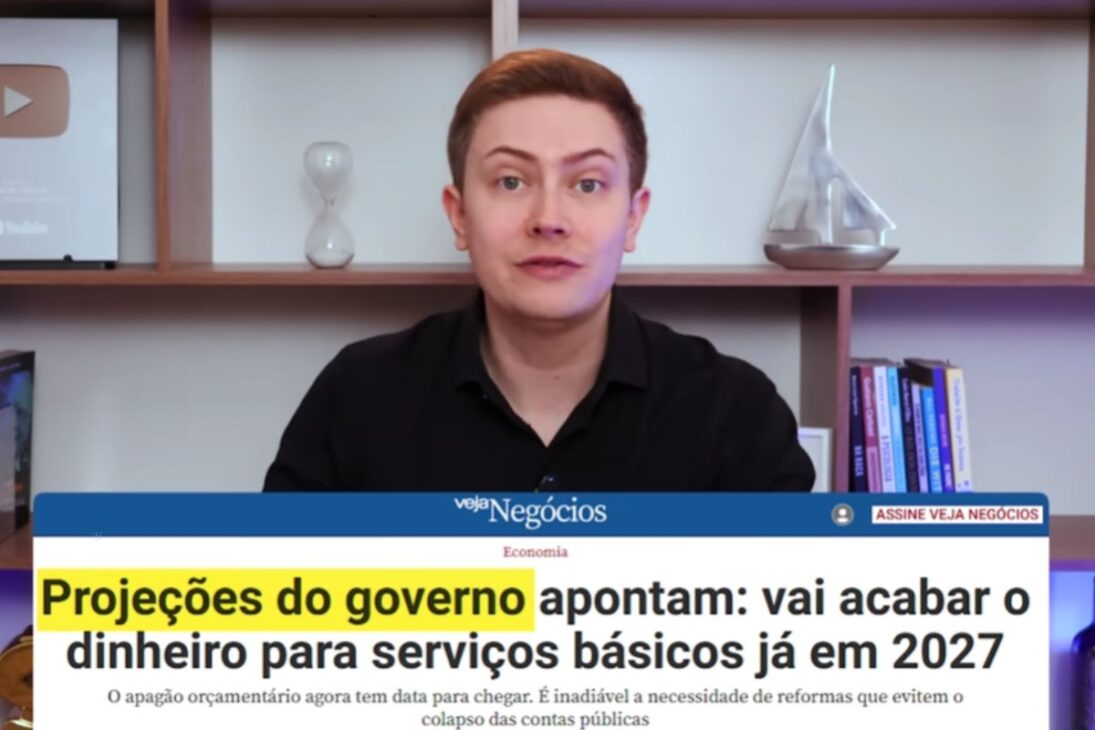
Chamber Consulting, Independent Fiscal Institution and Market Warn: By 2027, the Available Budget Will Reach Zero; Debt Is R$ 7.9 Trillion (77.6% of GDP)
The government’s available money will reach zero in 2027. This warning was issued by the Chamber of Deputies Consulting, the Independent Fiscal Institution (IFI) of the Senate, and reinforced by analyst Alexandre Winkler, based on official and market projections. This means that all federal revenue will be consumed by mandatory spending, leaving nothing to fund basic daily services.
In practice, the risk is of a Brazilian-style “shutdown.” Programs such as Popular Pharmacy, My House My Life, Enem, passport issuance, research grants, and Ibama inspections could stop due to lack of discretionary resources. It’s not a default, but an operational collapse: the machine collects, but cannot cover expenses not protected by law or the Constitution.
How Much Brazil Owes and Why Government’s Available Money Disappears
In July 2025, it reached R$ 7.9 trillion, equivalent to 77.6% of GDP.
-
50 viaducts, 4 tunnels, 28 bridges, and 40 kilometers of bike paths: BR-262 in Espírito Santo will receive 8.6 billion reais for the largest engineering project in the state’s history, inspired by the Immigrant Highway in São Paulo.

-
Brazil produces too much clean energy and doesn’t know what to do with it: over 20% of solar and wind capacity was wasted in 2025 while investors flee and 509 renewable generation projects were abandoned in the last year.

-
Piauí will produce a new fuel that replaces diesel without needing to change anything in the truck’s engine and reduces pollutant gas emissions by half: truck drivers from all over the Northeast are already celebrating the news that will arrive later this decade.

-
A new Brazilian shopping center worth R$ 400 million will be built in an area equivalent to more than 4 football fields, featuring 90 stores, 5 cinemas, a supermarket, a college, and parking for 1,700 cars, potentially generating 3,000 jobs.


According to the IMF‘s alternative calculation, the index is already over 90%. In 2010, the country owed less than R$ 2 trillion; since then, the curve has only grown.
With high interest rates and long maturity costs — such as Treasury Prefix 2035, close to 14% per year, and Treasury IPCA+ 2060, IPCA + 7.28% —, the debt feeds back on itself.
This is the phenomenon called fiscal dominance: raising interest rates does not reduce inflation because it makes the debt itself more expensive and increases distrust.
What Happens When the Budget Freezes
The government’s available money funds spending considered “discretionary”: infrastructure, maintenance of public buildings, utility bills, cleaning, outsourcing, and specific social programs.
Without it, even services such as women’s service centers or systems like “PX” will be compromised.
According to IFI, the total exhaustion of this funding in 2027 will leave only mandatory spending operating: Social Security, civil servant salaries, social benefits, and education and health linked to the Constitution.
The rest will stop.
Why Increasing Taxes Isn’t Enough
Even with a record revenue in 2025 — R$ 234 billion in June and R$ 254 billion in July, the highest results in 31 years —, analysts like Alexandre Winkler emphasize that raising taxes no longer solves the problem.
The so-called Laffer Curve shows that, after a certain point, higher taxes reduce revenue by bankrupting companies or driving capital away.
Currently, 31% of companies are in default, and judicial recoveries continue to rise.
In 2024, the number was a record, and the expectation is for another record in 2025.
About 30% of companies under recovery end up going bankrupt.
Given this situation, raising the tax burden could worsen the recession.
What the Government Could Cut
The only option left is to tackle mandatory spending, something no government has wanted to address so far.
Among the measures mentioned in official reports and by analyst Alexandre Winkler are: reducing public hiring, reviewing minimum wage adjustment rules, and making the machine more efficient.
The problem is that 2026 is an election year, and the trend is towards increasing, not cutting, spending.
Regardless of the outcome of the presidential election — whether Lula is re-elected or someone like Tarcísio de Freitas wins —, the diagnosis is unanimous: in 2027, adjustments will be needed.
Impacts for the Ordinary Citizen
The direct effect for the population would be to feel delays or halts in services that may seem trivial but rely on discretionary funding: passport renewal, Enem application, research grants, and maintenance of specific social policies.
The citizen would pay taxes but would receive no practical return in basic areas.
Experts remind us that the situation is already showing signs: regulatory agencies are under reduced oversight and are facing a lack of resources to operate.
This weakens the regulation of critical sectors such as energy, transportation, and telecommunications.
How People Are Protecting Themselves


The analysis also shows individual strategies to face uncertainty: investment diversification, part of the wealth in dollars, cryptoassets, real estate funds for income, and short and long-term fixed income.
The idea, according to Winkler, is to protect assets and seize opportunities, whatever the scenario in 2027.
The collapse of the government’s available money in 2027 is no longer a distant hypothesis: it is an official projection confirmed by different technical bodies and cited by analysts like Alexandre Winkler.
If nothing changes, Brazilians may see basic daily services simply stop due to lack of resources.
Do you agree with this analysis? Do you think spending cuts are possible, or will the government have to raise taxes even further? Share your opinion in the comments — we want to hear from those who experience this in practice.









Esta previsão do “mercado” é semelhante åquela feita para o PIB do primeiro ano deste governo: seria com certeza menor que 1%, algo em torno de 0,7 % se tanto. Para surpresa dos “analistas” deu quase 3 %. No segundo ano de novo, previram no máximo 1,5 % mas os dados voltaram a desmentir os economistas fechando acima de 3%. Deve ocorrer parecido com esta previsão alarmista. Além disso o governo já tem alternativas: cobrar de quem não paga ou paga muito pouco imposto, os super ricos, por exemplo, sem falar na diminuição a níveis razoáveis da “apropriação indébita” de grande parte do orçamento feita pelo Congresso.
Interessante notar que os analistas do “mercado” nunca sugerem os cortes e aumentos de impostos citados acima; preferem descartar reajustes de impostos a priori sob o falso argumento de que onerará quem já paga muito. Já com relação à outra alternativa proposta, nem ousam tocar no assunto.
“A chamada Curva de Laffer mostra que, a partir de certo ponto, mais impostos reduzem a arrecadação por quebrar empresas …”. Mais uma falácia! Empresa alguma “paga” tributos. A singela e verdadeira razão é que tributos são como custos, repassados aos preços dos produtos ou serviços que a empresa vende. Quem paga, efetivamente, são os consumidores diretos ou indiretos, sempre pessoas físicas. E, dentre estas, numa distorção que o Congresso não quer resolver, paga mais quem ganha menos.
Resumindo muito…no meu ponto de vista. Se aumentar ainda mais os impostos dos “super ricos” como vc sugeriu. Eles, os “super ricos tem 2 opções: sair do Brasil ou repassar esses custos pra seus produtos. No 1o caso o Brasil fica sem arrecadar,pois o fulano vai pagar impostos menores em outro país. No 2o caso quem vai acabar pagando a conta seriam os consumidores que na grande maioria são os mais pobres.