





 Portuguese
  English
  Spanish
  5 min of reading
  11 comments


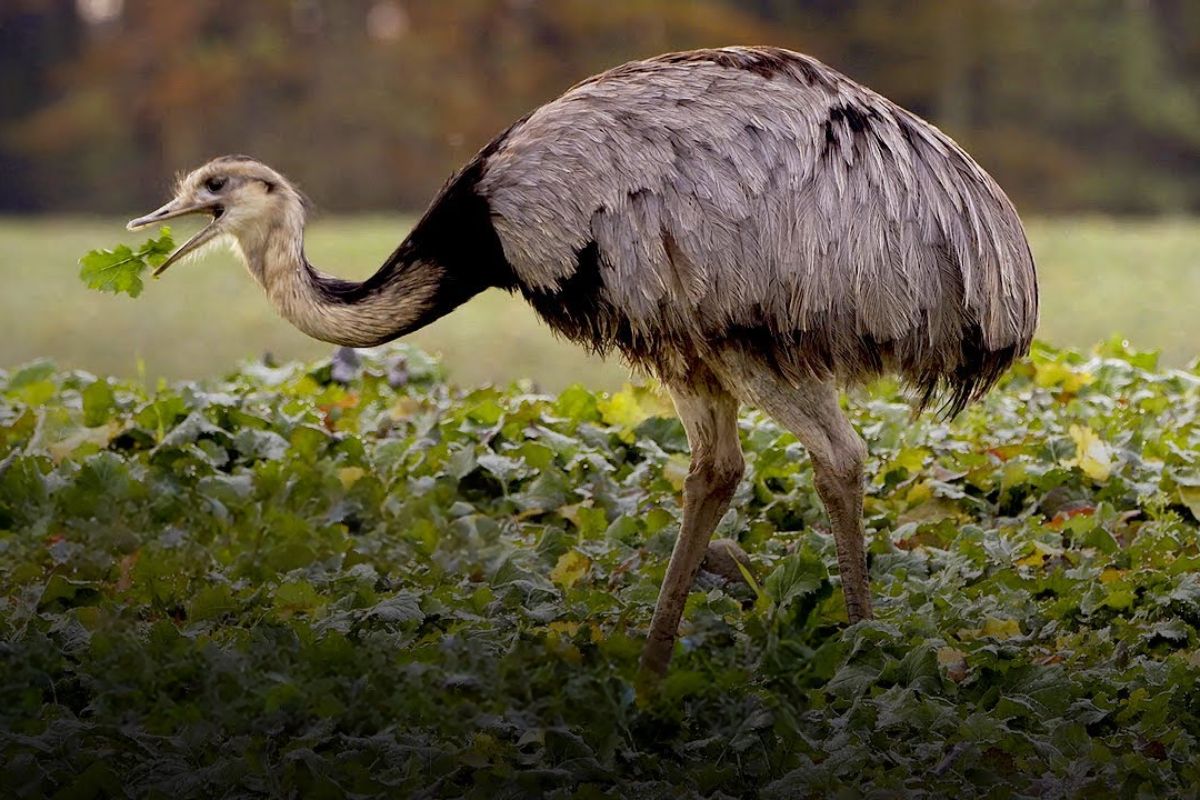


With Few Natural Threats and Access to Rapeseed, Beet, and Corn, Escaped Emus Near Lübeck Rose from Seven to About 450 in 19 Years, Occupying Nearly 100 km² of Mecklenburg-Vorpommern, Where Farmers Report Losses, Scientists Measure Impacts, and Controlled Culls Have Become Public Policy in Germany Today.
The emus have ceased to be a weekend curiosity and have become a public management issue in Germany, centered in the north, in a landscape of large agricultural areas, living fences, and wooded sections. The same bird that runs through the fields as if it has always belonged there today pressures decisions about wildlife, crops, and safety on rural roads.
The starting point is well known and small: seven animals that escaped from a private enclosure at the turn of the millennium in the neighboring region of Schleswig-Holstein and were never recaptured. In less than two decades, the emus began to roam in flocks, attracting tourists and photographers, while farmers tally damages and scientists try to assess ecological and social risks, in a scenario where culls enter as a control tool.
From Seven Emus to 450 in Less Than Two Decades

The growth draws attention because it occurred with low external interference.
-
A “silent skill” is allowing Brazilians to earn up to R$ 22,000 per month without a degree and become indispensable for companies that rely on millions of data to survive.

-
Researchers at the Toyota Research Institute found that if a human uses robotic arms to flip a pancake 300 times in an afternoon, the robot learns to do it on its own the next morning, and this is currently the most promising method to solve the biggest bottleneck in modern robotics.

-
Goodbye iron: a common item in households is starting to lose space to technology that smooths clothes in minutes without an ironing board and with less energy consumption.

-
Antarctica reveals an unusual clue high in the Hudson Mountains, and what appeared to be just an isolated rock began to expose a secret hidden under the ice for ages.

Without relevant natural predators in the territory, the emus found abundant and predictable food, with rapeseed, beet, and corn available on an industrial scale.
The combination of a constant food supply and little hunting pressure creates an environment for rapid expansion, even though the occupied territory has not spread indefinitely.
The winter count has become a local ritual: volunteers, environmentalists, and farmers roam the area to estimate how many emus are present.
The estimate cited in the monitoring indicates about 450 birds, a number built from direct observation over an area of nearly 100 km² in Germany.
To differentiate emus from cranes on bad days, the criterion is pragmatic: cranes take flight, emus do not.
What in the Landscape of Germany Favors Permanence

The emus are running birds, adapted to open spaces, and northern Germany offers exactly that: extensive fields, lines of vegetation that function as shelter, and little human fragmentation in some rural areas.
In daily movements, these groups can travel kilometers in search of food, making it difficult to contain them with fences or targeted pursuits.
There is also a risk factor outside the crop.
Rural roads cross migration routes and concentrate part of the mortality from collisions.
Even so, the population balance has remained positive, a sign that reproduction and survival in the open field have outweighed annual losses.
When a species can eat, move, and reproduce without barriers, the results tend to show up quickly in monitoring spreadsheets.
Farmers, Scientists, and the Real Cost in the Field

The conflict becomes visible when the flock finds easy food.
Piles of harvested beets become a feast, and young rapeseed areas can be pecked until they look cut.
One farmer reports that, in large flocks, the loss can approach local devastation, estimating a cost of about 100 euros per emu to deal with damages and deterrence attempts.
In this logic, the emus cease to be an exotic landscape and become a line item of cost.
On the technical side, scientists track two questions that do not always align: the immediate agricultural impact and the broader ecological impact.
There are suspicions that chicks may consume threatened insects and lizards, but the monitoring indicates the absence of conclusive evidence to confirm direct harm to local biodiversity.
Science here does not resolve politics, but it avoids decisions in the dark, even when the pressure for quick measures increases.
Culls as Public Policy and the Legal Gray Area

The legal dilemma arises from the clash between protected status and perception of a problem.
For a period, emus were in a regulatory vacuum, treated as a specially protected species and, at the same time, outside hunting rules.
The turning point occurs when the Ministry of the Environment of Mecklenburg-Vorpommern includes emus in the state hunting legislation, paving the way for culls under rules and seasons.
The stated idea is not to eradicate but to reduce.
Culls appear as a tool to limit numbers and mitigate damage, alongside other attempts already tested, such as electrified fences and scaring.
This control design brings an important side effect: a bird that previously did not associate humans with threat may change behavior with increasing pressure, altering migration patterns and contact with rural areas.
For farmers, culls promise predictability. For scientists, culls require clear metrics of effectiveness and proportionality.
Tourism, Ecological Risk, and the Paradox of Emus
The presence of emus has also become an attraction. They are easy to observe from the road, appear in flocks in winter, and feed a type of rural safari on weekends.
At the same time, there is a difficult-to-ignore contradiction: in South America, emus are associated with habitat loss and human pressure, while in Germany, they thrive in an agricultural mosaic that sustains them.
This contrast feeds the narrative dispute.
Some argue that, without strong evidence of broad ecological damage, the priority should be to minimize conflicts with farmers and maintain numbers at a controllable level.
Others see an invasive species that should not be there and advocate for culls as a correction of a historical management error.
When the discussion enters the realm of belonging, data rarely settle the debate, but it is they that define cost, risk, and proportionality.
The emus will remain at the center of the debate as long as the number remains high, rural losses continue to be documented, and scientists seek solid evidence about effects on native fauna.
In practice, Germany is testing a coexistence model that mixes monitoring, hunting rules, and culls, while also dealing with tourism and local economic pressure.
If you lived in an area where farmers deal with losses and the proposed solution involves culls, what would be the acceptable limit to control emus without transforming the rural landscape into a permanent conflict between science, politics, and production?







Moro no Mato Grosso, Engraçado que no Brasil elas vivem nos campos agrícolas, nunca ouvi falar que causassem prejuízo as lavouras .
Com nossos agrotóxicos **** algum vai ser **** de comer esses venenos. Na Europa nossos agrotóxicos não são permitidos facilitando assim que os animais dali se alimentem
Sorry but they definitely are not Emus from Australia. THEY ARE OSTRICHES
Para controlar e reduzir a população de Emas é simples e mais racional das população das aves, a estratégia é tirar ou reduzir ovos dos ninhos da Ema, se elas põem 4 ovos elimine dois e assim por diante.
E é você que vai procurar os ninhos??
Elas vieram de onde? Brasil? Devolve para o lugar de onde vieram.