





 Portuguese
  English
  Spanish
  4 min of reading
  0 comments


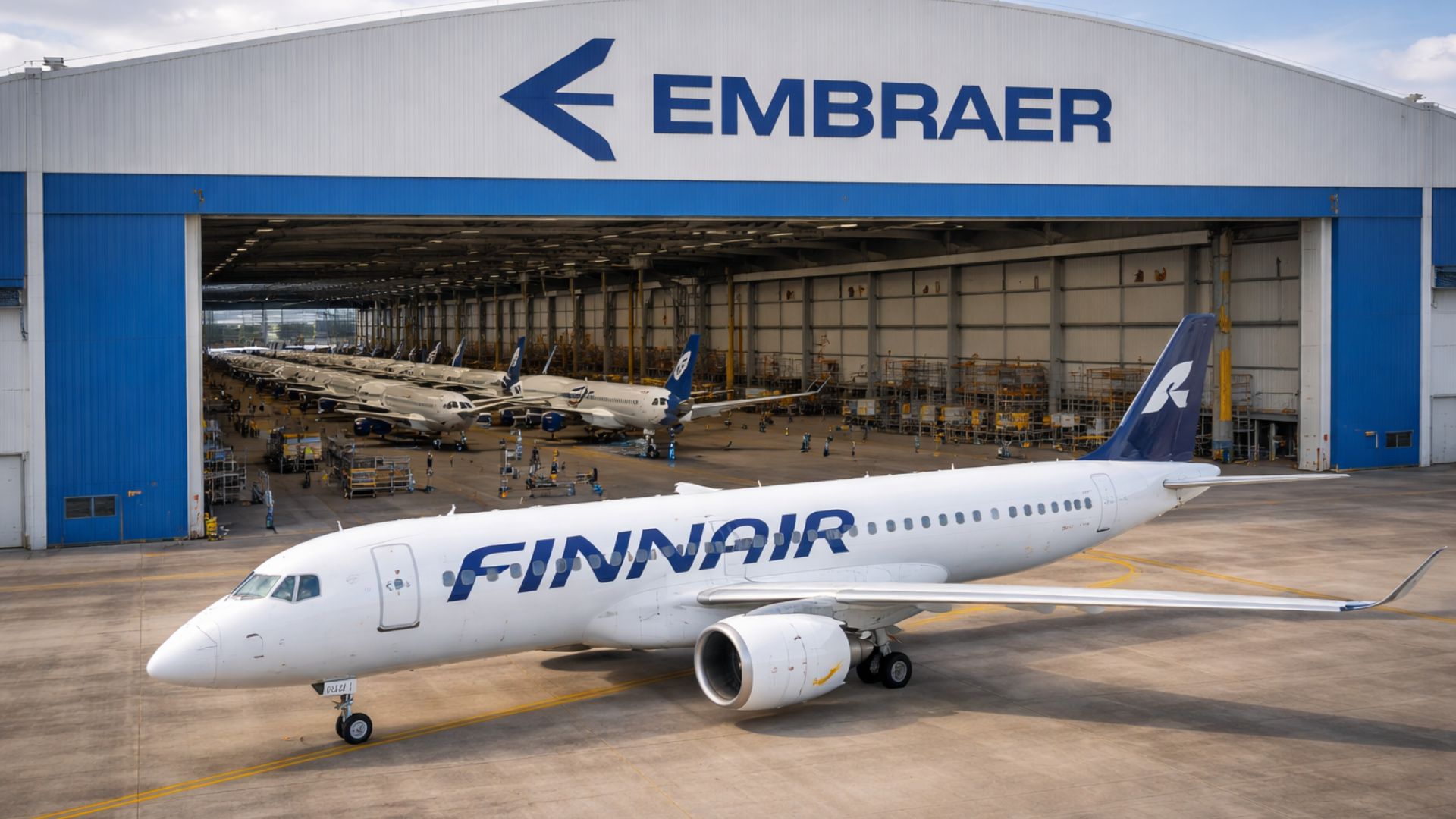
Billion-dollar negotiation between Embraer and Finnair marks historic fleet renewal, expands Brazilian presence in Europe, and redefines the operational strategy of the Finnish company focusing on efficiency, sustainability, and regional expansion starting in 2027.
Embraer announced on Monday, March 23, an agreement with the Finnish Finnair for the sale of up to 46 E195-E2 jets, in a negotiation that reinforces the Brazilian manufacturer’s presence in Europe and marks one of the largest investment decisions by the Nordic airline in over two decades.
The package includes 18 firm orders, as well as 16 options and 12 purchase rights, with the first deliveries expected in the second half of 2027.
Agreement between Embraer and Finnair gains strategic weight in Europe
The announcement was presented by Embraer itself as part of Finnair’s strategy to renew older aircraft and sustain growth with profitability on short-haul routes.
-
50 viaducts, 4 tunnels, 28 bridges, and 40 kilometers of bike paths: BR-262 in Espírito Santo will receive 8.6 billion reais for the largest engineering project in the state’s history, inspired by the Immigrant Highway in São Paulo.

-
Brazil produces too much clean energy and doesn’t know what to do with it: over 20% of solar and wind capacity was wasted in 2025 while investors flee and 509 renewable generation projects were abandoned in the last year.

-
Piauí will produce a new fuel that replaces diesel without needing to change anything in the truck’s engine and reduces pollutant gas emissions by half: truck drivers from all over the Northeast are already celebrating the news that will arrive later this decade.

-
A new Brazilian shopping center worth R$ 400 million will be built in an area equivalent to more than 4 football fields, featuring 90 stores, 5 cinemas, a supermarket, a college, and parking for 1,700 cars, potentially generating 3,000 jobs.


At the same time, the operation represents a significant move in the European market, as the Finnish company decided to choose the Brazilian model for the renewal of its narrowbody fleet, which is currently largely based on Airbus aircraft.
Although Embraer and Finnair did not disclose the final price just for the E195-E2, the CEO of the Finnish company informed Reuters that the investments planned by the company until the end of 2029 should total around 2 billion euros, equivalent to approximately US$ 2.31 billion.
This amount, however, encompasses fleet renewal and associated agreements, and was not publicly detailed as an exclusive value of the contract with the Brazilian manufacturer.
Contract structure increases expansion flexibility
The structure of the deal helps explain why the market treated the announcement as a milestone.
In practice, the 18 confirmed aircraft ensure the first phase of the renewal, while the options and purchase rights give Finnair room to expand the fleet as demand evolves.
Still within this same strategy, the company also stated that it intends to seek up to 12 used Airbus A320 or A321 aircraft in the secondary market.
E195-E2 bets on efficiency and operational comfort
The chosen model has advantages for the type of operation the company wants to strengthen in the coming years.
According to Embraer, the E2 family aircraft destined for Finnair will be configured with 134 seats, in a cabin without middle seats, a feature that the manufacturer highlights as a comfort differential for regional flights.
The Brazilian company also claims that the E195-E2 can be up to 35% more fuel-efficient than the previous generation of E190 operated by the Finnish airline.
On Finnair’s side, the public assessment was similar, but with an operational and environmental focus.
In an interview with Reuters, the company’s management stated that the E195-E2 is expected to reduce CO2 emissions per passenger transported by about 30%, in addition to offering a size considered more suitable for routes within Finland, the Nordic countries, and northern Europe.
Fleet renewal redefines regional operation
The decision also alters the design of Finnair’s regional operation.
Currently, the company reports that it has 12 Embraer 190, operated by the regional subsidiary Norra, with a capacity for 100 passengers.
With the arrival of the new E195-E2, the company plans to double the seat offering in part of its regional network, gradually replacing older aircraft and repositioning the operation for higher-density routes.


Backlog strengthens Embraer’s production in 2026
The Brazilian manufacturer reported that the contract will be incorporated into the backlog of the first quarter of 2026, which means that the order officially becomes part of the company’s order book at the beginning of this year.
This point is relevant because the backlog serves as a reference for the future flow of production and revenue for Embraer, in addition to signaling industrial predictability.
Dispute with Airbus gains a new chapter
The agreement also exposes an important industrial dispute in the sector.
Finnair’s choice represents another setback for Airbus in the lower-capacity narrowbody segment, precisely at a time when Embraer is trying to consolidate the E2 as an alternative for airlines seeking efficiency on short and medium routes.
Global context and strategic impact
There is also a symbolic component to the operation, as the investment’s destination is Finland, a country that has returned to the top spot in the World Happiness Report 2026.
Even though it is a peripheral data point to the aviation business, the association helps to gauge the institutional weight of a flag carrier airline in a strategic market for connections in northern Europe.
Finnair has undergone a period of strong adaptation in recent years, first pressured by the effects of the pandemic and then by changes in European airspace.
In this scenario, renewing the regional fleet has gained additional importance to reorganize the network, increase efficiency, and enhance connectivity on European routes.
For Embraer, the contract reinforces a strategic axis that the company has been exploring intensively: that of smaller commercial jets capable of serving markets that do not require larger aircraft but need economic performance and lower consumption.








Seja o primeiro a reagir!