





 Portuguese
  English
  Spanish
  5 min of reading
  0 comments


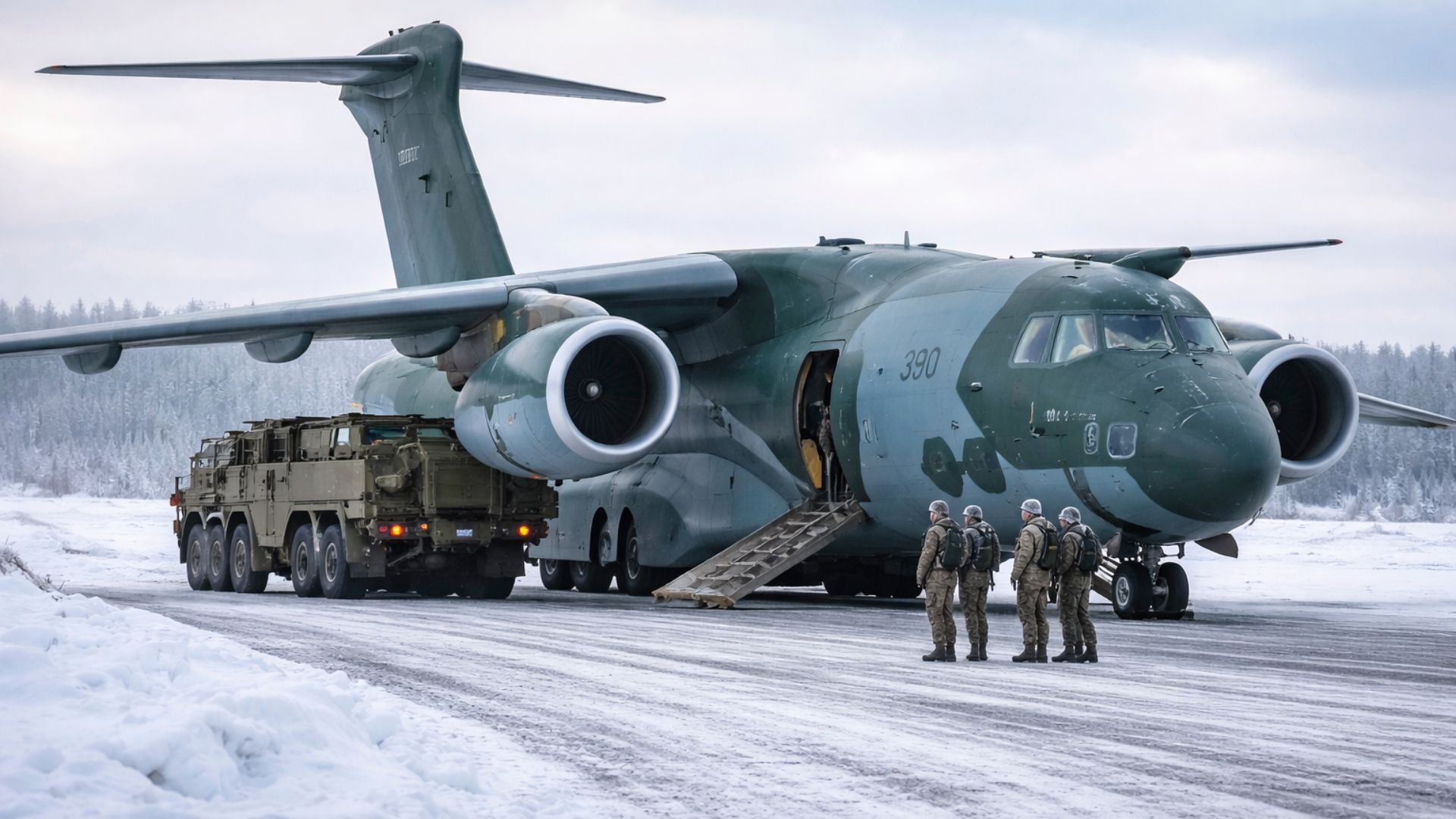
Operation in Arctic Environment Reinforces Logistics Capacity, Military Versatility, and Rapid Response of the KC-390 in Extreme Conditions, Focusing on Modern Missions and High Operational Demand Scenarios in Northern Europe.
Embraer reported that the KC-390 Millennium successfully completed a demonstration campaign in extreme weather in northern Sweden, in an operation aimed at proving the aircraft’s performance in an Arctic environment and in Agile Combat Employment missions, a concept known by the acronym ACE.
The activity took place at the Vidsel Test Range and, according to the manufacturer, confirmed the cargo aircraft’s ability to operate under intense cold, with rapid system activation, short takeoffs and landings, and simultaneous movement of cargo, troops, and equipment.
Tests in the Arctic Highlight KC-390 Performance in Extreme Weather
During the trials, the crew executed quick starts of the engines and onboard systems before performing maneuvers on a short runway, a relevant operational requirement in dispersed and austere scenarios.
-
Extratropical cyclone and cold front generate alerts for storms with winds of up to 90 km/h, occurring between April 6 and 10, advancing through 3 regions and risk of heavy rains in the South, Southeast, and Midwest.

-
Trapped between layers of lava for 44 million years, an ancient tropical island in the Atlantic is back on the map and puts Brazil in contention for valuable minerals on the seabed.
-
Specialists are urging residents to eat as many wild blackberries as they can because the invasive plant is destroying native species and causing billions of dollars in damages in the United States.

-
At 93 years old, Mr. Francisco completes a 5 km run, is cheered as he crosses the finish line, moves the city, and gives an emotional lesson in strength, discipline, and the will to live.

In the same campaign, the aircraft also quickly embarked and disembarked heavy military vehicles, including the SISU GTT, maintaining the capacity to transport military personnel and additional materials on the same flight, according to the description released by the company.
The demonstration occurred at a time of commercial advancement for the program in Europe and reinforces Embraer’s effort to position the KC-390 as a tactical and logistical transport alternative in NATO countries.
The Brazilian manufacturer asserts that the Swedish campaign demonstrated the model’s suitability for operations in Northern Europe and the Arctic region, where low temperatures, ice, restricted runways, and the need for dispersion often raise the operational demands on the aircraft employed.
Operation in Vidsel Validates Agile Combat Concept (ACE)
The exercise in Vidsel focused on validating performance in real conditions, not just in a controlled laboratory environment.
This detail is relevant because the ACE concept assumes high mobility, reduced ground preparation time, and the ability to sustain missions from limited structures, which requires the aircraft not only to have power but also quick reaction and logistical versatility.
Embraer stated that the KC-390 met these requirements while operating over icy surfaces and in extreme cold scenarios.
According to Bosco da Costa Junior, president and CEO of Embraer Defense & Security, the KC-390 once again demonstrated versatility and capability to execute demanding missions under rigorous conditions, with 100% reliability during the campaign.
The statement was released by the company itself and is part of the set of arguments used by the manufacturer to advocate for the aircraft as a suitable option for air forces that need to combine transport, readiness, and flexibility in a single platform.
By associating the performance achieved in Sweden with the Arctic environment, Embraer also seeks to enhance the perception of operational maturity of the program in a strategically important geographical area for European countries.
In contemporary military operations, the ability to land and take off on short runways, react quickly on the ground, and redistribute vehicles and troops in a short time has become increasingly significant, especially in scenarios that require dispersion of resources and reduction of vulnerabilities.
Transport of Vehicles and Troops Expands Operational Versatility
In the profile presented by the company, the KC-390 combines medium-lift military transport and aerial refueling functions on a single platform.
The manufacturer describes the model as a multi-mission aircraft designed to combine performance, flexibility, and lower operational costs, with applications in cargo transport, troop movement, evacuation, logistical support, rapid response, and other tasks associated with military and humanitarian operations.
The campaign in Sweden highlighted precisely one of the points most explored by Embraer in its commercial strategy: the ability to carry, in a single sortie, heavy vehicles, military personnel, and additional equipment, without sacrificing agility in loading and unloading.
In severe operational contexts, this combination reduces the number of movements necessary to assemble a force on the ground and can accelerate the response in support missions, tactical movement, and logistical sustainment.
The use of the SISU GTT in the demonstration was not coincidental.
It is a vehicle associated with the Nordic environment and use in difficult terrain, which helps illustrate the type of mission that Embraer sought to represent in Vidsel.
By highlighting that the loading of this type of cargo occurred without eliminating space for military personnel and extra equipment, the company aimed to show that the aircraft can operate as a versatile logistical link even when the mission requires a mix of resources and rapid repositioning.
Advancement of the KC-390 in Europe Reinforces Embraer’s Strategy
The operation in extreme weather comes after Sweden confirmed, on April 1, 2025, its commitment to acquire four C-390 Millennium, securing production positions for the program.
The Swedish government stated at the time that the purchase would be made in coordination with European partners, in a model aimed at accelerating delivery and reducing costs through joint acquisition.
This context helps explain why the campaign in Swedish territory holds political, commercial, and operational weight for Embraer.
In addition to serving as a technical showcase, the demonstration reinforces the presence of the Brazilian cargo aircraft in an increasingly sensitive European market regarding interoperability and readiness requirements.
For Embraer, showcasing the aircraft in action in the extreme cold of the Arctic helps sustain the argument that the KC-390 is capable of modern air mobility missions, including in countries that operate at high latitudes and depend on rapid response under severe conditions.
The manufacturer has been insisting that the KC-390 was designed to meet contemporary threats and demands, with a more recent architecture than that of previous-generation models still in service in various air forces.
In official communications, the company associates this design with gains in productivity, operational versatility, and cost efficiency, attributes that reappear as a backdrop in the Vidsel campaign.
With the conclusion of the Swedish campaign, Embraer adds another argument to the recent history of promoting the KC-390 in strategic markets.
The central message of the operation was that the aircraft can maintain readiness, mobility, and payload capacity in a severe environment, a set of attributes that remains at the core of the competition for new military contracts in Europe.





Seja o primeiro a reagir!