





 Portuguese
  English
  Spanish
  5 min of reading
  0 comments


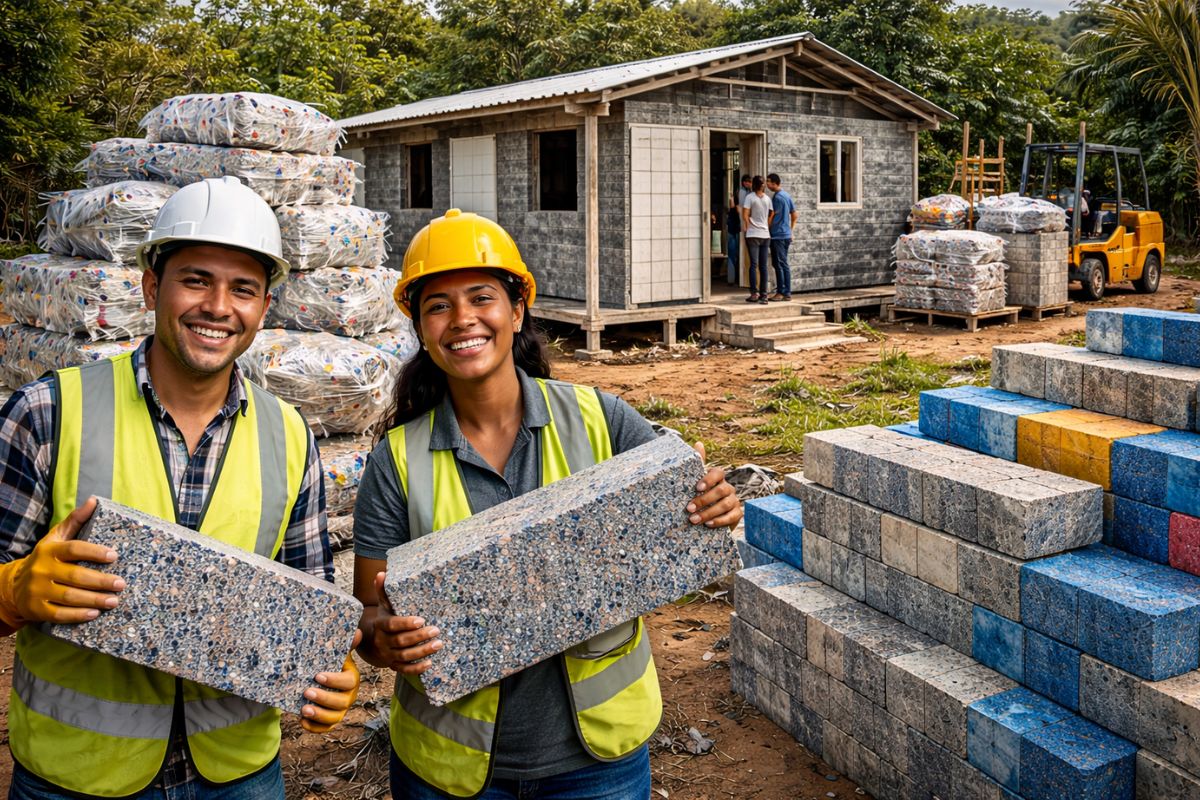
A Colombian Company Claims That, In Bogotá, 740 Tons Of Discarded Plastic Have Become A Daily Problem And Therefore Developed Easy-To-Assemble Structural Blocks. The Mixture Uses Hard-To-Recycle Waste, Generates Flexible And Durable Material, And Aims For Sustainable Housing With Low Production And Sales Costs
Discarded plastic is the starting point that the Colombian company Conceptos Plásticos chose to tackle two problems at once: urban waste and more affordable housing. In Bogotá, the base claims that 740 tons of plastic are discarded daily, and the company says it has transformed this volume into opportunity by developing structural blocks that can be assembled like pieces.
Discarded plastic is also the type of waste that tends to hinder traditional solutions. Conceptos Plásticos works with a mixture of plastics that are very difficult to recycle or even discard, precisely those “problematic” materials that remain when the recycling chain cannot cope. The announced result is a flexible and durable material, with low production and sales costs, aiming at cheaper sustainable housing.
Who Is The Company And Why Bogotá Becomes The Laboratory For The Problem

Conceptos Plásticos is described as a Colombian startup that created a plastic block with structural function for construction.
-
Friends have been building a small “town” for 30 years to grow old together, with compact houses, a common area, nature surrounding it, and a collective life project designed for friendship, coexistence, and simplicity.

-
This small town in Germany created its own currency 24 years ago, today it circulates millions per year, is accepted in over 300 stores, and the German government allowed all of this to happen under one condition.

-
Curitiba is shrinking and is expected to lose 97,000 residents by 2050, while inland cities in Paraná such as Sarandi, Araucária, and Toledo are experiencing accelerated growth that is changing the entire state’s map.

-
Tourists were poisoned on Everest in a million-dollar fraud scheme involving helicopters that diverted over $19 million and shocked international authorities.


The idea stems from a simple diagnosis: excessive plastic disposal is a socio-environmental problem that repeats in many places, but in Bogotá, it appears with a concrete number, 740 tons daily.
This type of data puts scale into the conversation. It is not a craft workshop. It is the portrait of a daily flow that pressures landfills, streets, and collection systems.
By treating disposal as raw material, the company seeks to change the logic of waste destination, which, according to the base, can take up to 300 years to decompose in the environment.
What Are The Structural Blocks And How Assembly Affects Cost

The central proposal is a plastic block with structural function, designed to become raw material for sustainable houses.
The base emphasizes that the blocks are easy to assemble, a characteristic that tends to have a direct impact on construction time, labor requirements, and material waste.
When the block is designed for easy fitting and assembly, the cost does not depend only on the input price. It depends on logistics, execution speed, and the repeatability of the system.
The company’s argument is that the blocks are very resistant and maintain low production and sales costs, paving the way for cheaper housing without relying on expensive traditional materials or complex processes.
The “Hard Plastic,” The Mixture, And The Choice To Attack The Waste That Nobody Wants
The base makes it clear that the blocks are made from a mixture of plastics that are very difficult to recycle or discard. This is relevant because much of the recycling discourse focuses on “easier” materials that already have established markets and chains.
Here, the company aims for the opposite: the problematic waste.
The technical justification presented is that the company managed to combine characteristics of these plastics to create a highly flexible and durable material.
Flexible, in this context, does not mean fragility, it is the ability to absorb effort without breaking immediately, which can be useful in structural applications when the assembly system and the material work together.
Resistance, Thermal And Acoustic Comfort, And What It Means In Real Use
The base claims that, contrary to what many people believe, hardened plastic can be more resistant than traditional building materials.
It also attributes to the blocks the ability to provide thermal and acoustic comfort to the environment.
These two promises point to a benefit beyond “being sustainable.” Thermal comfort means reducing the feeling of heat or cold inside the space, and acoustic comfort means reducing noise transmission.
When housing is cheaper but delivers comfort, acceptance tends to grow, because perceived value is not limited to price.
The Environmental Discourse, Global Warming, And The Company’s Public Argument
Ricardo Rico, the company’s manager, is quoted as saying that the goal is to address problems affecting the community, helping to reduce pollution caused by plastic waste and its impact on global warming.
This statement ties the project to a dual narrative: social and environmental.
This type of positioning matters because sustainable houses are sold not only as products but as urban policy solutions.
When the material comes from waste, construction becomes part of a waste reduction strategy, and not just an alternative to bricks. It is at this point that the project tries to legitimize itself as a response to a crisis that is not only housing-related but also disposal-related.
Production And Sale, What “Low Cost” Really Tries To Say Here
The base uses a strong expression: low production and sales costs. This does not come accompanied by a detailed spreadsheet, so what can be stated with certainty is the meaning of the argument.
The company means that the model works economically because the input is abundant waste, assembly is simple, and the final material is resistant.
There is an operational detail that appears as an expansion of impact: in addition to producing the raw material, the company also trains the recycling community in different regions, from Colombia to Africa.
This suggests that the model tries to scale through method transfer, not just product export. If the system depends on training, it tries to organize the chain and labor around the waste, which influences costs and repetition.
Discarded plastic has become raw material for a model that seeks to convert a daily problem, 740 tons in Bogotá, into easy-to-assemble structural blocks that are resistant, flexible, and durable.
Conceptos Plásticos presents the proposal as a pathway for cheaper sustainable housing, with low production and sales costs, using precisely the hard-to-recycle waste that usually remains at the end of the chain.
Now I want concrete answers: in your city, what plastic do you see most going to regular waste, bags, food packaging, bottles, or thin film, and would you trust a house made with blocks of this type because of the resistance, thermal and acoustic comfort, or only after seeing an entire neighborhood using it for years?










-

-

4 pessoas reagiram a isso.