





 Portuguese
  English
  Spanish
  7 min of reading
  0 comments


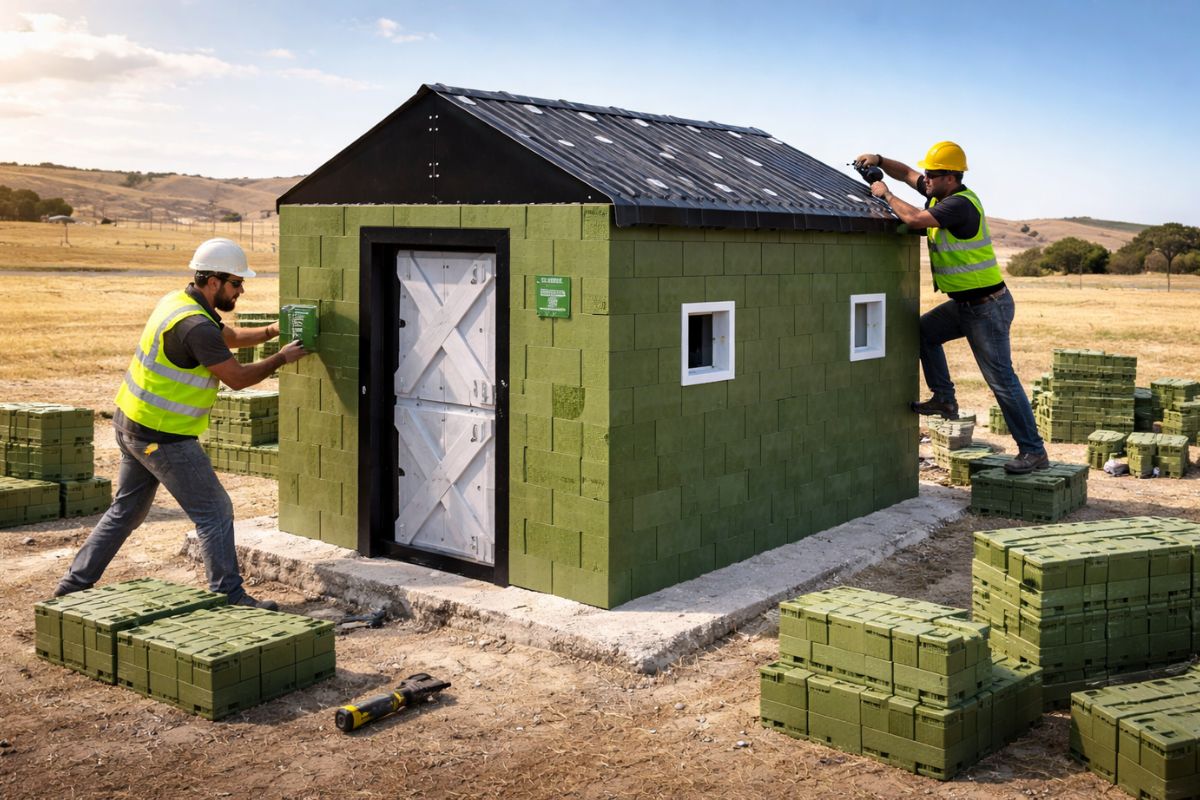
Created For Humanitarian Aid Operations, QUICKBLOCK® Uses 100% Recycled Plastic Blocks In A Patented System That Assembles And Disassembles Quickly, Can Be Shipped Anywhere, Provides Safety From Day One, And Accepts Upgrades Like Doors, Windows, Roof, And Installations Without Traditional Construction In Real Emergencies.
Plastic blocks are at the center of a proposal that seeks to mitigate one of the most challenging moments of any emergency: the gap between losing one’s home and regaining a minimally safe place to sleep, store belongings, and protect oneself from the elements. The idea is simple to explain yet complex to execute well: transport a disassembled home and assemble it quickly wherever necessary.
Being displaced by conflict or natural disaster often comes with fear, disorientation, and loss of privacy. When protection does not arrive quickly, trauma deepens, especially if the alternative is to remain exposed to rain, wind, extreme heat, and safety risks while waiting for permanent solutions to appear.
What Is At Stake When “Home” Needs To Mean Safety From Day One

In humanitarian operations, home is not just a roof: it is a minimal amount of control over one’s routine. A dry, sheltered space reduces immediate vulnerabilities and helps re-establish basic habits, such as rest, hygiene, and organization of essential items.
-
New CCR concrete paving technology promises roads up to 3x more durable, less maintenance, and cost reduction in Brazil.
-
Made from recycled plastic, plastic wood is gaining space in the construction industry because it does not rot, resists moisture, and reduces maintenance costs over the years.

-
Florianópolis will receive a million-dollar BRT that will begin construction in 2026 with nearly 400 million in funding from the federal government and the Inter-American Development Bank, and the map already shows the routes for the exclusive bus corridors.
-
Without a blueprint, without an engineer, and using scrap from the dump, a father spends 15 years building an 18-room castle for his daughter, featuring tram tracks, 13 fireplaces, and over 700 m², which may now be demolished.

The urgency often remains invisible until it becomes collective exhaustion: sleepless nights, a constant sense of threat, and lack of privacy add up and hinder any fresh start.
This is why solutions that promise to depart from the logic of “indefinite camping” draw attention. The QUICKBLOCK was created with this focus: to offer an immediate home that arrives disassembled, can be mobilized globally, and provides protection against the elements while the community awaits permanent housing.
The practical question for those coordinating crisis responses is always the same: who can assemble it, where will it be installed, and how to keep the home functional long enough without relying on traditional construction.
How Plastic Blocks Fit Together To Raise The House In A Few Hours

The system is based on 100% recycled plastic blocks that fit together to form walls and structures without requiring the type of construction site that rarely exists in a disaster zone.
In the proposed solution, assembling the house is quick: a QUICKBLOCK shelter can be erected in 2 hours with 4 people, which completely changes the scale of deployment when there are many families needing space at the same time.
The described model includes basic habitability elements: 1 door, 2 windows, and a roof. This “essential needs kit” is relevant because, in the field, each component affects safety, ventilation, light entry, and the sense of privacy.
The decision to store and transport the unit disassembled also addresses the logistical side of missions: moving volume and weight is always a bottleneck, so solutions designed for rapid mobilization tend to be prioritized when time is the scarcest resource.
Why A House “As Quick As A Tent” Tries To Go Beyond What The Tent Delivers
Tents are quick and familiar, but they often fall short in what they can offer in protection and sense of permanence. The proposal of QUICKBLOCK is to occupy that middle ground: assembly as quick as a tent, but with greater safety from day one.
The practical difference lies in the rigidity and the sense of “real structure”, which influences everything from protection against the elements to the behavior of people nearby (including in high-tension scenarios).
At the same time, durability is not just about “withstanding wind and rain”; it is about remaining useful as the emergency evolves.
The system describes a patented design intended to withstand the elements, with the ability to disassemble and reuse.
In a long operation, the capacity to reconfigure units and repurpose components is an operational advantage: when the flow of people changes, the shelter may need to shift from temporary housing to another use or to a different location.
From Immediate Home To Semi Or Permanent Housing: Modularity And Adaptation To The Local Context
One of the most strategic promises of the model is the transition: the same initial set can become semi-permanent or permanent housing, with options to add roofs, windows, doors, and cladding.
This matters because emergencies rarely end on the expected timeline; the “temporary” often extends. When the crisis prolongs, the home needs to evolve without becoming junk.
The possibility of customization also addresses a social issue that is often overlooked in standardized solutions: aesthetics and cultural appropriateness. Allowing communities to modify the design to resemble the local appearance can reduce rejection, increase the sense of belonging, and facilitate the integration of the shelter into daily life.
Even though the core consists of plastic blocks, the surroundings, such as openings, closures, cladding, and arrangements, can make the difference between a “people depot” and a “livable place.”
Building Segmentation: When The Emergency Demands Internal Spaces, Not Just Separated Houses
Humanitarian responses do not always happen in open terrain. There are scenarios where the available structure is a larger building (warehouses, community centers, temporary facilities) and the problem becomes organizing the interior: separating sleeping areas, triage, care, and storage.
In this context, QUICKBLOCK appears as a solution for “building segmentation,” quickly creating partitions and rooms to compose an improvised hospital or rest areas.
The utility here lies in flexibility: building “inside the building” allows control over the flow of people, reduces exposure, and organizes essential services more orderly.
Interlocking plastic blocks, when designed for assembly and disassembly, can accelerate this organization without requiring permanent construction and can ultimately be removed and reused in another arrangement as needs change.
Security Solutions: Barriers, Access Control, And Protection In Humanitarian Operations
Security in humanitarian missions is not just policing; it is often simple engineering applied quickly.
QUICKBLOCK is presented as applicable to measures such as high-volume barriers in areas of people transport, vehicle checkpoints, and protective infrastructure.
In places where movement needs to be organized due to either risk or logistics, the ability to create perimeters and clear access can reduce chaos and vulnerability.
These “non-residential” uses are an important part of the equation because a relief operation needs to function as a system: shelter, circulation, triage, storage, and protection.
When the same modular set can serve more than one function, the mission gains agility. Still, actual deployment depends on planning: where to position barriers, how to maintain evacuation routes, and how to balance control with humanitarian access.
The Prototype In The Desert: What It Means To Test In Unstable Climatic Conditions For A Year
The company reports the launch of the QUICKBLOCK shelter prototype V1 and its installation at Camp Roberts, California, as part of JIFX (Joint Interagency Field Experiment) in August 2024, with permission to remain on-site for a year.
The logic of the test is straightforward: observe the behavior of the shelter under unstable desert climate conditions, something that stresses materials, fittings, and sealing in cycles of heat, dust, and environmental variations.
This type of evaluation is valuable because it brings the promise closer to real use. It is not just about “assembling quickly,” but maintaining integrity and functionality over time. In humanitarian aid, infrequent failure is not acceptable when many people depend on the same standard.
The extended observation period also helps answer operational questions: how the system behaves under repeated assemblies and disassemblies, how it ages when exposed, and how it can be adjusted for different scenarios.
Essential Installations Without Relying On Traditional Construction: Comfort Possible, With Adaptations As Needed
Beyond basic shelter, the QUICKBLOCK system’s design is described as compatible with the installation of essential equipment adapted to the specific needs of residents. This opens up the possibility to think about comfort and autonomy without promising magical solutions: insulation, electricity, solar/pv power, solar water heating, furniture, rainwater collection, water filtration, plumbing.
The central message is modular: the structure can receive additional resources as the situation demands and as there is operational and maintenance capacity.
In practice, this point often separates the “shelter that exists” from the “shelter that works.” Energy and water, for example, are not just comfort items; they are factors that influence health, hygiene, and safety. The advantage of a system that assembles and disassembles is the ability to allow reuse and reconfiguration: a unit can serve a purpose today and, tomorrow, be adapted for another, as long as there is planning and a team to implement changes responsibly.
The use of 100% recycled plastic blocks in humanitarian shelters like QUICKBLOCK presents a clear proposal: deliver rapid protection, with assembly in a few hours, logistics for disassembled transport, and a possible trajectory from temporary to more durable without depending on traditional construction when everything is interrupted.
At the same time, as any solution applied to real crises, the final value depends on execution, local coordination, and practical choices about security, configuration, maintenance, and cultural adaptation.
If you had to choose a shelter for an emergency in your area, what would weigh more: assembling quickly, having more safety from day one, or the possibility of evolving to something semi-permanent with energy and water installations?
And what would be your biggest concern upon seeing homes made with plastic blocks arriving to replace tents?







Seja o primeiro a reagir!