





 Portuguese
  English
  Spanish
  4 min of reading
  4 comments


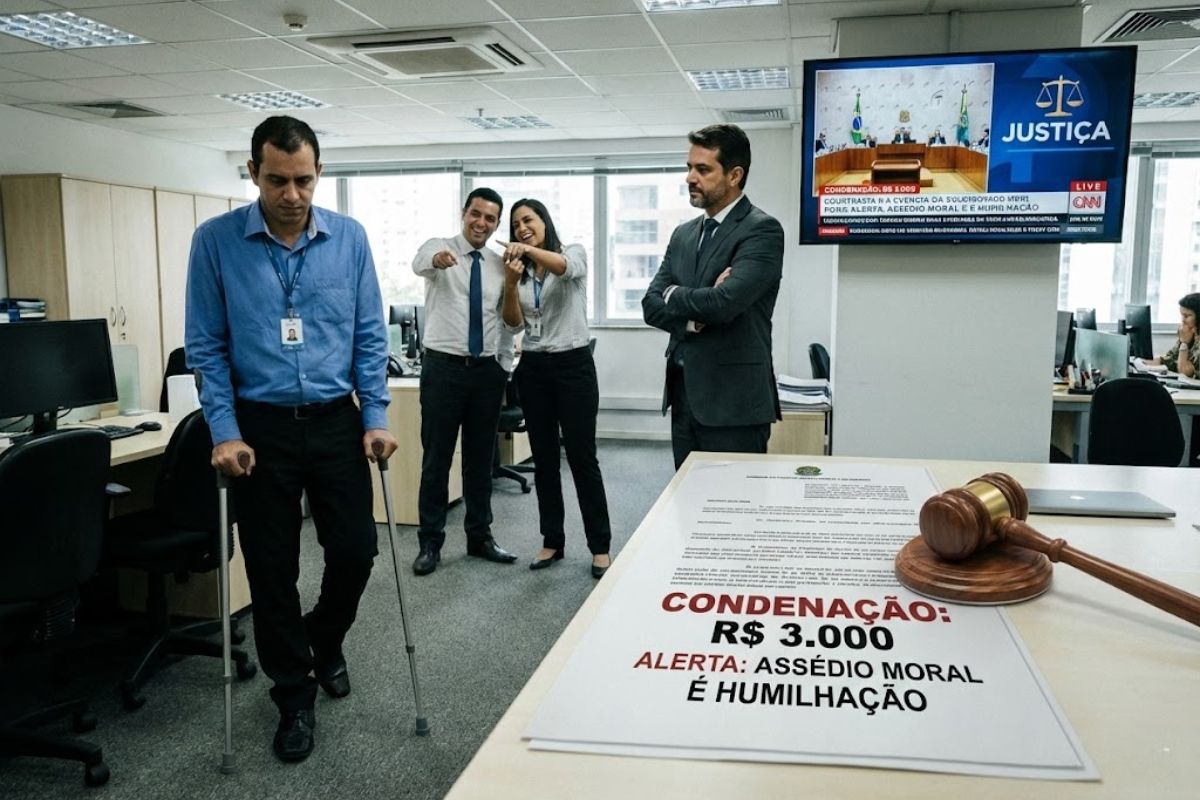


In the Decision, The Justice and The Labor Court Understood That Mockery About Disability Constitutes Moral Harassment and Moral Damage in the Workplace, Forced The Company to Compensate The Employee and Reinforced That No Joke Authorizes Humiliation in Front of Colleagues in The Professional Environment.
The justice, through the Labor Court, confirmed the condemnation of a company to pay 3,000 reais for moral damage, after colleagues repeatedly mocked an employee who limped in the workplace, under the pretext of a simple joke.
The justice understood that the company’s management was negligent for failing to intervene in the face of mockery, imitations of the employee’s way of walking, and derogatory comments about his physical limitation. For the court, the tolerance of such behavior normalized a hostile and discriminatory environment, in which disability became a reason for jokes and public exposure, demanding a compensatory and pedagogical response.
How The Justice Sees Jokes About Disability in The Workplace
In the analyzed case, the episodes of mockery were not treated as simple exaggerations of cohabitation, but as moral harassment linked to physical condition, repeated in front of colleagues and with the full knowledge of the management.
-
The Senate approves a bill that criminalizes misogyny, hatred, or aversion towards women, and includes the crime in the Racism Law with a penalty of up to 5 years.

-
Chamber Approves Bill That Allows Pepper Spray for Women Over 16 and Imposes Strict Rules for Purchase, Possession, and Use as Self-Defense

-
Chamber Approves Law to Combat Leucaena, Fast-Growing Plant That Dominates Land and Threatens Native Species in Various Regions of the Country

-
Asset Division: Know What Cannot Be Divided in Case of Divorce


The justice highlighted that imitating the way someone with a mobility limitation walks attacks self-esteem, harms professional image, and undermines the sense of belonging to the team.
Even though the authors of the offenses claimed it was just a joke, the decision reinforced that there is no space for humor based on disability within employment relationships.
According to the adopted understanding, the repeated exposure of the worker to ridicule violates personality rights and generates compensable moral damage, regardless of direct financial loss.
Company Omission and Duty of Permanent Vigilance
A central point of the condemnation was the evaluation of the employer’s conduct.
For the justice, the company had the duty to act as soon as it became aware of the mockery, adopting measures such as formal warnings, team guidance, and explicit protection for the victim.
By failing to do so, it assumed the risk of maintaining a toxic and discriminatory environment.
The ruling emphasized that the management’s silence in the face of repeated aggression amounts to complicity, attracting direct civil liability for the employer.
Testimonies and internal reports were decisive in demonstrating that the episodes were known and that, nonetheless, no effective measures were taken to cease the humiliations.
Legal Basis That Supports The Condemnation for Moral Damage
The labor justice based its decision on provisions that protect human dignity and repudiate discrimination in employment. Among the legal pillars used, the following stand out:
• Principle of the dignity of the human person, which requires respect for the physical and psychological integrity of the worker
• Norms that ensure compensation for moral damages due to illicit or omitted acts
• Rules that hold the employer responsible for the acts of their agents and team members
The set of these norms leads to the conclusion that companies cannot allow physical limitations to become objects of mockery, under penalty of being held liable for direct violations of fundamental rights.
The condemnation of 3,000 reais, although modest in value, was described as a pedagogical measure and a warning to the labor market.
Practical Measures to Avoid Similar Condemnations
The decision emphasizes that preventing is more efficient than compensating. To avoid repeating the case, human resource specialists indicate that companies need to:
• establish clear codes of conduct against jokes about disability, appearance, or health condition
• create confidential reporting channels, allowing victims to seek help without fear of retaliation
• promote periodic training on moral harassment, inclusion, and respect for physical and functional diversity
• act immediately in response to any reports of humiliation, with internal investigations and proportional sanctions
In addition, providing psychological support and institutional care to the victim of mockery signals a real commitment to the mental health of the team and reduces the risk of recurrence.
Ignoring or minimizing complaints, on the other hand, increases labor liabilities and damages the company’s reputation.
What The Worker Can Do in The Face of Humiliations
For the justice, evidence is a decisive element in cases of moral harassment linked to disability or physical limitation. Therefore, it is recommended that the worker:
• record dates, locations, and frequency of jokes or offensive imitations
• save messages, videos, or audios that demonstrate the behavior of colleagues
• identify witnesses who have witnessed the humiliating situations
• seek guidance from a union or labor attorney to assess the best legal path
By gathering these elements, the victim strengthens the possibility of recognition of moral damage and the employer’s liability for omission.
The decision that established the 3,000 reais compensation shows that episodes treated as jokes can turn into judicial condemnations and important precedents for the protection of people with disabilities in the labor market.
Given this scenario in which the justice system is starting to crack down more rigorously on jokes about physical limitations, do you think Brazilian companies are really prepared to curb this type of humiliation, or do they still treat the issue as an exaggeration from those who report it?










As palavras são bonitas e dependendo da situação certas palavras não são bem vistas de conforme a situação aplicada.
Mas saber o significado é simples , agora praticar o significado é muito difícil para a maioria dos seres humanos ( Amor, respeito, amizade ….) .
Quando as pessoas vão aprender que zoação agora só de si mesma? Nem sei se vou fazer cirurgia da catarata ou emagrecer. Como vou fazer piada de cega e gorda sem poder usar a primeira pessoa do singular? Ainda bem que eu tô ficando surda. Logo vou poder variar meu repertório. Mundo **** esse de hoje em dia. As pessoas levam as palavras pra alma, como se a opinião dos outros devessem ter algum valor. Amor próprio ia cair bem pra essas pobres almas.
Aff… d0¡d○ virou palavra sensurável? kkkkk
A empresa foi condenada? Penso que a empresa não é responsável pela educação das pessoas que ali trabalham uma vez que o tema discriminação é exaustivamente divulgado como crime. Talvez a notificação da empresa sobre o problema para tomar atitudes em face a legislação e provável punição seria mais coerente. Identificar os responsáveis direto pela atitude e aí sim condenar e cobrar indenização do CPF e não do CNPJ.
Legislação distorcida visando punir empresário.
Expressando opinião com receio da legislação me punir como crime de opinião .