





 Portuguese
  English
  Spanish
  6 min of reading
  0 comments


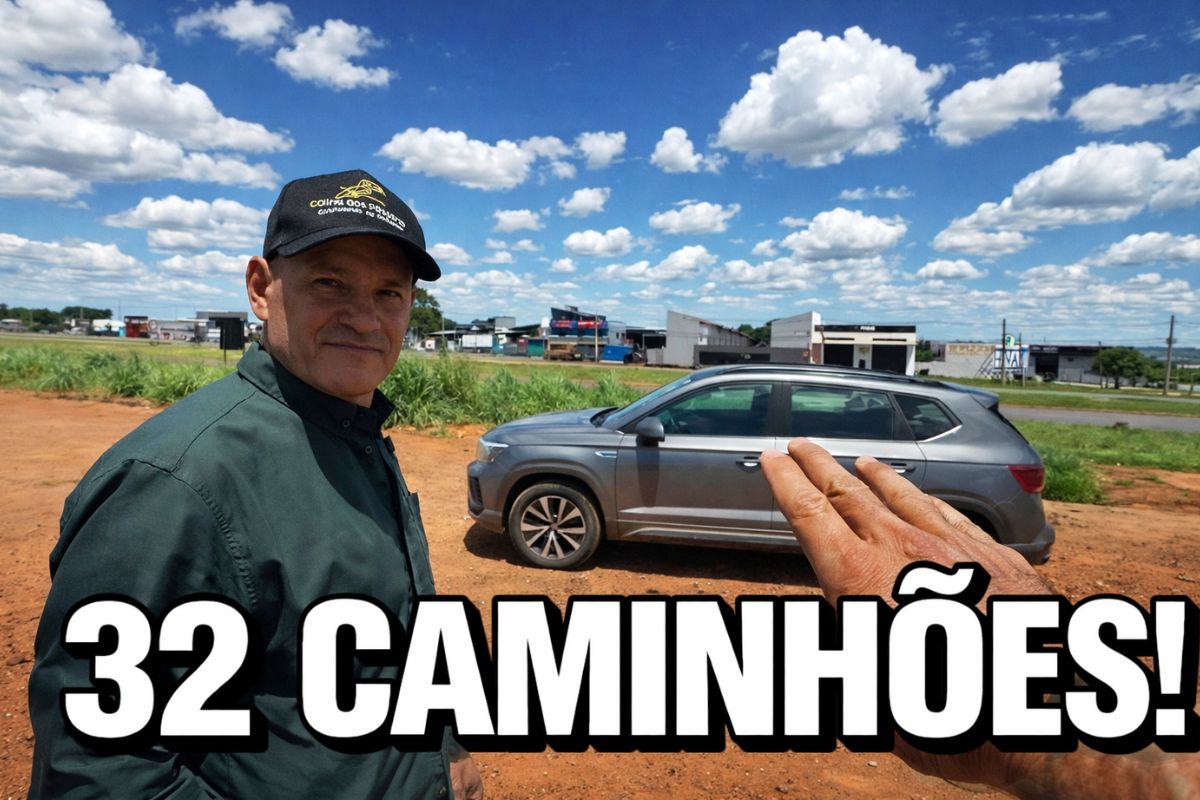
Broke After Crisis in Anápolis, Goiás Entrepreneur Leaves Daughters in Brazil, Goes to the United States, Returns in 2011, Trades Land on BR-060 for 32 Bitrem Trucks, Creates Condominium of Vacation Homes and Now Lives on Established Real Estate Income Along the Highway Between Anápolis and Brasília in a Planned Gated Community
The journey of a Goiás entrepreneur from Anápolis has once again caught attention by showing how a decision made back in 2003, in the midst of a crisis and in debt, paved the way for him to leave the country without selling a plot of land on the banks of BR-060 for a low price and return years later with 32 bitrem trucks in hand. Throughout the period from 2004 to 2011, he lived and worked in the United States to support his family, keep three daughters in college in Brazil, and preserve the asset that would later be exchanged for entire fleets of trucks.
Upon returning to Brazil in 2011, this same property on the highway had already appreciated significantly compared to the scenario of 2003, when the market was in crisis. The sale of the land, combined with the experience gained abroad, allowed the Goiás entrepreneur to reorganize his business, structure rental income with urban properties, and invest in a subdivision of vacation homes on BR-060, between Anápolis and Brasília, which now makes up the Colina dos Pássaros condominium and ensures the family’s income.
From the Crisis in Anápolis to the Decision to Go to the United States

The Goiás entrepreneur built his life in Anápolis since the 1970s, working with the buying, selling, and refurbishing of used trucks.
-
50 viaducts, 4 tunnels, 28 bridges, and 40 kilometers of bike paths: BR-262 in Espírito Santo will receive 8.6 billion reais for the largest engineering project in the state’s history, inspired by the Immigrant Highway in São Paulo.

-
Brazil produces too much clean energy and doesn’t know what to do with it: over 20% of solar and wind capacity was wasted in 2025 while investors flee and 509 renewable generation projects were abandoned in the last year.

-
Piauí will produce a new fuel that replaces diesel without needing to change anything in the truck’s engine and reduces pollutant gas emissions by half: truck drivers from all over the Northeast are already celebrating the news that will arrive later this decade.

-
A new Brazilian shopping center worth R$ 400 million will be built in an area equivalent to more than 4 football fields, featuring 90 stores, 5 cinemas, a supermarket, a college, and parking for 1,700 cars, potentially generating 3,000 jobs.


On a plot of approximately 24,000 square meters along BR-060, he set up a truck garage, heavily invested in a warehouse, and planned to live off the income generated by renting the space to transport companies.
A strong wind, however, destroyed the newly installed roof of the warehouse and compromised the capital that had been invested in the structure.
At the same time, three daughters of college age increased monthly expenses and pushed the budget to the limit.
Without cash flow, struggling to rotate the trucks, and facing the prospect of having to sell the property at a low price in the midst of a crisis, he decided to postpone the sale of the land and seek another way out.
The alternative he found was to follow the path of many Brazilians in the early 2000s and try to start over in the United States.
The idea, as he himself reports, was clear from the beginning: to go abroad to earn in dollars, pay off debts, support his daughters’ studies, and return to Brazil preserving the land on BR-060 for a better business in the future.
Seven Years of Hard Work in Dollars to Support the Family
Between 2004 and 2011, the entrepreneur and his wife lived in a U.S. city while their daughters initially stayed in Brazil.
He took on multiple roles sequentially: delivered newspapers in the early morning, maintained lawns at a golf club, worked in landscaping, and faced the heavy routine of the construction industry, seizing any opportunity to increase the income sent back to Anápolis.
His wife, who already had experience working in a beauty salon in Brazil, opened and operated a salon in the city where the couple lived, helping to boost their budget.
Over time, the daughters also spent some time living in the United States, but the plan was always to return.
Meanwhile, part of the money earned in dollars was directed towards purchasing an apartment in Anápolis, financed over about 30 installments and paid off with effort in approximately two and a half years.
At the end of this phase, in 2011, the family returned to Brazil.
The result of the experience was not a fortune accumulated abroad, but a set of structured assets: a paid-off apartment, maintenance of the land on BR-060, and the peace of mind of having navigated their daughters’ college years without having to sell the property “at a loss.”
The Exchange of the Land for 32 Bitrem Trucks and the New Phase in Transportation

When the Goiás entrepreneur returned to look at the highway land, the scenario had changed.
Between leaving for the United States in 2003 and returning in 2011, property prices in the Anápolis area had risen significantly, driven by the city’s expansion and the appreciation of logistical areas along BR-060.
The decisive negotiation came when he found, in his own words, “the right person at the right time.”
The land, with about 120 meters of frontage and a total area of 24,000 square meters, was sold for a much higher value than what could be achieved before the trip, in a deal that resulted in the delivery of 32 complete sets of bitrem trucks, with tractors and trailers, as well as a supplemental cash payment.
Not all the vehicles physically passed through the seller’s hands, as some were already operating in other states and were received “by number,” just with the documentation and contracts. Still, the asset jump was clear.
That property, which almost got liquidated during a crisis, ended up transforming into an entire fleet capable of repositioning the Goiás entrepreneur in the road transport sector and opening new sources of income.
From Cargo Transport to High-End Vacation Homes on BR-060
After successfully exchanging the land for trucks and reorganizing accounts, the entrepreneur began directing part of the capital towards long-term real estate investments.
In Anápolis, he built a building with nine residential apartments and a commercial space, which generates recurring income from rent.
At the same time, he and his family initiated a subdivision of vacation homes in a strategic area of BR-060, between Anápolis and Brasília, in the Abadiânia region.
The project, named Colina dos Pássaros, was planned with 126 lots of at least 1,000 square meters, with units of approximately 2,300 square meters facing directly onto the highway.
The proposal is to offer space for vacation homes and higher-end houses in a condominium surrounded by green areas, but close enough to both cities to allow for daily commuting to work.
In reports, the lots are offered starting around 150,000 reais, with affordable down payments and the possibility of installment payments over dozens of months, interest-free, directly with the owners.
The strategy combines future land appreciation with immediate cash flow from sales, focusing on an audience seeking larger spaces than traditional urban lots of 180 or 300 square meters.
Rental Income, Vacation Home Condominium, and a More Peaceful Life in Goiás
With the building of nine apartments and a commercial space rented in Anápolis, along with the house where he lives and the revenues from the subdivision on BR-060, the Goiás entrepreneur has become less dependent on the intense routine of transportation and more on real estate income diversified across several contracts.
He summarizes the result by stating that “it’s possible to live off this income,” after decades exposed to crises, high winds, debts, and uncertainties in Brazil and abroad.
Today, part of the family is dedicated directly to managing Colina dos Pássaros, showing land, overseeing infrastructure works, and handling the bureaucracy of licenses and deeds, considered one of the biggest obstacles for anyone trying to undertake in subdivisions in the country.
The former truck driver and second-hand dealer has become a local reference in an exclusive vacation home condominium, with an open view of the countryside and direct access to BR-060 between Anápolis and Brasília.
Given a journey where a land plot almost sold during a crisis turned into 32 bitrem trucks and now sustains a vacation home condominium on BR-060, do you think more Brazilians should follow the example of this Goiás entrepreneur and transform simple properties into long-term income, or is the risk still too high for those starting from scratch?









-

-

-

-

-

-

12 pessoas reagiram a isso.