





 Portuguese
  English
  Spanish
  3 min of reading


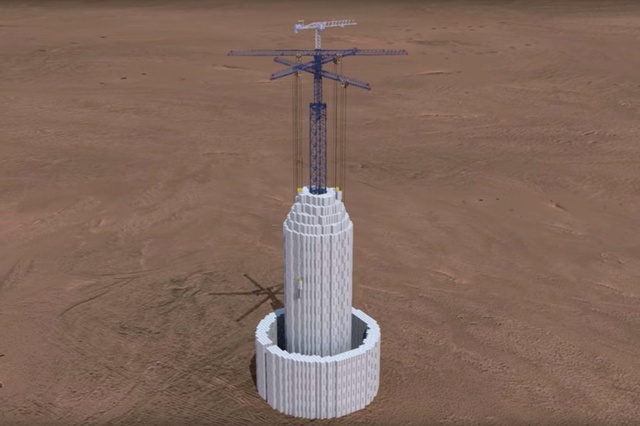
The Idea That Seems Trivial: Hoisting Concrete Blocks with Rope and Crane Using Renewable Energy and Then Lowering Them to Generate Electricity
Renewable energy is great in essence. But what to do when the sun doesn’t shine and there is no wind? The start-up company Energy VaultLink externo seems to have found an answer to one of today’s central questions. The difficulties of storing energy make nuclear energy and fossil fuels indispensable. This is the “Achilles’ heel” of renewable energy.
Also Read:
- Accident with Wind Turbines in Piauí Recorded on Video Scares Residents
- The Giant Wood Opens New Offshore Hiring Process to Work on 14 x 14 Schedule
- São Lourenço do Sul Could Get Wind Energy Industry and Create 2,000 Jobs
Solar and wind energy play an important role in the energy strategies of many countries. These renewable sources aim to reduce the consumption of fossil fuels, which emit CO2 and other polluting gases.
Moreover, it is necessary to find a substitute for nuclear energy due to its risks. However, the challenge is to store the produced energy and use it according to fluctuations in consumption during the day.
-
Renewable energy advances over protected areas in Brazil, and a survey by the Energy Transition Observatory reveals silent impacts that challenge environmental conservation and pressure sensitive traditional territories.

-
Rio Grande do Sul accelerates energy transition: State invests in renewable technologies and consolidates decarbonization strategies and pathways to attract billions in new industrial investments.

-
With 160,000 m² of collectors, an area larger than 20 football fields, Silkeborg, in Denmark, hosts a solar thermal plant that heats 19,500 homes and could become the largest solar heating plant in the world.

-
A study reveals the expansion of renewable energy procurement in Brazil and shows how companies are taking advantage of opportunities to reduce expenses, ensure energy efficiency, and strengthen strategic environmental commitments.


Words from Robert Piconi, CEO of Energy Vault
“We started looking for a solution two years ago,” says Robert Piconi, CEO of Energy Vault. He explains that the company chose not to invest in already known technologies such as batteries for storing electricity. “They require the use of chemical or metal substances, like lithium. Thus, they have a serious impact on the environment,” notes Piconi. Furthermore, the efficiency of batteries decreases with usage over time.
Concrete Instead of Water for Renewable Energy
The solution found by the young company consists of a gigantic tower of concrete blocks, each weighing 35 tons. A specially integrated crane with six arms moves the pieces – which resemble Lego toys – from top to bottom using renewable energy.
During the downward movement, caused by gravitational force, the stored energy is converted back into electrical energy, almost with no loss of energy. A special software automatically controls the charging and discharging process in the tower. Factors like wind, which could potentially affect the blocks and the tower, are also taken into account.
Principle of Pumped Storage Hydropower Plants
Furthermore, the system resembles the principle of pumped storage hydropower plants, which take advantage of the elevation difference between two water basins. This is a technology used for many decades. Water is pumped to the higher level when there is excess energy and electricity rates are low. When consumption is high, the water is drained, and the electricity generated is sold at higher rates. This is the most popular form: 96% of the energy stored in the world occurs through this process.
Robert Piconi admits there is a weakness in the system: “These plants can only be built in countries that have plenty of water, mountains, and financial resources.” However, in many of them, there is strong opposition due to concerns about environmental conservation. Researchers from the young company found a solution: “Our battery tower can be built anywhere. The costs are much lower, and the energy efficiency is 80%, higher than in pumped storage plants,” emphasizes Piconi.










Seja o primeiro a reagir!