





 Portuguese
  English
  Spanish
  3 min of reading


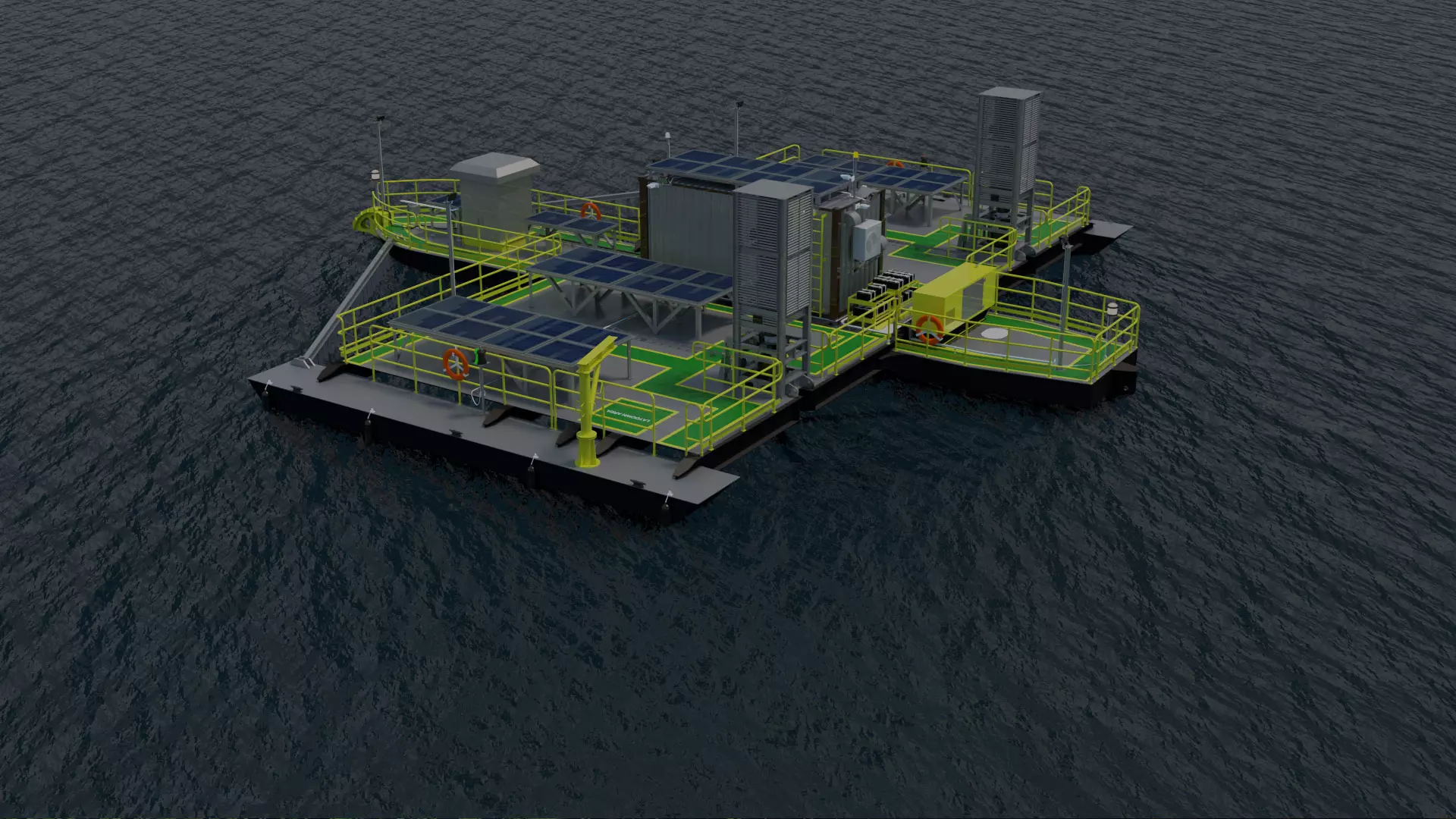
With the objective of reducing the impact on the environment through sustainable practices, the platform of Achelous Energy has focused on generating clean energy. This is being done through the power of tidal currents and the contribution of solar panels to achieve the result.
Achelous Energy, an English company, has an ambitious goal: to generate sustainable energy 24 hours a day, 7 days a week. To achieve this mark, the team developed a model based on a floating platform that uses the force of tidal currents and photovoltaic solar panels to generate energy for the population. With everything ready, expectations are high to see if the project is not only clean but also functional in practice.
The Entire Project Was Designed to Be Sustainable, Practical, and Minimally Invasive from an Environmental Perspective
The platform used by Achelous Energy has been named FITS: Floating Instream Tidal and Solar, still without a direct translation into Portuguese, but which refers to the forces that are received and converted into energy by the platform. Tidal and solar (photovoltaic solar panels).
With two sources of renewable energy, the goal of providing assistance to society continuously becomes easier to fulfill, as the two sources combine to meet public demand.
-
Renewable energy advances over protected areas in Brazil, and a survey by the Energy Transition Observatory reveals silent impacts that challenge environmental conservation and pressure sensitive traditional territories.

-
Rio Grande do Sul accelerates energy transition: State invests in renewable technologies and consolidates decarbonization strategies and pathways to attract billions in new industrial investments.

-
With 160,000 m² of collectors, an area larger than 20 football fields, Silkeborg, in Denmark, hosts a solar thermal plant that heats 19,500 homes and could become the largest solar heating plant in the world.

-
A study reveals the expansion of renewable energy procurement in Brazil and shows how companies are taking advantage of opportunities to reduce expenses, ensure energy efficiency, and strengthen strategic environmental commitments.


In technical terms, the FITS, the platform of the English company, is a moored floating unit. It uses two vertical axis turbines to take full advantage of the river flow, converting kinetic energy into electrical energy through a conversion process.
Furthermore, it is worth mentioning that the project was developed with other scenarios in mind as well. For instance, shallow rivers can accommodate the FITS comfortably, and it will still be possible to generate energy even without submersion. The electrical equipment, in these cases, would be positioned above the water, which would further facilitate maintenance if needed at any time.
In the context of large seas, the turbines are completely submerged. Thanks to the force of tidal currents, they are moved, thus occurring the phenomenon of hydrokinetic energy – the force of water being converted into electrical energy for the population.
Achelous Energy Highlights That the Method Is Advantageous Compared to Other Renewable Energies and Requires Less Financial Investment
From an environmental perspective, the team at Achelous Energy emphasizes that the FITS operates in a non-invasive manner, thereby reinforcing the sustainable nature of the initiative.
Additionally, the group also makes some comparisons when comparing the developed method with traditional hydroelectric energy, known for being harmful to nature. The FITS does not require dams or large structures to operate, which consequently reduces the costs necessary for it to function, as well as mitigates the strain on the environment.
When compared to renewable energy sources, the FITS also shows advantage. For onshore solar and wind farms, for example, a considerable amount of land is necessary for the initiative to take place, while Achelous Energy’s initiative does not depend on that.
So far, an agreement has been established with the Nepal Energy Foundation with the aim of conducting the first tests of the FITS and analyzing its functionality. This smaller-scale phase is essential to evaluate the project’s reach and envision how it will function on a larger scale.
With a floating platform capable of harnessing energy from tidal currents and photovoltaic solar panels, it is indeed possible to generate sustainable energy, as the English company is trying to prove.









Seja o primeiro a reagir!