





 Português
  Inglês
  Espanhol
  4 min de leitura
  12 comentários




Chinese Engineers Are Developing Super-Fast Submarine Technology Using Lasers As Underwater Propulsion, Capable Of Reaching Impressive Speeds That Rival Jet Aircraft
Can you imagine a submarine so fast that it has the capability to outrun even a torpedo fired to intercept it? This futuristic vision may be closer to reality than one thinks, thanks to an innovative propulsion technology that Chinese engineers believe is the key to creating the fastest submarines in the world.
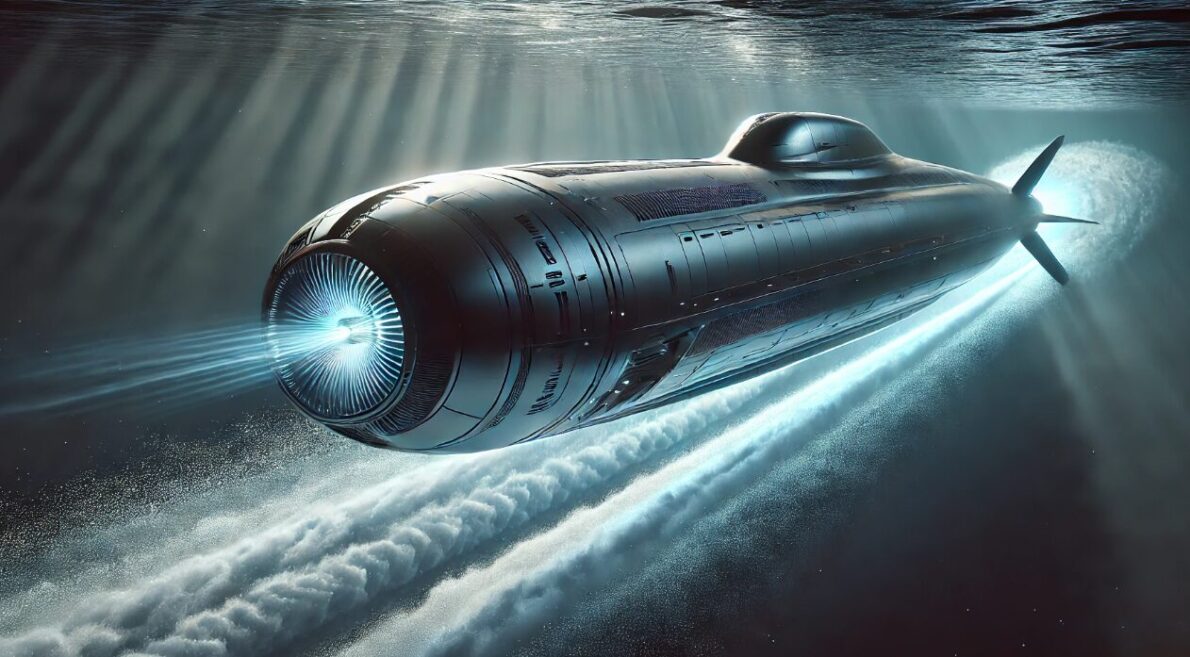
The Chinese proposal involves the use of “laser propellers“, an approach where small laser pulses create explosions that propel the submarine to speeds never before achieved.
Although this technology is theoretically possible, it comes with an important limitation: it could make submarines more vulnerable to detection, contradicting the basic principle of submarine warfare, which is to operate in silence.
-
A bright yellow mushroom imported from Asia escaped from a cultivation farm in the United States in 2010 and is now aggressively spreading across 25 states, destroying entire communities of native fungi in American forests.

-
Buried under China, a colossal machine weighing 20,000 tons began operating as the largest neutrino detector on the planet and, in just 59 days, surpassed results that science took half a century to achieve.

-
Iran enters the center of a climate alert after the war emitted 5.6 million tons of CO2 in two weeks, surpassing the annual pollution of entire countries.

-
Lunar exploration may change after a Chinese probe finds a “cavity” of radiation that reduces the impact on astronauts by up to 20% at certain times on the Moon.


How The Chinese Discovery Was Made
The newspaper South China Morning Post published in April 2024 the proposal of scientists from Harbin Engineering University.
According to them, the new technology uses lasers as a form of underwater propulsion, resulting in speeds comparable to those of jet aircraft. This technology was actually originally proposed in 1972 to propel spacecraft.
In the case of aircraft, the concept involved superheating the air beneath them with a laser, creating a plasma explosion that propelled them upward.
Now, the same principle is being applied to submarines. The scientists from Harbin believe that the use of lasers could not only increase submarine speed but also make them quieter by eliminating the use of conventional turbines and propellers.
If this theory is confirmed, we would be looking at a significant advancement in underwater mobility.
How Laser Underwater Propulsion Works
The underwater laser propulsion process involves coating the submarine with a network of extremely thin optical fibers. These fibers are traversed by lasers powered by a two-megawatt energy source.
When the lasers come into contact with the water, they create a plasma that vaporizes the liquid, generating thrust. This phenomenon also creates a bubble barrier around the submarine, reducing friction with seawater.
This method generates a force of up to 70,000 newtons, something unprecedented for underwater vehicles. For comparison, these forces are comparable to those generated by aircraft flying at hundreds of miles per hour. This technology could theoretically allow submarines to move faster than the speed of sound.
Additionally, without propellers and turbines, the submarine could travel with much less noise, potentially gaining an advantage over its adversaries.
The Limitation Of Cavitation
However, there is a major problem. Most submarines use propellers to move underwater. When a propeller spins rapidly, it creates pressure in the surrounding water, generating enough heat to boil the water and create small bubbles. These bubbles, in turn, burst and produce noise, something known as cavitation.
This sound is similar to the noise of stones being thrown inside a pipe and is easily detected by passive sonar systems that capture sounds in the ocean without needing to emit signals.
Cavitation is a nightmare for submarines seeking to remain undetected. While the use of laser propulsion may solve the traditional cavitation problem of propellers, it creates another challenge: the noise generated by the plasma formed by the laser explosions.
Even if the submarine moves quickly, the sound it would make would be easily picked up by enemy sonar systems, making it an easy target for aircraft and other submarines.
A Dilemma For China
The new laser propulsion technology presents a dilemma for Chinese engineers. While the submarine’s speed would be impressive, the noise generated by the propulsion would make the vessel extremely vulnerable to detection.
Noisy submarines, as experts say, are dead submarines. In underwater warfare, stealth is as important as speed.
Even if a Chinese submarine outpaced its adversaries, it would be easily tracked and eventually would need to stop—and at that moment, it would be an easy target for aircraft or other anti-submarine weapons.
The fact that the research has been made public indicates that, for the Chinese government, this technology holds limited value in the military field. When truly innovative technologies are discovered, they are often kept secret, as was the case with the stealth fighter F-117A Nighthawk, which the U.S. kept hidden for almost a decade.







A maior limitação ao meu ver acredito ser os obstáculos que tem debaixo da água do mar no espaço e altitude não tem rochas nem outros obstáculos.
A razão de submarinos terem sido criados é sua capacidade de ataque em surpresa. Sem isso não há motivos para existirem, melhor uma fragata lotada de mísseis inteligentes.
😅😂🤣🤣🤣🤣🤣🤣