





 English
  Francês
  Alemão
  Italiano
  Japonês
  Norueguês
  Portuguese
  Spanish
  4 min of reading
  0 comments


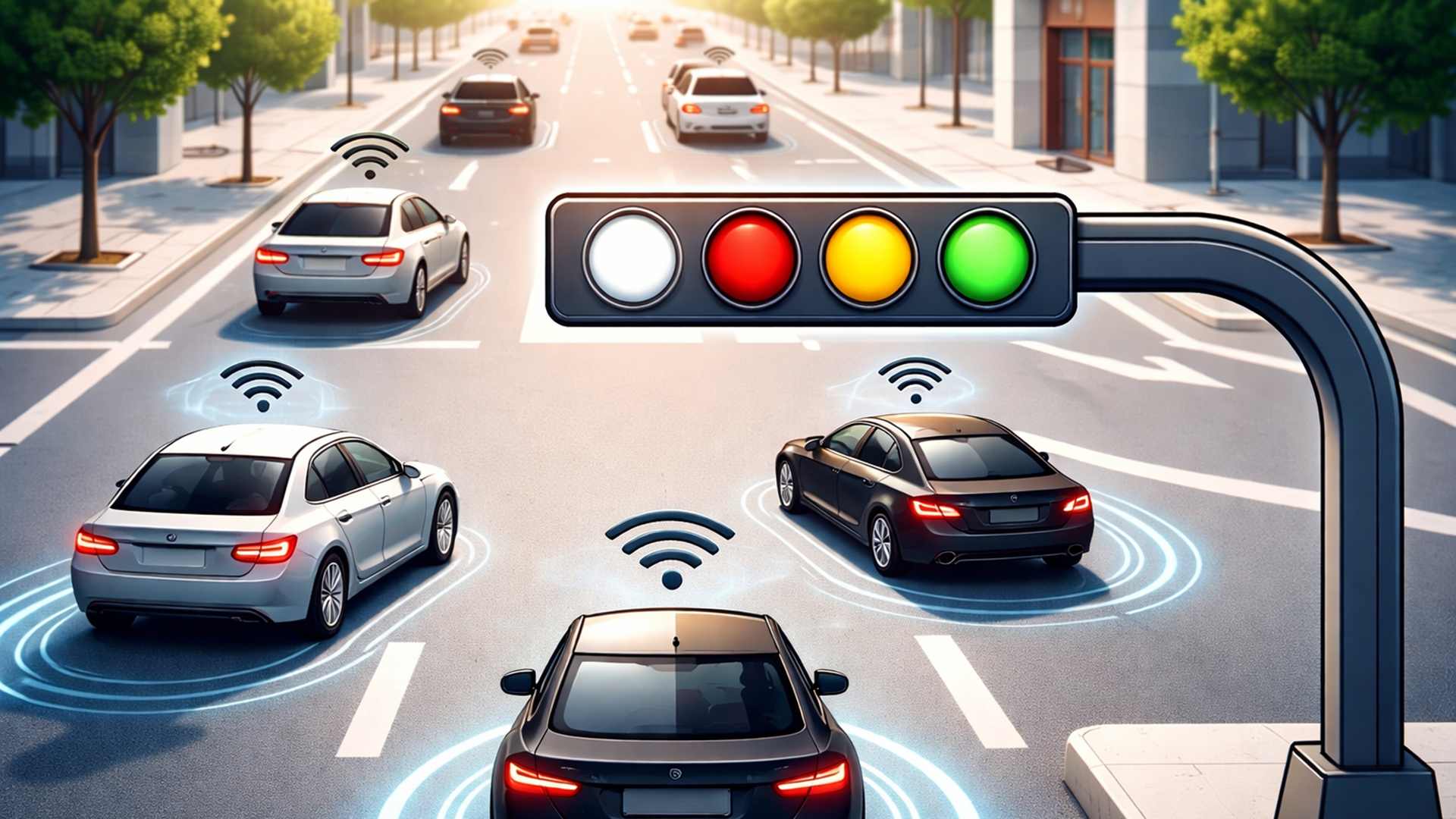
The proposal for a new traffic light with a white phase was presented by engineers to allow connected autonomous vehicles to organize passage at intersections, reduce delays in flow, and change the way human drivers interact with traffic
The traffic light may gain a new color at intersections with autonomous vehicles, according to a proposal from transportation engineers at North Carolina State University. The idea envisions the creation of a fourth phase, called the white phase, to allow connected autonomous cars to coordinate traffic flow directly at the intersection, while human drivers simply follow the vehicle in front.
The proposal stems from a critique of the traditional functioning of traffic signals, marked by stops, waiting at red, and slow resumption of movement when the signal turns green.
In this model, the natural delays of human reaction cause traffic to flow gradually again. With the new approach, part of this management would no longer depend solely on the traffic light and would be shared with the autonomous vehicles themselves.
-
Chevrolet Suburban Z71 lands in Brazil with a V8 engine, off-road design, air suspension, seven seats, and colossal size, a rare version imported for around R$ 1.3 million with luxury and exclusivity.
-
The Chevrolet Onix 1.0 turbo achieves 17.7 km per liter on the highway and ranks among the three most economical cars in Brazil in 2026, alongside two more expensive Toyota hybrids available at dealerships.
-
Little sister of the Hilux: Toyota launches Land Cruiser FJ with 4 radical versions, 2.7 engine with 166 hp and 4×4 traction with locking.
-
Fiat retired the ‘unbreakable’ engine that runs over 300,000 km after 40 years, but the models remain among the best-selling in Brazil.

According to the researchers, the white phase would be activated when a sufficient number of autonomous vehicles approached an intersection. From that point, these vehicles would begin to communicate wirelessly, negotiate the right of way, and form platoons. Upon reaching this critical mass, the traffic light would change to white, indicating a new mode of circulation for all road users.
How the white phase would work at the traffic light
In practice, the concept transforms autonomous vehicles into active agents of traffic organization. Instead of waiting for a conventional traffic light to dictate each movement, connected cars would take on the role of managing vehicle flow directly from the street, in an operation described by the researchers as highly orchestrated.
Ali Hajbabaie, associate professor of civil, construction, and environmental engineering at NC State, states that the concept leverages the computational power of the autonomous vehicles themselves. According to him, the proposal for intersections, called the white phase, utilizes the capacity of these vehicles to coordinate circulation on-site in an integrated manner.
In this system, the new color does not completely replace the already known signals. Red lights would still mean stop, green would continue to indicate that it is allowed to go, and white lights would guide drivers to simply follow the car in front.
The proposal, therefore, maintains the basic logic of the traffic light but adds a step aimed at coexistence between human driving and vehicle autonomy.
The role of autonomous vehicles and human drivers
The central idea is that, in a scenario with a sufficient presence of connected autonomous vehicles, these cars can communicate with each other to organize passage through the intersection. They would negotiate priorities and group into platoons, allowing movement to occur continuously, without relying solely on the traditional alternation between red and green.
For human drivers, the logic would be simpler. Instead of making decisions based on a complex reading of the movement around, it would be enough to follow the robot in front. The authors of the proposal argue that this dynamic could reduce the effects of human delay in reaction to the traffic light and contribute to a more efficient flow at intersections.
The concept is presented as an adaptation to the advancement of a future of mixed autonomy, where autonomous vehicles and human-driven vehicles will share the same roads. In this context, road infrastructure would need to adjust to new forms of circulation. The white light would thus emerge as a transitional element within this process.
Where the proposal could be tested first
The researchers assess that the first practical applications of the white phase should occur in controlled environments with high traffic volume.
The choice of these locations relates both to the need for greater operational predictability and the possibility of gathering, at certain points, a higher concentration of autonomous vehicles capable of activating the new control model.
Hajbabaie states that several elements of the concept could be adopted with minor modifications at intersections and also in existing autonomous vehicles.
He also believes that there are concrete opportunities to test the approach in specific locations, which would pave the way to verify its functioning outside of conceptual simulations.
Among the examples cited by the researchers are ports, which concentrate a high volume of commercial vehicle traffic and rely heavily on road fluidity. In this type of environment, vehicle flow is considered particularly important. Furthermore, commercial vehicles, according to the proposal, seem to exhibit higher rates of adoption of autonomous vehicles, which could favor the implementation of a pilot project.
In the authors’ assessment, a test in a port context could benefit both internal traffic and commercial transport.
The proposal is presented as a response to the need for infrastructure adaptation in light of the expansion of autonomous systems. In this scenario, the traffic light with a white phase would cease to be merely a signaling element and would begin to act as part of a coordinated network between road technology and connected vehicles.







Seja o primeiro a reagir!