





 Portuguese
  English
  Spanish
  5 min of reading
  1 comment


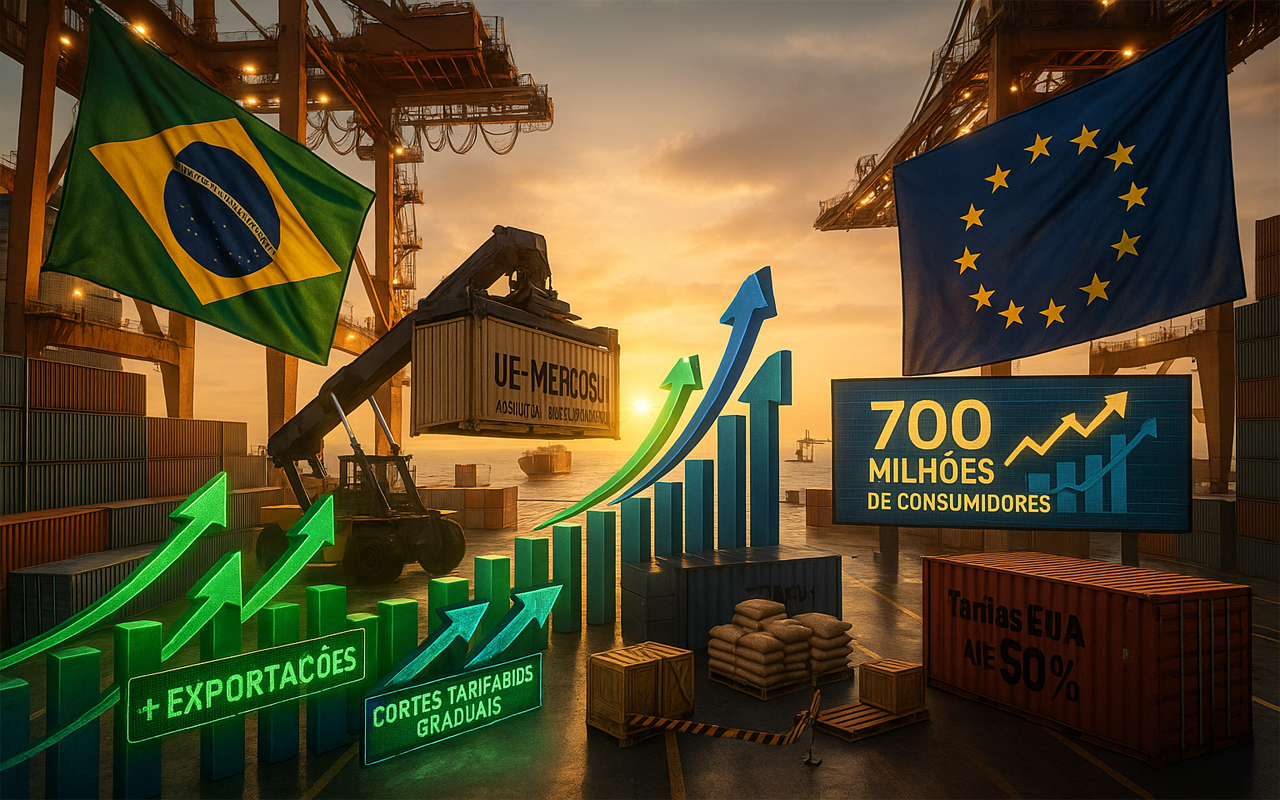


The European Commission Adopted on September 3, 2025, the Proposals to Sign and Conclude the EU-Mercosur Agreement. The Move Comes as the US Raises Tariffs. Understand What Was Decided and What Brazil Can Gain.
The advancement of the EU-Mercosur Agreement comes at a sensitive time for Brazilian foreign trade. With higher tariffs in the United States and the end of exemptions for small shipments, companies are rushing to rethink markets and logistics. For Brussels, the initiative strengthens trade diversification and regulatory predictability between two blocs that, together, create a market of hundreds of millions of consumers.
According to the European Commission, on September 3, 2025, formal proposals were submitted to the EU Council for signature and conclusion of two instruments: the EU-Mercosur Partnership Agreement (EMPA) and an Interim Trade Agreement. The interim agreement will remain in effect until the EMPA is fully ratified. Approval will still be needed from the governments, the European Parliament, and, as per internal requirements, national parliaments.
Meanwhile, trade with the US has become more challenging. The American government ended the de minimis threshold of US$ 800 starting August 29, 2025, and began enforcement on the same day. The new rule affects low-value shipments, imposing tariffs and more complex procedures for operators and carriers.
-
A new Brazilian shopping center worth R$ 400 million will be built in an area equivalent to more than 4 football fields, featuring 90 stores, 5 cinemas, a supermarket, a college, and parking for 1,700 cars, potentially generating 3,000 jobs.

-
Larger than entire cities in Brazil: BYD is building a 4.6 km² complex in Bahia with a capacity for 600,000 vehicles per year, but the discovery of 163 workers in conditions analogous to slavery has shaken the entire project.

-
With an investment of R$ 612 million, a capacity to process 1.2 million liters of milk per day, Piracanjuba inaugurates a mega cheese factory that increases national production, reduces dependence on imports, and repositions Brazil on the global dairy map.

-
Brazilian city gains industrial hub for 85 companies that is equivalent to 55 football fields.


What the EU Approved and What Is Still Needed
There was no final “ratification.” The Commission proposed that EU countries politically decide on the signature and conclusion of the texts, a preliminary step before legislative processing. The plan calls for the use of an interim agreement to bring forward benefits until the EMPA is fully implemented, reducing uncertainties for companies on both sides.
Among the terms already disclosed, the EU promises to cut tariffs on 92% of Mercosur exports over a period of up to ten years, while Mercosur will eliminate tariffs on 91% of European exports in the timeframe of the agreement. Cars and auto parts will see gradual reductions over up to 15 years, and sensitive agricultural products will be subject to quotas.
The Commission also introduced safeguards and monitoring to respond to spikes in imports or sharp drops in prices in sensitive sectors. Recent signals include an agricultural crisis fund and triggers to limit flows when there is a risk to European producers.
Why Timing Matters for Brazil, US Tariffs, and the End of De Minimis
The regulatory shift in the US has increased costs and paralyzed international shipments. After the end of the de minimis level of US$ 800, global mail traffic to the United States dropped 81% in the week the rule took effect, and 88 postal operators suspended part or all shipments, according to the UPU. For small businesses and consumers, costs rose and predictability fell.
The CBP confirmed that it began implementing the executive order on August 29, requiring formal entry and tax payment for low-value shipments. The Federal Register detailed the suspension of benefits for shipments, reinforcing the immediate change in the customs process.
The impact is already reflected in Brazilian data. In August, the first month with the new US tariffs in effect, Brazil’s exports to the US fell by 18.5%, even with a larger surplus in the total balance. Sectors like aerospace, sugar, and machinery were the most affected.
Obstacles and Safeguards, French Agriculture, Environment, and Politics
Despite the progress, the European path is not clear. French farmers continue to press against the agreement due to concerns over unfair competition and distinct environmental standards. Resistance involves France and allies, with protests and signs of political veto if there are no compensatory measures.
To calm Paris and other critics, Brussels is discussing protection clauses and a “political protocol” with circuit breakers to limit imports in case of damage to producers, as well as a financial package for the sector. The Financial Times reported the intention to approve clearer safeguards, with monitoring of volumes and prices and the possibility of quick measures.
Environmentalists and some members of Parliament remain skeptical about the enforceability of climate commitments. The debate contrasts the strategic gains of diversification and industrial integration against internal pressures from sensitive segments, which may extend timelines and require adjustments before voting.
How Much Brazil Can Gain, GDP, Investments, and Market Access
A study by Ipea estimates that between 2024 and 2040, the agreement could raise Brazil’s GDP by 0.46% and increase investments by 1.49%, equivalent to US$ 9.3 billion at 2023 prices. Projected gains for Brazil exceed those of the EU and other Mercosur countries overall.
For the industry, tariff reductions help lower the cost of machines, inputs, and technology coming from Europe, with effects on productivity and competitiveness. In agriculture, quotas and timelines outline gradual opening, which requires logistical planning and regulatory adjustments to capture the windows of European demand.
On the European side, analysts highlight the potential of a combined market close to 700 million consumers, an argument used by proponents of the pact to reduce dependence on other poles and offset losses related to US tariffs.
What Comes Next, Signature, Ratification, and the Political Window
With the proposal already on the EU Council’s table, the next step is the political decision by governments. After that, the European Parliament needs to give its consent. Depending on the legal framework, some national parliaments will still need to vote. It is a multi-step process, susceptible to delays if resistance from key countries persists.
There is anticipation for acceleration to seize the political moment, but approval “is not guaranteed.” The negotiation of safeguards and clearer environmental commitments is seen as a condition to make the timeline feasible. For Brazilian companies, the message is to prepare market strategies for the EU while seeking to mitigate the regulatory shock in the US.
In practice, those who move first are likely to capture the transition better: adjusting rules of origin, sanitary certifications, positions on quotas, and mapping European customers become urgent tasks for 2025 and 2026, a period of likely intensification of negotiations.
And what do you think? Can the EU-Mercosur agreement offset US tariffs and open a more stable route for Brazilian exports, or do you fear that safeguards and environmental requirements will create new barriers and little real market supply? Leave your opinion in the comments.








O Mercosul tem de fazer um acordo com o mundo árabe!!..😁👍