





 Português
  Inglês
  Espanhol
  5 min de leitura
  0 comentários



Discover How Infrastructure Strategies Impact Urban Development, The Economy, And The Job Market, And Why Understanding This Topic Is Essential For Professional Future.
Infrastructure has always been one of the strongest foundations for the growth of a society.
Since ancient times, civilizations like the Egyptian one have shown how planning and building roads, aqueducts, and bridges were vital.
The construction of transportation systems, such as Roman roads, for example, facilitated the expansion of the empire.
-
Employee Fired After Accumulating 114 Days of Medical Leave in One Year, Labor Court Upholds Company’s Decision

-
Employee Fired While Treating Depression Wins in Court and Vale Is Required to Rehire Him Following Decision Based on the CLT and INSS Benefits

-
Workers Should Be Aware! March 6 Will Be The Fifth Business Day Of March And The Final Deadline For Companies To Pay Salaries According To The CLT

-
2026 FGTS Anniversary Withdrawal Is Released According to Birth Month, Sets Amounts by Balance Range, Establishes Deadlines for March and April, and Changes Rules in Case of Dismissal


This type of infrastructure was a fundamental pillar for the stability and power of the Roman Empire, and its legacy is evident even today.
Over the centuries, infrastructure strategies have undergone profound transformations, reflecting technological development.
The changes in human needs and the emergence of new forms of urban and rural spatial organization.
In the 19th century, the Industrial Revolution brought a significant increase in demand for infrastructure, such as railways, bridges, and factories, essential for the new economic model.
Today, speaking about infrastructure goes far beyond large civil engineering works. In fact, we are dealing with an expanded concept that involves logistics, mobility, energy, sanitation, digital connectivity, housing, and effective public policies.
This, in turn, directly impacts the job market and the lives of the population.
Therefore, understanding the strategies behind these systems is essential for professionals from various fields.
According to the Ministry of Infrastructure of Brazil (2021), with the advancement of cities and the evolution of technologies, infrastructure planning has become increasingly sophisticated.
It is no longer just about building access roads or expanding power distribution networks.
It is also about thinking about how cities can adapt to future challenges, such as population growth and climate change.
The Evolution of Infrastructure Strategies Over Time
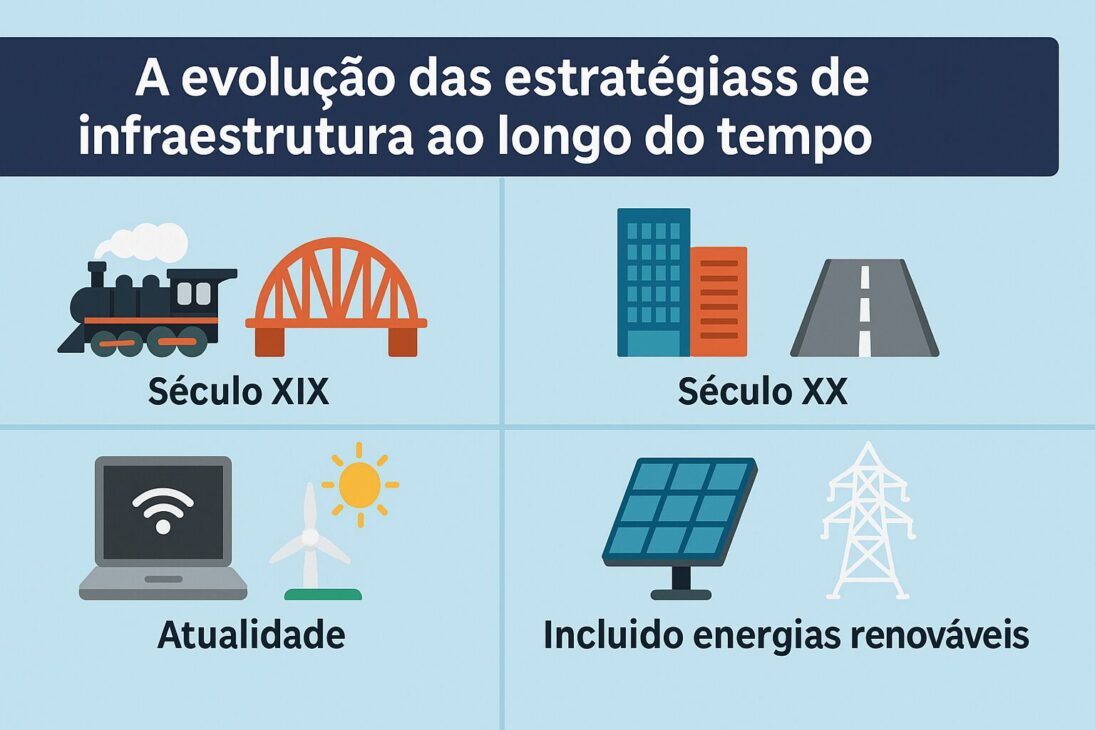
During the 19th century, with the Industrial Revolution, the need to integrate transportation and supply systems grew exponentially.
Railroads revolutionized transportation and enabled trade between different regions.
According to the Ministry of Infrastructure of Brazil, this period was crucial for creating strategic infrastructures in European and American countries that enabled industrial growth.
By the 20th century, with the advancement of cities and the rise of the urban population, governments began to think of urban planning as a tool for organizing and distributing resources.
In this context, the first infrastructure strategies emerged that considered long-term impacts, such as the construction of sewage networks, water supply systems, public transportation, and highways connecting different regions.
These strategies, often led by public bodies in partnership with private companies, aimed to meet not only immediate demands but also prepare the ground for future growth.
Today, these strategies have gained a new dimension. In addition to physical infrastructure, we must consider the digital.
The inclusion of high-speed internet, data networks, smart urban management systems, and renewable energy has become an essential part of modern city planning.
The Ministry of Science, Technology, and Innovations of Brazil, in a 2021 report, highlights how digital innovations are transforming urban infrastructure, emphasizing the importance of smart cities and connectivity in the future of metropolises.
The Role of Infrastructure Strategies in The Job Market
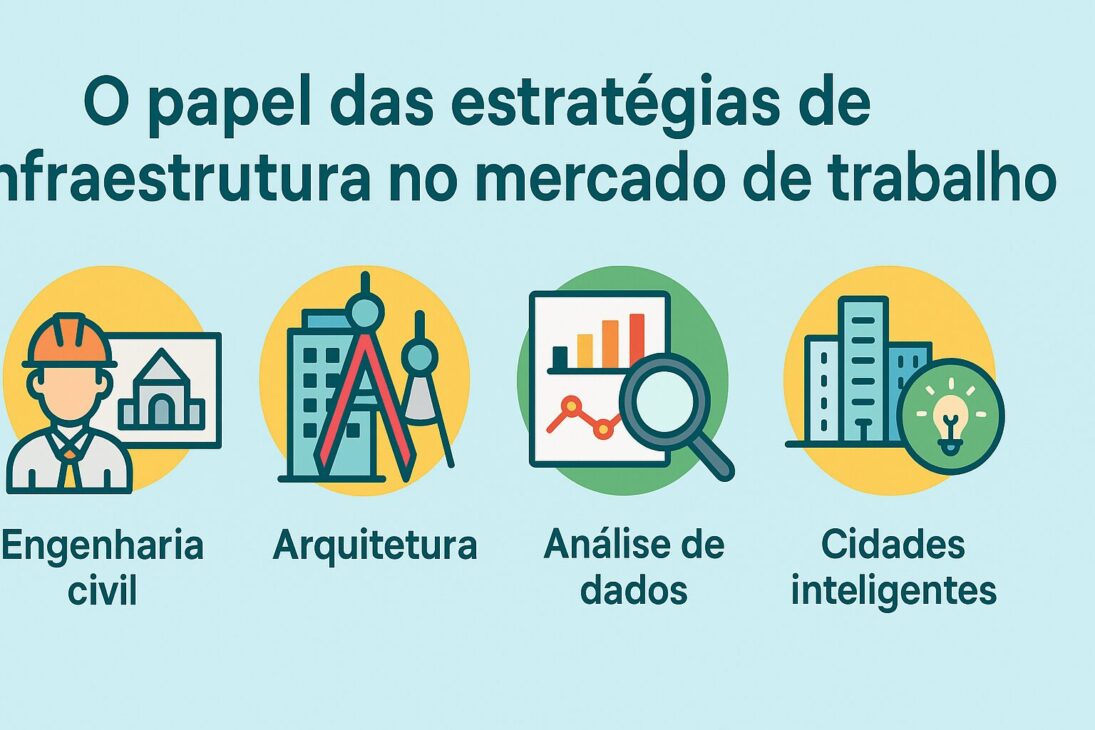
Infrastructure strategies not only shape the space we live in but also create thousands of job opportunities in various areas.
Professions like civil engineers, architects, urban planners, building technicians, environmental managers, and data analysts are essential for developing projects that ensure the efficiency of works and the quality of solutions.
Moreover, with technological advancement, new professional profiles are being integrated into this market.
Experts in smart cities, sustainable energy management, urban mobility, and digital logistics are increasingly sought after by companies and governments.
The Brazilian Institute of Geography and Statistics (IBGE) reports, in its latest survey on the job market (2022), that the infrastructure and construction sector registered a significant increase in demand for qualified labor, reflecting the growth of urban strategies in Brazil.
Companies operating in the construction, electricity, telecommunications, sanitation, and transportation sectors need qualified professionals.
Not only to execute the works but also to plan, analyze risks, ensure sustainability, and efficiency.
The Brazilian Association of the Construction Materials Industry (ABRAMAT) states that sustainability, digitalization, and adaptation to new technologies are now determining factors for the success of these companies.
Thus, these professionals are essential to ensure that infrastructures are not only well-built but also adaptable to future needs.
This landscape reflects a transformation in the job market, where innovation and sustainability are the pillars.
Therefore, professionals need to continuously update themselves, seeking creative solutions to address the challenges posed by city growth and the scarcity of natural resources.
Sustainable Development as a Strategic Guideline
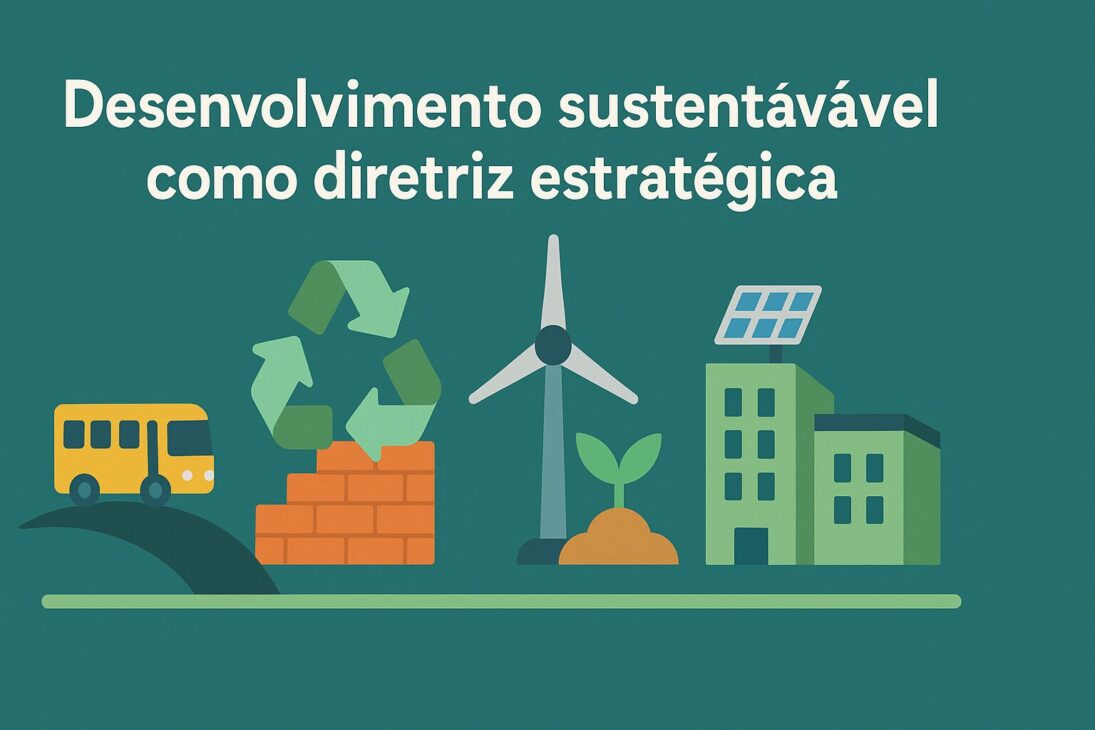
With climate change and the growing concern for the environment, infrastructure strategies have begun to incorporate concepts of sustainable development.
This means that, in addition to building, it is necessary to think about how to maintain, preserve, and adapt existing structures without compromising natural resources.
This new perspective also requires professionals to have a broader education that considers social, environmental, and economic aspects in planning and executing works.
That’s why many universities and research centers are adapting their curricula to meet the new demands of the sector. The integration of emerging technologies with sustainable practices is generating a fertile ground for innovation and job creation.
Thus, sustainability in infrastructure also requires a review of traditional business models.
Companies need to rethink their practices, adopting greener and more resilient solutions without losing sight of the need to meet the growing demand for efficient and quality urban services.
The Role of Public Authority and Private Initiative
Infrastructure strategies are the result of a combination of political will, public investment, and the action of the private initiative.
In countries that consistently invest in infrastructure, the benefits are felt at various levels of society: improvement in quality of life, job creation, reduction of regional inequalities, and increased competitiveness in the international market.
Brazil, for example, has an extensive territory with significant logistical challenges.
For this reason, governments at all levels need to develop long-term plans and public-private partnerships that are sustainable and effective.
These plans must consider not only current needs but also future trends, such as population growth, the use of emerging technologies, and climate transformations.
An example of this is the projects for revitalizing degraded urban areas, which have brought positive results both socially and economically, according to the report from the Institute of Applied Economic Research (IPEA).











Seja o primeiro a reagir!