





 English
  Francês
  Alemão
  Italiano
  Japonês
  Norueguês
  Portuguese
  Spanish
  3 min of reading


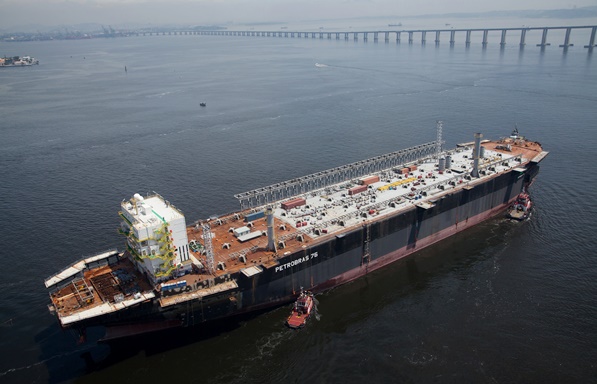
The Possibility of Leveraging Brazil’s Potential in the Shipbuilding Industry Through the Delivery of FPSO P-76 and Thinking About a Better Future for the Job Market in the Country
One of the units that will help Petrobras achieve its goal of increasing oil and gas production is the P-76, which is currently at the Pontal do Paraná shipyard. The project is unusual due to the high level of local content (70%), symbolizing the capability of the Brazilian shipbuilding industry. The FPSO will be delivered by Techint by the end of this year, a renowned company recognized in the industrial and oil sectors for the good work it has done.
According to Techint’s commercial director Luís Guilherme Sá, the P-76 serves to show that the national market is fully capable of meeting the demand for new drilling platforms. However, there are challenges ahead after the delivery of the ship; unfortunately, layoffs will be necessary due to the lack of new ventures, but a minimum level of activity will be maintained.
The P-76 platform is considered a successful project that is currently being completed, generating about 5,000 jobs in the Pontal do Paraná region. It has shown that Brazil can indeed produce competitive local content, and a positive change is expected, including the contribution made to ANP, which conducted technical studies, concluding a balance between competitiveness, local industry valuation, and companies that invested in the country.
-
Government unlocks R$ 554 million for a highway that has been requested for decades and accelerates the duplication of BR.
-
Without bricks, without cement, and without endless construction: the cardboard house that is assembled in modules and can be moved.

-
Billions of barrels on the equatorial margin could lead Amapá to double its oil production in Brazil — the state aims to enter the route of companies in the Campos Basin, attract investments, and boost jobs and businesses in the oil and gas sector.
-
Without bricks, without cement, and without endless construction: the cardboard house that is assembled in modules and can be moved.

The sector still needs to overcome the biggest challenge, which is to raise government awareness to consider the study conducted by ANP. This is because there is currently an inconsistency, with the National Petroleum Agency stating that the industry can meet 40% of local content, while the government has set a local content index of 25% for future auctions defined in 2017 without a very clear technical criterion.
In the short term, add-ons will be offered in a series of opportunities for the market, and that is where bets and beliefs regarding the impacts of these add-ons are being credited. This decision regarding local content is not something incomprehensible, as it involves thousands of people. Considering that when speaking of a project going to China, it involves 5,000 direct jobs going to Asia and another 10,000 indirect jobs. This is sad, as Brazil is not valuing what is most valuable, which is its workforce.
Techint hopes that with all these changes, future projects will emerge within the new model of 40% local content, and the P-76 will not just be another project completed at the end of the year, but a stepping stone for new projects generating more jobs and growth for the Brazilian shipbuilding industry.
Oceaneering Kicks Off the Week with Offshore, Onshore, and Administrative Openings









Seja o primeiro a reagir!