





 Portuguese
  English
  Spanish
  5 min of reading
  0 comments


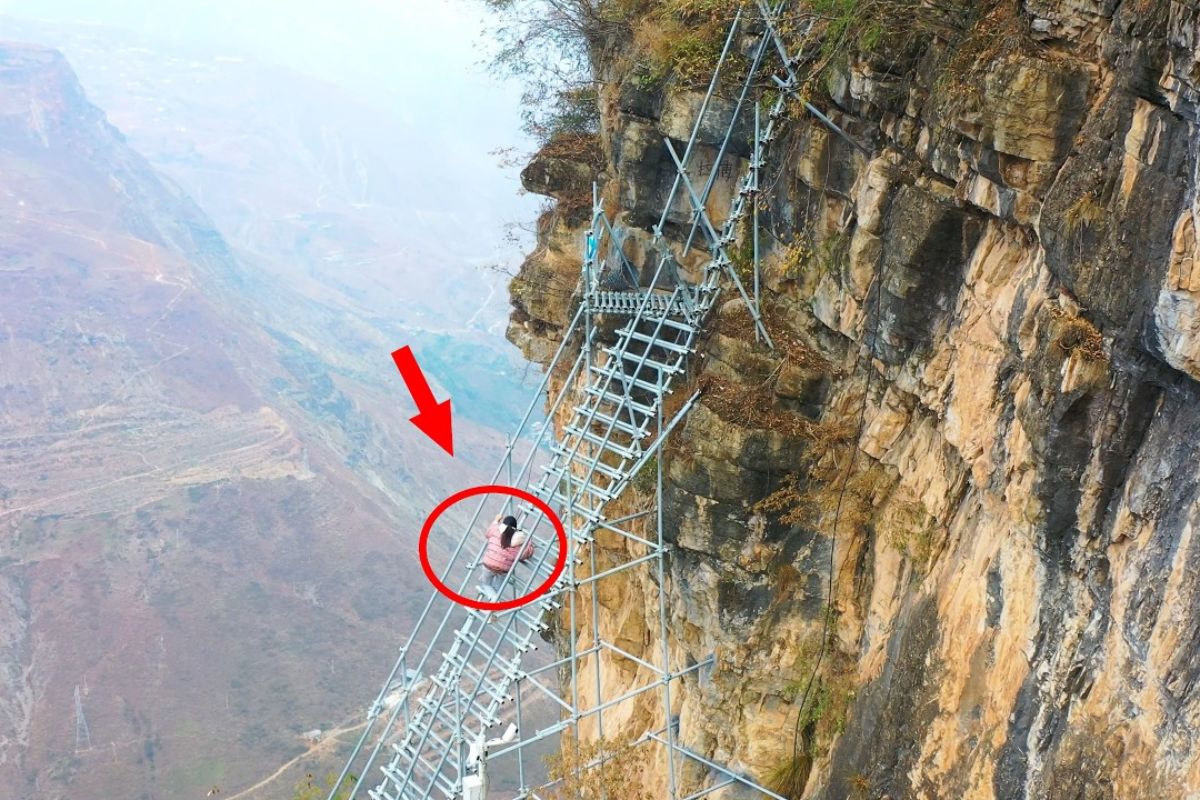
With an Almost Vertical Angle, Abyss on the Left and Right, Barren Ground and Straight Sections Over the Void, the Staircase on the Cliff Imposes a Test of Body and Mental Control That Many Describe as Much More Difficult on the Way Back Than on the Way Up.
On Daliang Mountain, the staircase on the cliff alters the logic of the trail: going up requires breath and consistency, but going down brings the body closer to the void, shifts the weight forward, and makes reading the step a decision in split seconds. The section that “seems simply straight” reveals itself to be almost vertical, with a real feeling of ninety degrees and abyss on both sides.
The narrative of those descending confirms the pattern: vertigo appears exactly when the gaze falls into the canyon and the brain loses depth references. Legs tremble, the center of gravity wobbles, the backpack becomes an obstacle, and the natural impulse is to grab the steps with hands and feet to regain stability. The psychological clock stretches, and half an hour begins to feel like an eternity.
Why the Descent Weighs More Than the Ascent
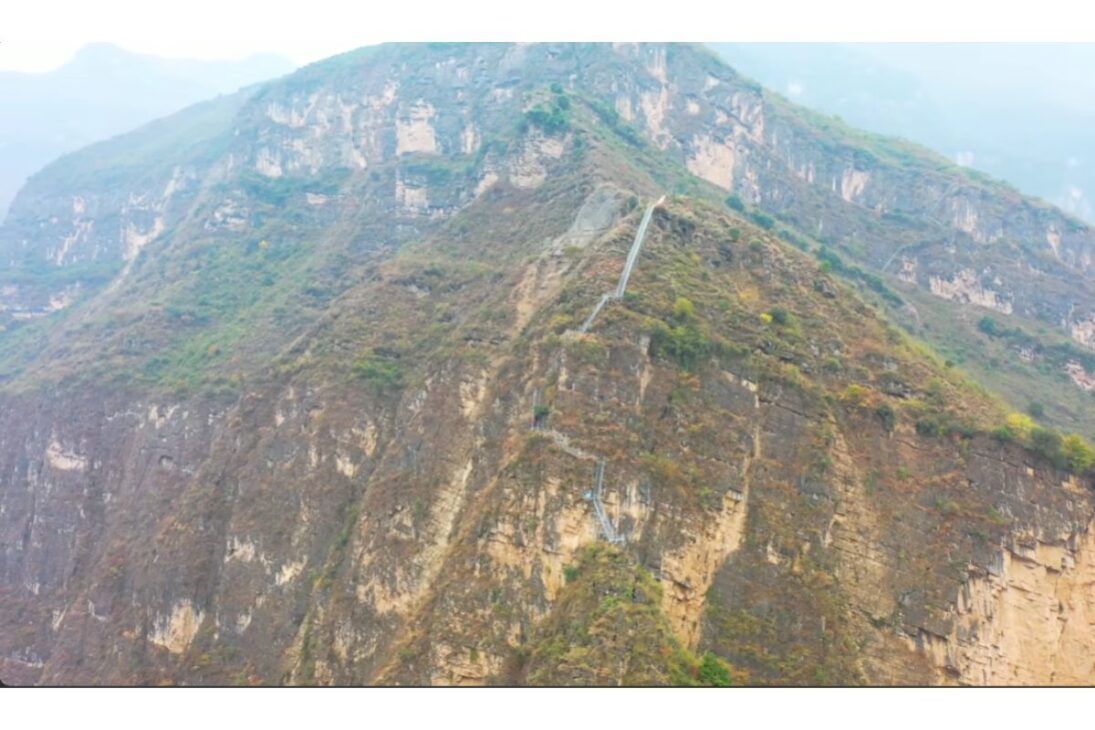
On the ascent, the body exerts force against the step while the gaze seeks the rock ahead.
-
Friends have been building a small “town” for 30 years to grow old together, with compact houses, a common area, nature surrounding it, and a collective life project designed for friendship, coexistence, and simplicity.

-
This small town in Germany created its own currency 24 years ago, today it circulates millions per year, is accepted in over 300 stores, and the German government allowed all of this to happen under one condition.

-
Curitiba is shrinking and is expected to lose 97,000 residents by 2050, while inland cities in Paraná such as Sarandi, Araucária, and Toledo are experiencing accelerated growth that is changing the entire state’s map.

-
Tourists were poisoned on Everest in a million-dollar fraud scheme involving helicopters that diverted over $19 million and shocked international authorities.


On the descent, the gaze falls into the void, the sole needs to “feel” the support without seeing it fully, and any hesitation shifts the weight to the wrong edge.
The result is greater mental energy expenditure per step, even when the total distance is the same.
There is also the factor of accumulated fatigue. Half the day has already been spent in the ascent, and the return begins with partially exhausted muscles.
Joints and hips start absorbing impact with each weight transfer, which explains the feeling of “softened” legs on the vertical sections.
Center of Gravity and Body Control
The critical point is where the center of gravity falls in relation to the support foot. If it advances too much, the body “pulls” forward; if it retreats, it lacks reach for the next step.
On cold, smooth rock, micro-slips multiply instability, forcing one to reduce step length and to support with the whole sole.
Managing this axis is dynamic: slightly bent knees, torso slightly inclined, and short steps reduce levers and keep the body “inside” the staircase.
At angles that seem ninety degrees, three points of contact become the rule, not advice.
Continuous Exposure and Vertigo
Lateral exposure, with a deep canyon and edges without visible protection, produces a “peripheral void” that distorts the perception of incline.
The account of “seeing dazzling” translates the sensory shock when the horizon disappears and the brain loses the horizon line to calibrate balance.
This condition amplifies the autonomic response: fine trembling, interrupted breathing, and hyper-focus on the next support.
Fixating the gaze on the next step and avoiding looking at the abyss for long seconds helps to reorder balance.
Barren Ground and Surface of the Steps

The surrounding mountain lacks a dense cover of trees or grass, exposing rock, dust, and small flakes.
On staircases embedded in stone, loose grains and moisture create a surface with variable friction, worse precisely on the outer edge of the step.
Without flat sections, there are no “natural respites”. This requires short and planned pauses on more secure supports, so that heart rate decreases and fine control of ankles and knees returns to normal.
Equipment, Clothing, and Free Hands
Bulky clothing hinders hip flexion and gets caught on handrails or projections.
The account of those who removed layers to descend with free hands and feet illustrates the priority: to allow a full range of motion and guarantees of friction in the palm and sole.
Backpacks pull the axis back on steep pitches.
Adjusting the straps, locking the chest strap, and eliminating swaying reduces the pendulum effect. Thin gloves with good grip protect the skin and increase safety when supporting with hands.
Rhythm, Pauses, and Energy Conservation
The strategy is short and steady rhythm, with micro-pauses of a few seconds on reliable supports. Long stops in the middle of a pitch worsen vertigo and cool down the muscles, making it difficult to resume.
Cadenced breathing stabilizes the torso and maintains focus.
At the slightest sign of fine fatigue in the quadriceps, reducing step length and reactivating the three-point contact pattern preserves energy and safety margins.
Trail Reading and Line Choice
Even when the staircase appears “straight,” each step has variation in height and width.
The reading starts from above: locating steps with better texture and using the inner edge, more protected from the void, reduces exposure and provides leeway if something goes wrong.
In the sections that “shake more than before,” the cause is a combination of incline and channeled wind.
Diagonal supports with the foot slightly turned towards the inner edge increase friction and control hip rotation.
When the Ground Becomes Flat Again
Upon emerging into a straighter stretch, the feeling is one of immediate relief, but beware of “premature relaxation”.
It is common to pull out the phone to capture the valley and lose focus on the last steps, when fine fatigue and euphoria combine.
The view of the village in the distance signals proximity, not arrival. Sticking to the protocol until the last pitch avoids stumbling on smaller steps and uneven ground, which is common during transitions.
The descent on Daliang Mountain synthesizes the dilemma of any staircase on a cliff: constant exposure, precise biomechanics, and mind under the noise of the void.
Those who respect the short rhythm, protect the center of gravity, and use three points of contact without vanity prevail. The “straight” path is, in practice, a laboratory of decision-making with each step.
Would you tackle the staircase on the cliff with this almost vertical angle, or would you leave the descent to those who frequently train balance and center of gravity control?










-

Uma pessoa reagiu a isso.