





 Portuguese
  English
  Spanish
  4 min of reading
  8 comments


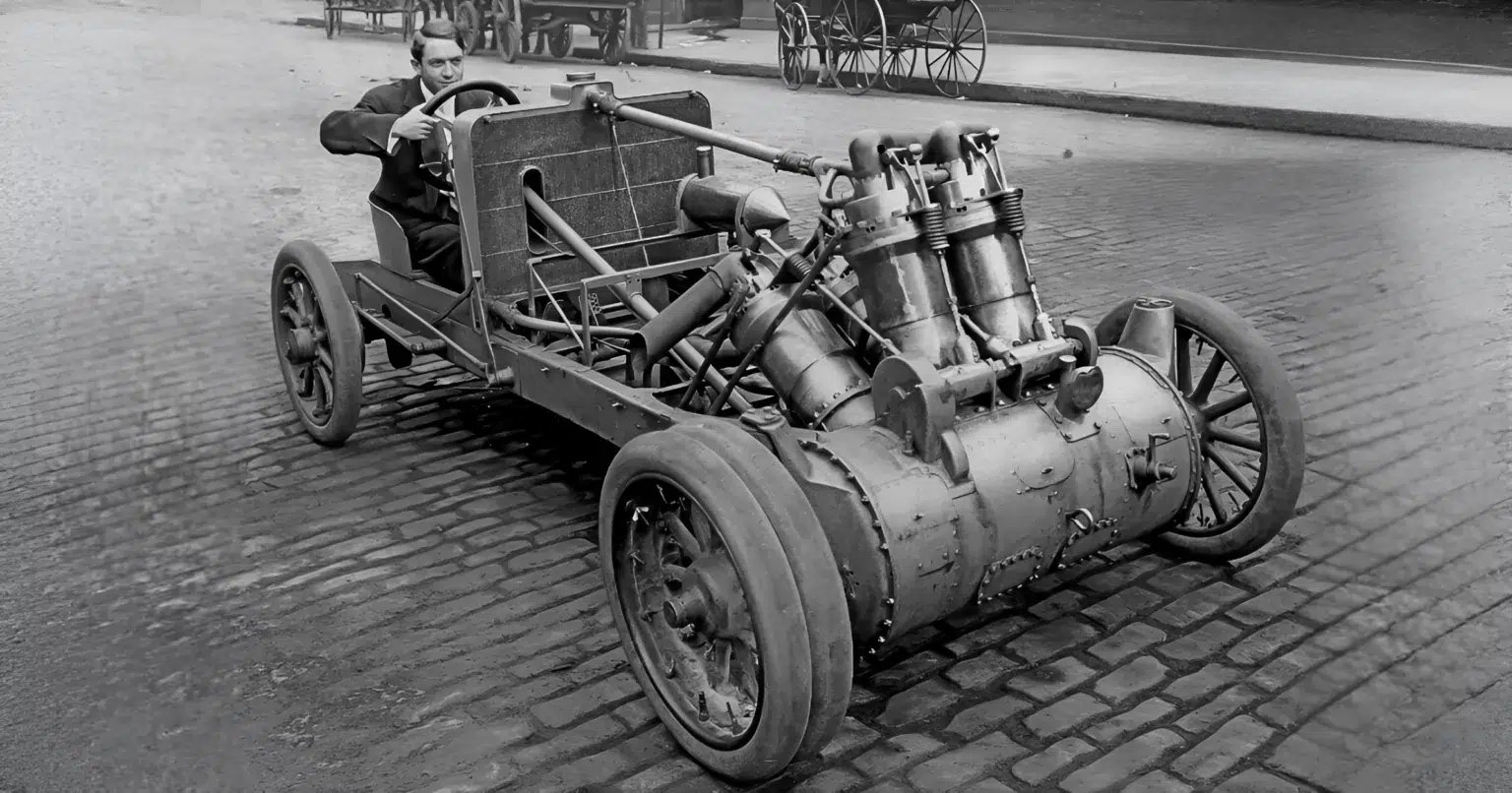


V-4 Engine of 20.0 Liters, Created in 1908, Surprised the World with Its Capacity and Power, Exceeding the Standards of the Time and Intriguing Enthusiasts to This Day.
In an era when automobiles were still a new and evolving technology, engineer J. Walter Christie envisioned something entirely different. The 1908 Christie V-4 Front-Wheel Drive Racing Car was not just another race car; it was a beast that challenged conventional automotive design.
With its massive 20-liter V-4 engine (1,214 cubic inches) mounted transversely and its crankshaft functioning as the front axle, this car was one of the most radical and brutal racing machines ever built.
Breaking the Norms: The Birth of the Christie V-4
Walter Christie was an engineer ahead of his time. He was unafraid to break the rules and challenge traditional race car designs.
-
Costing R$ 16,000, the new Yamaha features a 125 cc hybrid engine with electric assistance, delivers 8.3 hp, includes ABS, optimized fuel consumption, Y-Connect connectivity, 25 liters of storage space, and a surprising 4-year warranty in the urban segment.

-
OMODA & JAECOO grows in Europe in 2026 with an integrated strategy of sales, innovation, local production, and technological advancement in the United Kingdom, Italy, and Spain.

-
OMODA & JAECOO expands after-sales service in Brazil with competitive maintenance, a 7-year warranty, and high availability of parts for technological SUVs.

-
OMODA & JAECOO appoints Alessandra Souza as executive marketing director in Brazil and accelerates brand expansion with a focus on innovation, networking, and hybrid portfolio.


While most manufacturers followed the conventional rear-wheel drive layout, Christie took the bold step of developing one of the world’s first front-wheel drive racing cars—decades before this technology became popular.
But what truly made the 1908 Christie V-4 a legendary engineering experiment was its astonishing engine size and configuration.
It was an attempt to squeeze insane power into a compact design while maintaining traction and control. The result? A mechanical marvel that was both inspiring and frightening.
A Monstrous Powerhouse Unlike Any Other
This giant machine was powered by a surprisingly large 20-liter V-4 engine. Its bore and stroke measured 184 x 184 mm (7 1/4 square inches), making it one of the largest displacement racing engines of its time.
It was designed to generate immense torque, a crucial factor for speed and acceleration on the early racetracks.
Engine Highlights:
- 20-liter V-4 engine (1,214 cubic inches) – One of the largest racing engines ever built.
- 8 atmospheric intake valves per cylinder – A highly unusual configuration aimed at maximizing air intake.
- 1 mechanically opened overhead exhaust valve – A primitive, yet effective, means of expelling combustion gases.
- Transversely mounted engine – A radical approach, placing the engine across the chassis rather than longitudinally.
- Crankshaft functioning as the front axle – An unprecedented design in the automotive world.
- Front-wheel drive with straight cut gears and telescopic universal joints – One of the earliest applications of this technology in racing.
A Race Car or a Deathtrap
Despite its innovative technology, the Christie V-4 was a high-risk machine. The front-wheel drive system was experimental and prone to failure, while the exposed gears in its original transmission setup were extremely dangerous.
During the early races, drivers faced serious risks. The open transmission gears could easily catch clothing, and the brutal torque delivery made the car hard to control at high speeds. It was a machine that demanded extreme skill and bravery to drive.
Performance and Speed:
- Estimated top speed: Over 193 km/h – Madness for the early 1900s.
- High torque output – Allowing for rapid acceleration despite its enormous size.
- Unconventional handling – The front-wheel drive setup made steering unpredictable.
1908 Racing Season: The Christie V-4 in Action
The Christie V-4 was specifically designed for the 1908 racing season. It was unlike anything else on the track, both in size and appearance.
With its transversely mounted engine protruding from the front, it resembled more of a machine from another world than a traditional race car.
However, its performance was a double-edged sword. While it had incredible straight-line speed, its unpredictable handling and mechanical complexity made it difficult to maintain control through tight corners and high-speed maneuvers.
Although the Christie V-4 never won major races, its technology paved the way for future automotive engineering breakthroughs.
Christie’s front-wheel drive concept was later refined and adopted in modern passenger cars, and elements of its suspension design found their way into military tank developments.
- Inspired future front-wheel drive cars – Pioneering a design decades before widespread adoption.
- Contributed to tank suspension technology – Elements of Christie’s engineering were later used in World War II tanks.
- Proved the potential of radical racing concepts – Encouraging future engineers to think outside the box.
The Christie V-4
Despite its impact, the Christie V-4 remains one of the forgotten legends of history. The car itself disappeared long ago, and only a few photographs remain as proof of its existence.
However, its story continues to fascinate enthusiasts who appreciate engineering innovation and the sheer bravery of motorsport pioneers.
The Christie V-4 was not a winner on the racetrack, but its boldness marked an era. Even today, when we look at ultra-technical race cars, we can see echoes of Christie’s vision.
His quest for innovation and courage to challenge established standards helped pave the way for many of the technologies we now consider common.
Front-wheel drive, which at the time seemed like an absurd idea, is now a feature present in most passenger cars. The crankshaft functioning as a front axle, although it did not become popular, demonstrated the potential for integrating different mechanical systems in an innovative way.









Pensando q estavam em 1908…o cara era um gênio…..
Bastava ele inverter a direção ficando na frente do motor.
Me cheira montagem isso por que se o virabrequim toca a traçao direto nas rodas como que a direçao tá conectado nesse mesmo eixo e