





 Portuguese
  English
  Spanish
  5 min of reading
  0 comments


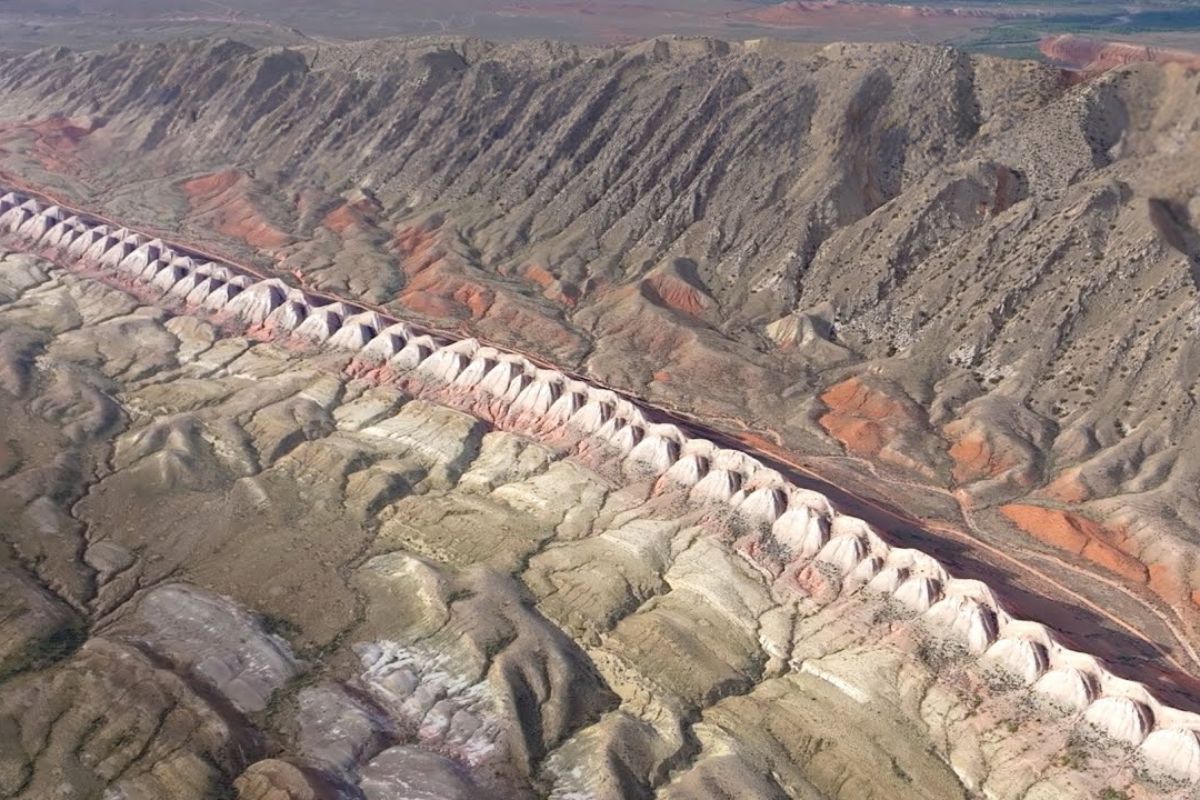
In The Tooth of Serra Mountains in Yemen, Double Ridges Become Fins and Sharp Plates Because Layers of Fine Limestone and Gypsum Resist While Red Mud and Clay Yield. The Slope Reaches Up to 50°, and Drainage Cuts V-Canyons, Repeating Valleys Spaced Along a Long Ridge
In The Tooth of Serra Mountains in Yemen, the landscape resembles a misplaced spine: a double ridge of giant “fins,” so dramatic it resembles dragon bones emerging from the earth and becomes a source of astonishment for tourists and locals. Even with simple observations, understanding the design requires looking at the rock, the layers, and the rhythm of erosion.
The scenery is dominated by long ridges and parallel canyons with surprisingly consistent spacing, along with upper drainages flowing into the lower ones like a repeated mesh. The geological reading links this pattern to inclined layers, differences in resistance between rocks, and the continuous action of drainage which carves deep cuts and transforms the slope into plates and points.
What Gives the Appearance of Bones and Fins in the Mountains

The most striking shape is the double ridge with plates that look like aligned “fins,” creating a serrated and very narrow relief in several sections. The visual impact is so strong that the first reaction is often one of strangeness, as if the mountain had been cut into tall, parallel slices.
-
Son of a seamstress from the rural area of Ceará who did not speak English wins a scholarship of over 2 million reais at Williams College, one of the top 10 universities in the United States, covering everything including dormitory, meals, and annual trips to Brazil.

-
Bill Gates revealed that the true secret behind every great achievement is not a brilliant leap but rather small improvements repeated over the years, and the data from his own career and the fight against climate change prove that he is right.

-
With 22 thousand tons of steel, a height nearly three times greater than the Eiffel Tower, and a cost of R$ 1.6 billion, China is building the highest bridge on the planet over a colossal canyon, reducing a crossing time of over 2 hours to just over 2 minutes.
-
With more than 635,000 doctors, Brazil sees competition increasing in large cities, and recent graduates are competing for shifts at an accelerated pace while the countryside still faces shortages.


The key detail is that these “fins” receive a technical name used by geologists: plates. They appear when erosion removes the softer material around, leaving more resistant layers that become the “spine” of the ridges.
The Clues Are in The Rock: Hard Limestone, Fragile Clay, and Resistant Gypsum

The reading begins with the composition. In the mountains, layers of fine-grained limestone appear, described as resistant enough to support the ridge. In some parts of the relief, gypsum also forms “caps” and occurs along the ascent, a material noted for its resistance to erosion in the desert environment.
Right below and between these harder layers are materials that yield: red mud, claystone, and shale, treated as softer. It is the alternation between hard and soft that creates the relief contrast, because what disintegrates quickly makes way for what remains to become a plate.
Inclined Layers and The Number That Changes Everything: 50° Dip

In addition to composition, geometry matters. The layers are significantly tilted, and there is a direct reference to a tilt of around 50° observed in the outcrop. This tilt causes the resistant layers to appear “upright,” ready to become narrow ridges when the surrounding fragile material is removed.
The pattern repeats at different points: resistant limestone layer supporting the ridge and, underneath, soft material highlighting the contrast. When the fragile material “disappears” faster, the limestone stands out in relief and begins to shape the serrated edge with fine cuts, as if they were stacked blades.
The Rhythm of The Valleys and The Drainage That Carves V-Canyons
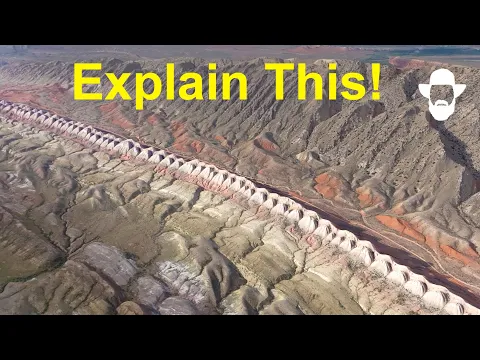

In the mountains, it is not only the shape of the ridges that stands out, but the spacing of the valleys along the slope. There is mention of a visible “rhythm”: lower drainages with relatively regular spacing and upper drainages with surprisingly uniform spacing, converging towards the lower ones.
This drainage is the tool that transforms layers into points. The described cut is the classic V-canyon, which starts narrow at the base and widens as it deepens, removing and transporting material outward. When neighboring canyons grow and come closer, erosion between them creates the points and plates, shaping increasingly sharp plates.
Mini Canyon, Plates, and The Logic of Sharp Points
The relief includes a “mini canyon” observed up close, used as an example to understand the process. The description highlights the initial narrowness of the drainage channel and the progressive widening as the cut advances, always removing material and deepening the V.
The result is a kind of serration: each drainage tries to deepen its own V, and when systems meet, what remains is the plate between them. The plates do not “appear” ready; they emerge when the fragile material goes away and the resistant layer becomes the edge.
Why Are Some Fins Giant While Others Are Subtle
The difference in size between the plates was also explained by the contrast in resistance. When the soft material “is not so soft,” it holds back the process and prevents the fin from fully developing, resulting in more discreet shapes.
On the other hand, giant plates emerge when there is a favorable combination: very soft mud and red material in front and behind, with a thicker resistant layer in the middle. This arrangement amplifies the contrast and allows the resistant layer to stand out on a large scale, forming a dominant fin in the set.
Comparisons That Help See The Mechanism in The Mountains
To understand the mountains, examples of comparison with other areas with similar erosive forms arise. There is reference to the flank of the Big Horn Mountains, where huge finger-shaped limestone plates appear deposited on the side of the mountain, along with a large notch cut into the relief whose scale is hard to communicate without a vehicle as a reference.
These comparisons reinforce that the pattern of ridges and regularly spaced canyons is not exclusive, but in The Tooth of Serra Mountains, it emerges on an impressive scale, repeating along a long ridge and having such an extreme appearance that it causes confusion at first glance.
In The Tooth of Serra Mountains in Yemen, the appearance of “dragon bones” comes from an objective combination: inclined layers, contrast between hard limestone and resistant gypsum against fragile clay and red mud, and a persistent erosion that organizes the drainage in repeated cuts, opening V-canyons and leaving plates like sharp blades in the landscape. The result is a relief that looks fantastic but arises from simple processes repeated over time.
Do you think the mountains become more impressive when the geological mechanism is understood, or is it the visual mystery that most scares and attracts tourists?







-

-

-

-

8 pessoas reagiram a isso.