





 English
  Francês
  Alemão
  Italiano
  Japonês
  Norueguês
  Portuguese
  Spanish
 4 min of reading
  0 comments


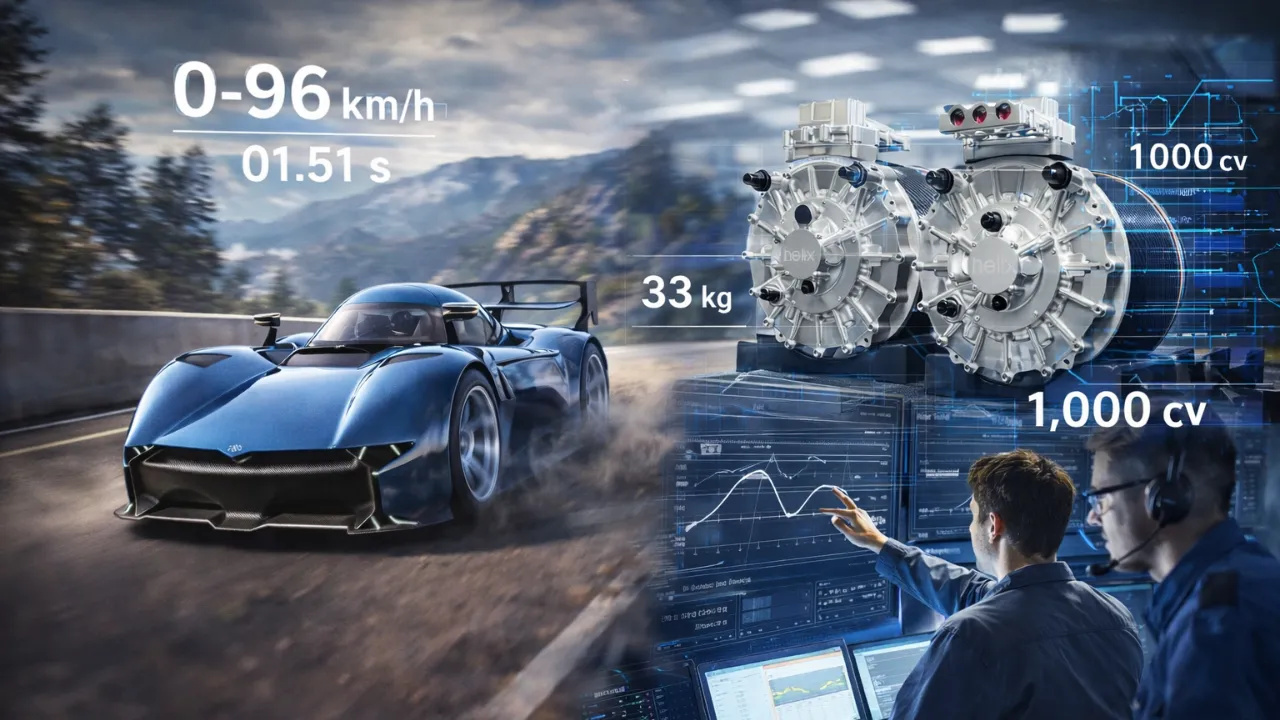
With Two Ultracompact Motors and a Suction System That Sticks the Car to the Asphalt, the McMurtry Spéirling Redefines the Relationship Between Weight, Power, and Extreme Acceleration in the New Era of Electric Hypercars
There are moments when automotive engineering ceases to be just evolution and begins to sound like technical provocation. What the British McMurtry Automotive has built with the McMurtry Spéirling falls exactly into this category. While much of the electric industry debates range and energy efficiency, this small hypercar has chosen to aim for the more radical territory: almost instantaneous acceleration.
The protagonist of this story is not just the car itself, but the electric system developed by Helix. Each motor of the SPX242-94 model weighs only 33 kg and delivers around 500 Nm of torque. In the McMurtry Spéirling, two of these motors work on the rear axle and generate approximately 1,000 hp combined, creating a power-to-weight ratio that challenges any traditional reference.
McMurtry Spéirling and the Obsession with Power Density
The McMurtry Spéirling is not designed to be just fast. It was conceived to explore physical limits with the minimum possible mass. Therefore, the central strategy was not to increase the size of the batteries or simply boost raw power, but to optimize the power density of the system.
-
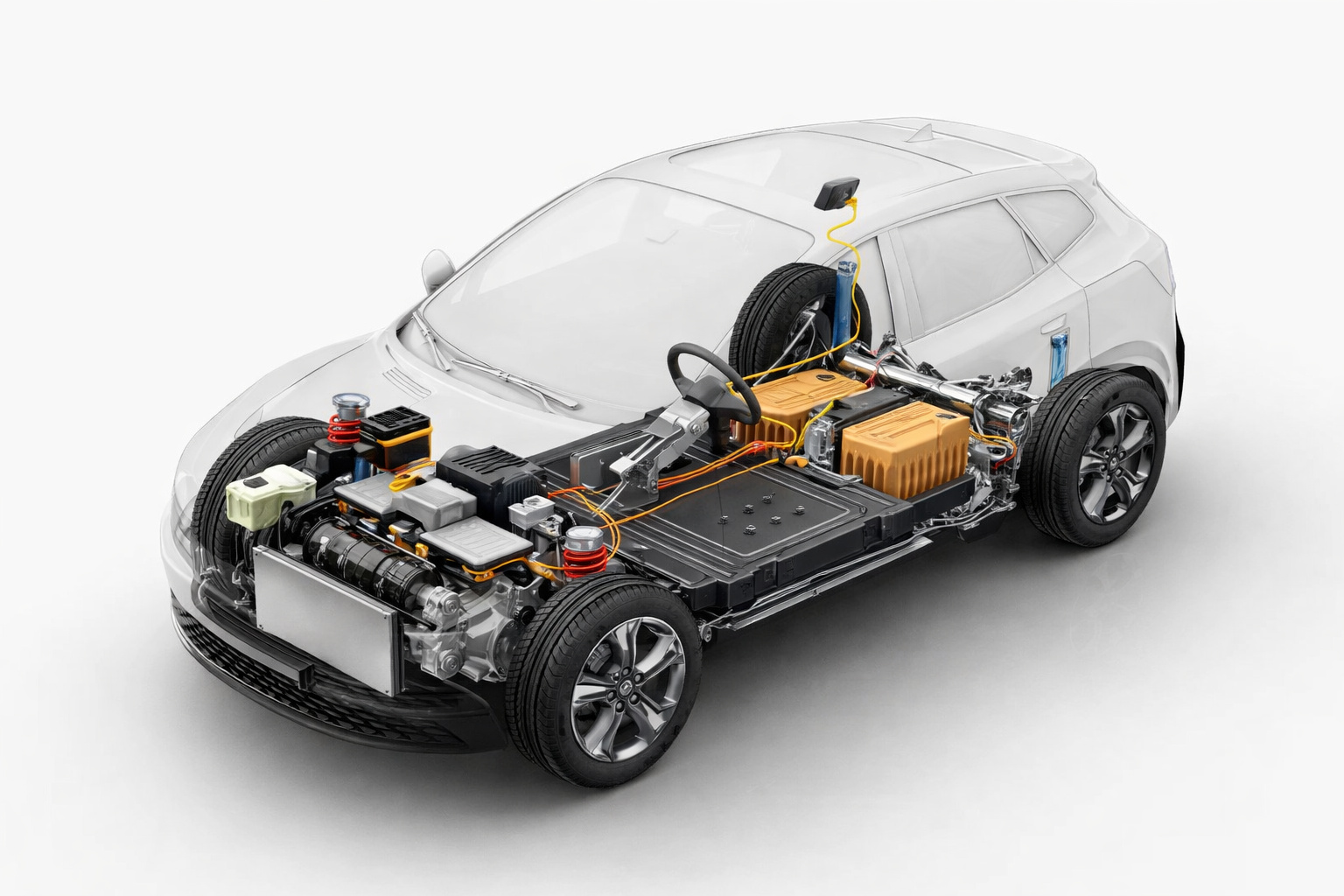
China Surprises Automotive Industry With Battery That Promises Electric Car Able to Run Up to 1,000 km Without Recharge
-
Why BYD Grew So Fast in Brazil and How Blade Batteries, Electric Cars, and Industrial Incentives Shaped This Expansion in the National Automotive Sector
-
Electric Cars Make Progress in Brazil in 2026 and Promise to Reduce Drivers’ Costs with Cheaper Energy, While Infrastructure Grows Slowly Across the Country
-
Recycling Electric Car Batteries Becomes The New “Urban Mine” And Opens A Global Race For Lithium, Nickel, And Cobalt — Whoever Dominates Now Could Control A $70 Billion/Year Market By 2040


Each 33 kg motor adopts a compact architecture, focusing on thermal efficiency and high rotational capacity. This allows the system to sustain extreme performance levels without compromising weight distribution. In a car that weighs just over a ton, any structural savings directly impact acceleration, stability, and braking capacity.
While many high-performance electric cars rely on bulky batteries to sustain eye-catching figures, the McMurtry Spéirling bets on lightness as an essential part of the equation. This balance between power and mass explains why the model achieves results that seem unreal even in the hypercar universe.
0 to 100 km/h in 1.5 Seconds: The Physical Impact of Acceleration
Talking about 1.5 seconds to reach 100 km/h may sound like mere statistics, but in practice, the number places the McMurtry Spéirling in an extremely restricted territory. The sensation is so intense that the body barely processes the movement before the speedometer crosses the three-digit mark.
Part of this extraordinary performance comes from the active suction system installed at the rear. Unlike traditional wings that depend on airflow, the mechanism generates downforce even at low speeds. This means the car creates negative pressure under the body, drastically increasing grip from the very first meter.
As a result, the McMurtry Spéirling can apply all its power to the ground without waste from traction loss. Instead of spinning, it simply takes off. This solution has already helped the model achieve impressive times in hill climbs and closed circuits, reinforcing its role as an extreme laboratory of electrical engineering. Here are the technical data:
- Downforce – Up to 2,000 kg of aerodynamic force from 0 km/h (4,400 lb)
- Power – 1,000 hp (approx. 1,000 bhp)
- Dimensions (Length | Width | Height) – 3,815 mm | 1,795 mm | 1,056 mm
- Wheelbase – 2,200 mm (86.6”)
- Track Autonomy – 20 minutes at GT3 pace
- Charging Time – 25 minutes with a 350 kW charger
- Driver Assists – Traction control and ABS braking system
- Driver Comfort – Air conditioning (optional), custom-molded seat, adjustable pedals and steering wheel
- Tires – Michelin Slicks (globally available)
- Brakes – Carbon ceramic ventilated discs with 6-piston Brembo calipers
- Customization Options – Wide external and internal configuration
- Chassis and Body – Carbon composite, single-seater, closed cockpit
- Maximum Driver Height – Up to 195 cm (6 ft 5”)
- Battery – 100 kWh lithium-ion
- Weight – Approximately 1,300 kg (2,860 lb)

Small on the Outside, Radical on the Inside, and Irrelevant in Sales Volume
Projects like this serve as technological showcases. Many of the solutions tested in extreme environments eventually migrate, years later, to larger-scale electric sports cars. The history of the automotive industry shows that initially radical innovations often become standard in future generations.
Moreover, the development of ultracompact motors with high power density can influence various segments. Reducing weight has always been an obsession in automotive engineering, and the McMurtry Spéirling demonstrates that there is still ample room to evolve the electric motor beyond simple energy efficiency.
When the Electric Becomes Brutal
For a long time, the discourse surrounding electric vehicles focused on silence, economy, and sustainability. Although these pillars remain relevant, the McMurtry Spéirling reminds us that electrification can also be visceral. The instantaneous delivery of torque, combined with extreme lightness and aggressive aerodynamic solutions, creates a package that rivals traditional supercars.
The most intriguing part is that this brutality happens in an almost clean manner. There are no dramatic gear shifts or mechanical explosions. The acceleration is continuous, linear, and unsettling. It’s as if the time between deciding to accelerate and reaching 100 km/h simply shrinks.
In the end, the McMurtry Spéirling shows that electrification is still far from reaching its creative limits. While the mass market seeks a balance between range and cost, some engineers continue to explore the extreme end of the spectrum. And by putting two motors of only 33 kg to generate 1,000 hp combined, the project sends a clear message: the electric future can also be radical.










Seja o primeiro a reagir!