





 Portuguese
  English
  Spanish
  5 min of reading
  23 comments


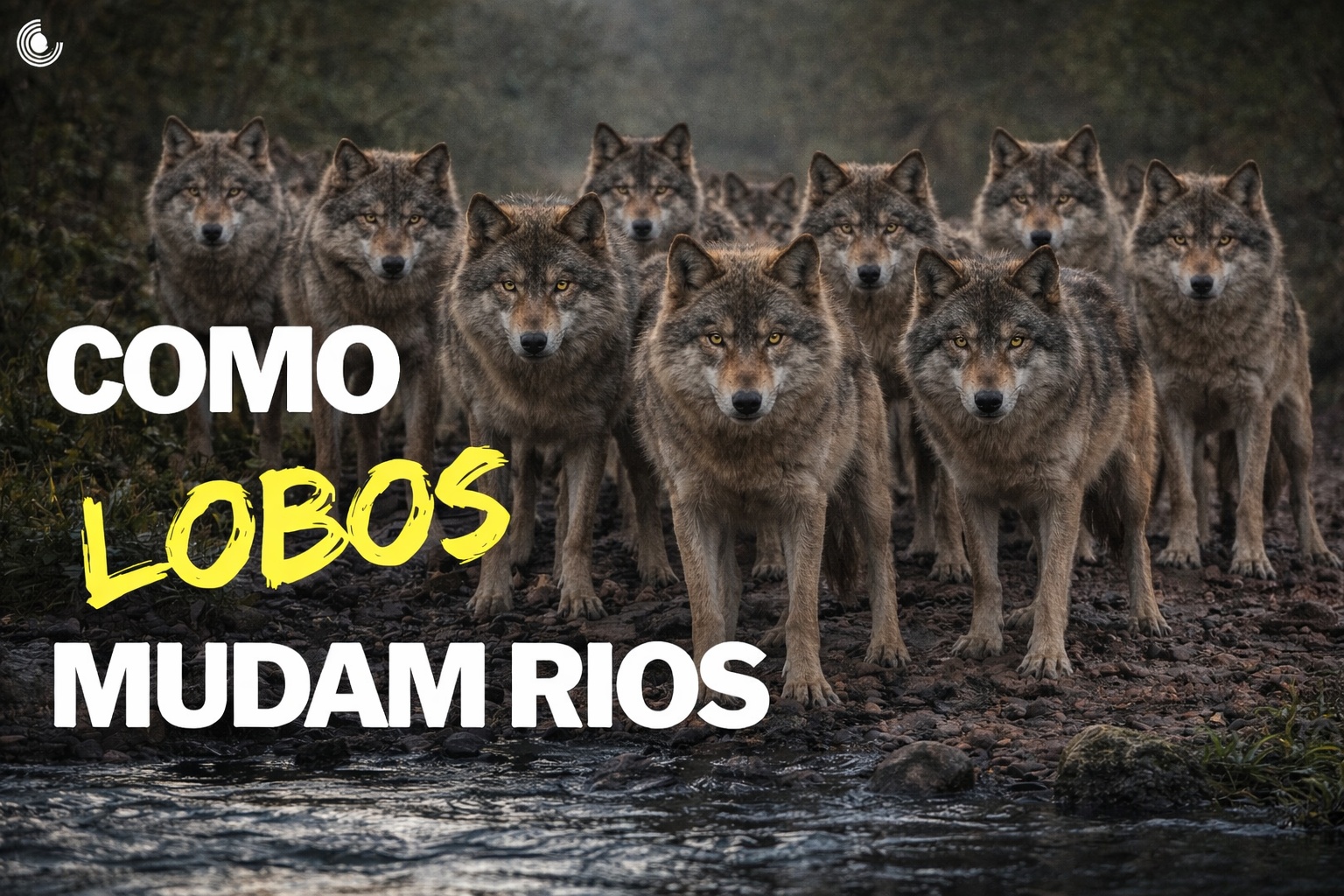


The Reintroduction of 31 Wolves in Yellowstone from 1995 to 1996 Triggered a Documented Ecological Cascade Effect Changing Even the Course of Rivers.
In the decades leading up to 1995, Yellowstone National Park in the U.S. faced a serious ecological imbalance. Since the early 20th century, gray wolves had been hunted and exterminated in the region due to federal predator control policies. The last confirmed wild wolf in Yellowstone was killed in 1926. The absence of predators led to uncontrolled growth of elk (Cervus canadensis). Without predatory pressure and with milder winters, herds began to heavily consume riparian vegetation, especially willows (Salix spp.) and aspens (Populus spp.). The result was visible degradation of riverbanks, loss of vegetation cover, and erosion of the banks.
Researchers noticed that species such as beavers and riparian birds were disappearing. The explanation was straightforward: without willows and aspens, beavers had no wood to build dams and no plants to feed on in the winter. With fewer beavers, fewer dams; with fewer dams, fewer flooded areas and less aquatic diversity. The collapse was silent, gradual, and systemic.
By the 1980s, Yellowstone was a park with large mammals but with an incomplete functioning ecosystem. It lacked the predatory component capable of reorganizing the trophic chain.
-
A “silent skill” is allowing Brazilians to earn up to R$ 22,000 per month without a degree and become indispensable for companies that rely on millions of data to survive.

-
Researchers at the Toyota Research Institute found that if a human uses robotic arms to flip a pancake 300 times in an afternoon, the robot learns to do it on its own the next morning, and this is currently the most promising method to solve the biggest bottleneck in modern robotics.

-
Goodbye iron: a common item in households is starting to lose space to technology that smooths clothes in minutes without an ironing board and with less energy consumption.

-
Antarctica reveals an unusual clue high in the Hudson Mountains, and what appeared to be just an isolated rock began to expose a secret hidden under the ice for ages.

The Reintroduction of the 31 Wolves and the Beginning of the “Cascade Effect”
In 1995 and 1996, after years of political, legal, and scientific debate, the U.S. Fish and Wildlife Service reintroduced 31 gray wolves (Canis lupus) captured in Canada. These animals were released in specific areas within Yellowstone under constant biological monitoring.
What happened in the following years became known as trophic cascade — because a single predator reorganized multiple layers of the ecosystem.
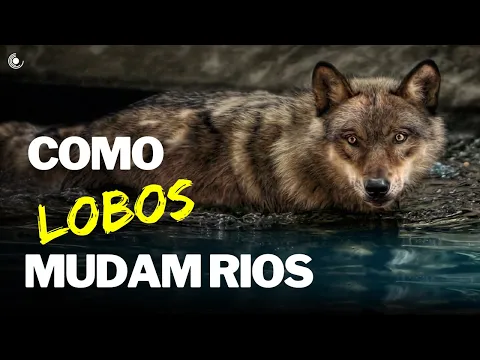

The wolves began by preying on elk, but more importantly than the number of elk killed was the change in behavior of the herds. Elk began to avoid certain valleys and riparian areas where they were exposed to attack, something ecology refers to as the “landscape of fear.”
With elk avoiding these spots, willows, aspens, and cottonwoods began to return. The return of riparian vegetation opened the space for the return of beavers (Castor canadensis), who used the material to build dams and shelters.
This produced a chain reaction:
- dams created flooded areas
- flooded areas captured sediments
- sediments stabilized banks and reduced erosion
- more insects, amphibians, and fish found habitat
- riparian birds returned attracted by the forest structure
The predator not only controlled a prey; it reorganized an entire ecosystem.
From the Return of Beavers to Changes in the Rivers
The most impressive data pertains to hydrology. By returning to build dams, beavers altered water rhythms, created microzones of water retention, reduced flood peaks, and increased local recharge of shallow aquifers.
In areas where erosion had previously eaten away the riverbanks, willows over 2 meters tall began to emerge a few years after the reintroduction of wolves, something documented by research conducted by Oregon State University and other institutions.
As a result, sections of rivers such as the Lamar and the Yellowstone changed their morphology, stabilizing banks where there had previously been ravines and irregular deposits. What was observed was not “the wolf directly moving rivers,” but rather an ecological system recovering biological processes that shape river pathways.
Science calls this ecosystem engineering, and it is one of the most cited phenomena in modern conservation literature.
What the Wolves Caused in Fauna Beyond Elk
The impact was not limited to herbivores and beavers. The presence of wolves also altered coyote (Canis latrans) populations, which decreased in overlapping areas, opening space for smaller species such as red foxes (Vulpes vulpes), which compete with coyotes.
Vultures, crows, and eagles began to frequent carcasses of hunted elk, increasing the food supply for scavenger birds during the winter. Grizzly bears also benefited, competing for carcasses and consuming remains from kills.
In summary, an introduced predator:
- decreased herbivore pressure
- reduced a mesopredator (coyote)
- boosted an engineering species (beaver)
- favored scavenger birds
- facilitated the return of riparian birds
This reorganization is what makes the case so instructive in applied ecology.
Concrete Data from the Historical Process for Those Seeking Precision
For those seeking documentary rigor, the essential data are:
- Year of Reintroduction: 1995–1996
- Number of Wolves Reintroduced: 31 Individuals
- Origin of Wolves: Canada (regions of Alberta and British Columbia)
- Location: Yellowstone National Park, USA
- Species Directly Affected: elk, coyotes, cervids
- Species Indirectly Favored: beavers, foxes, riparian birds, fish
- Associated Ecological Concept: trophic cascade
- Park Area: ~8,983 km²
- Drivers of River Change: beaver dams + return of riparian vegetation
This set of factors transformed the case into a global reference for rewilding.
Why Yellowstone Became a Global Symbol of Rewilding
There are many predator reintroductions around the world, but Yellowstone has become the most famous because it presented five rarely combined elements:
- Broad and continuous scientific monitoring post-reintroduction
- Keystone species with well-defined ecological roles
- Documented impacts on vegetation and hydrology
- Public and media interest, increasing ecological awareness
- Clear photographic and temporal evidence before/after
The episode became study material in universities, documentaries, PhD theses, and influenced conservation policies outside the U.S., including in Europe.
What This Case Teaches About Ecological Restoration
The Yellowstone episode showed that recovering ecosystems is not just about planting trees or starting breeding programs — sometimes it is about replacing the right predator in the right place.
It also showed that:
- the trophic chain is not a static thing
- behavior matters as much as biomass
- animals shape geography, not just vegetation
- living systems can “self-correct” if critical pieces are replaced
Unlike an artificial restoration, with machines and concrete, Yellowstone restored natural processes that then unfolded on their own.
The reintroduction of 31 wolves from 1995 to 1996 was not just an environmental project — it was a practical demonstration of how ecology functions as an interconnected system. The wolves not only controlled elk; they triggered an ecological cascade that recovered vegetation, brought back beavers, reinforced bird populations, reorganized predatory chains, and even altered the behavior of rivers.
That is why Yellowstone is considered one of the largest rewilding experiments ever conducted and, perhaps, the most well-documented in the world.







They are also decimating the deer population and attacking ranchers cows in droves. Nothing GOOD came from reintroducing wolves.
E ,a procriação dos lobos , trouxe algum prejuízo ou não?
Maybe we need to apply the same principle to human. We are in plague numbers right across the world. No apex preditors to control our population like prehistoric times. Sound unplatable, but we are just another **** in the natural scheme of events