





 Portuguese
  English
  Spanish
  6 min of reading
  0 comments



Cycloidal Propellers Promise a Leap in Control for Aviation by Allowing Hovering, Side Slipping, and Spinning on Their Own Axis, with Drum Rotors That Redirect Thrust in Real Time, as Already Seen in Water.
Cycloidal propellers have entered the engineering radar because they do something that traditional aviation treats as a compromise: change direction without tilting the body. In the described concept, thrust is not confined to a single axis, and the aircraft can hover, move sideways, and spin on its own axis with a precision reminiscent of choreographed maneuvers.
The impetus for this return comes from a combination of factors mentioned in the report: electric motors, lightweight materials, fast onboard computers, advanced simulation and real-world testing. The result is a family of designs aiming to transform drones, air taxis, and aircraft into platforms capable of adjusting thrust instantaneously, with full directional control.
What Are Cycloidal Propellers and Why Do They “Break” the Thrust Logic

Cycloidal propellers are described as drum or disc-shaped rotors, with vertical blades that do not operate like a common propeller.
-
China accelerates global science and may surpass the United States in 2 years with increased public investment, continuous growth, and direct impact on the global technological competition.

-
Scientific studies indicate that drought may be strengthening a much greater silent threat: more resistant superbugs.

-
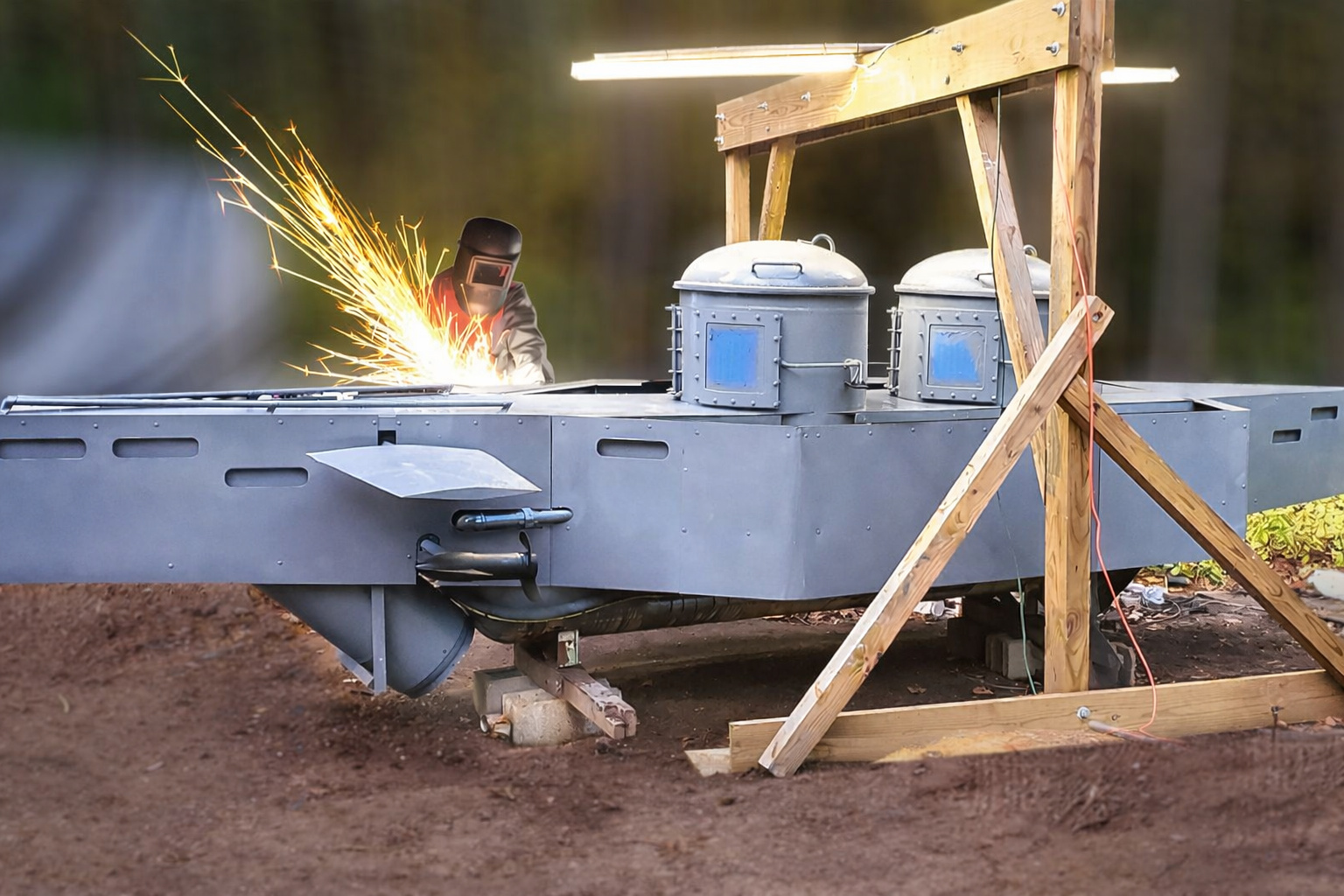
Man builds functional 5-meter submarine in his garage using gas cylinders, PVC pipes, and a refrigerator motor, and navigates with the vessel on a lake in Colombia.
-
Millions of people have been eating yam for centuries without knowing that this humble tuber contains a compound called diosgenin, which scientists have now discovered can improve memory and help control blood sugar levels.


Instead of pushing air or water always backwards, each blade acts like a small adjustable wing, changing its angle multiple times per second while the rotor spins.
This real-time adjustment allows for redirecting the thrust vector to virtually any direction.
This is what explains the cited maneuvers: hovering without losing level, sliding sideways without “laying down” the aircraft, moving diagonally, stopping quickly, and spinning on its own axis.
In the case described for the aerial environment, the promise is to have an aircraft remain level while changing direction instantly, something that differs from the typical behavior of helicopters, which need to tilt to generate lateral movement.
The Maritime Origin: Venice as a Laboratory for Extreme Maneuverability

The report positions the historical turning point in the 1930s, when a German company is cited as the refiner of what became known as the Voith Schneider type cycloidal propeller.
The test scene takes place in the canals of Venice: a rotary disk under vessels, with vertical blades projecting like drumsticks and adjusting the angle multiple times per second.
The result is described as surreal, and serves as proof of concept for maneuverability: boats with this system can slide sideways, spin in place, move diagonally, and stop quickly without relying on the rudder in the traditional way.
The narrative links adoption to uses that value precision in tight spaces, such as tugs, fire-fighting boats, ferries, and dredgers, building a reputation as a high maneuverability propulsion method.
The logic is always the same: thrust vectorized by geometry and the angle control of the blades, not by the rotation of a fixed propeller.
The system does not “think” about pushing backward; it thinks about orienting the thrust.
From Water to Air: The Old Attempts and Why They Have Returned Now


The aerial history appears as a persistent echo.
The report mentions attempts in the 1920s with Frederick Kirsten, who mounted cycloidal rotors on the sides of a model, and refers to wind tunnel tests by Boeing.
The idea did not succeed at that time, described as too advanced for the available technology.
The return is explained by the maturity of elements that today make a difference: more viable electric motors, lightweight materials, and primarily fast onboard computers capable of controlling blade adjustments at high frequency.
In a cycloidal propeller, it is not enough to spin; it is necessary to continuously control the angle of each blade throughout the cycle, and this positions computing and control as central parts of the system.
The Cited Modern Prototype: Blackbird and Six Drum Rotors
The report names and shapes a contemporary version: a demonstrator called Blackboard, with a prototype nicknamed Blackbird, presented as using six cycloidal drum-shaped rotors instead of traditional helicopter blades.
The most frequently mentioned technical point is fully directional thrust, allowing the aircraft to hover like a drone, fly like a plane, move sideways, and spin smoothly in the air.
The comparison made in the report, “parallel parking in the sky,” is an operational metaphor for something concrete: controlled lateral movement without the need to tilt like a helicopter.
This, in the narrative, paves the way for urban aerial mobility, where air taxis would require fine control to operate among obstacles.
What Changes in Drones and Air Taxis When Thrust Becomes a Free Vector
The central promise for drones and air taxis in the report is the gain in stability and response.
It is asserted that drone-sized versions can maintain stability even under strong crosswinds because the rotors adjust thrust much faster than a human pilot would be able to react.
In practical terms, this means three things, all derived from the ability to redirect thrust in real time:
Lateral movement without tilting, useful for approaches in tight spaces.
Rotation on their own axis with control, useful for precise alignment.
Change of direction without losing level, useful for keeping the aircraft stable while deciding where to go.
The report positions this as a redesign of flight.
It is not just “more performance”; it is a different way to control movement.
2023 and the Leap in Engineering: Blades in Row, Whale Tail, and Cited Efficiency
The narrative also includes a recent maritime development in 2023: a system presented by ABB, described as mimicking the movement of a whale’s tail.
Instead of a single rotor, a row of vertical blades operates like a biological fin, with each blade having its own motor, and promises to navigate without a rudder.
The cited numerical data is of efficiency “up to 85%,” linked to fuel savings and a quieter, cleaner marine environment.
Even though it is an aquatic context, this passage reinforces the underlying argument: controlling blades individually and at high frequency can produce more efficient and maneuverable propulsion.
Materials, Simulation, and Manufacturing: Why the Cycloidal Became Viable
The report insists that it is not just an old idea resurfacing, but a realization enabled by modern tools. The following are cited:
Titanium alloys and carbon fiber composites for strong and lightweight blades.
3D-printed lattice structures, allowing previously impossible shapes.
Computational fluid dynamics to simulate the behavior of each blade in hundreds of conditions.
Finite element analysis to ensure durability.
Tests in water channels and wind tunnels to refine design.
This list describes an engineering pipeline where cycloidal propellers cease to be a curiosity and become a controllable system, because each blade needs structural precision and control, which depends on materials and simulation to avoid failure in real operation.
Open Community and Prototyping: The Role of Makers in Accelerating the Cycloidal
The report points to a layer parallel to large companies: a community of makers, students, and enthusiasts sharing open-source cycloidal projects and building prototypes with 3D printers.
This part is relevant because it suggests a diversity of solutions, rapid experimentation, and the circulation of ideas outside the traditional industrial cycle.
In practice, this means that cycloidal propellers could appear in smaller drones, academic prototypes, and experimental platforms, fueling an incremental evolution of geometry, control, and materials.
What makes cycloidal propellers a topic of “UFO of the future” is not mystery; it is engineering: blades that change angle in real time, thrust that becomes an adjustable vector, and platforms that can hover, move sideways, and spin with precision.
The history spans 1909, the canals of Venice, old aerial attempts, and reaches modern prototypes like the Blackbird, sustained by electric motors, lightweight materials, and embedded computing.
If you had to choose an immediate use for cycloidal propellers, would you first bet on delivery drones or urban air taxis?








-

Uma pessoa reagiu a isso.