





 Português
  Inglês
  Espanhol
  3 min de leitura


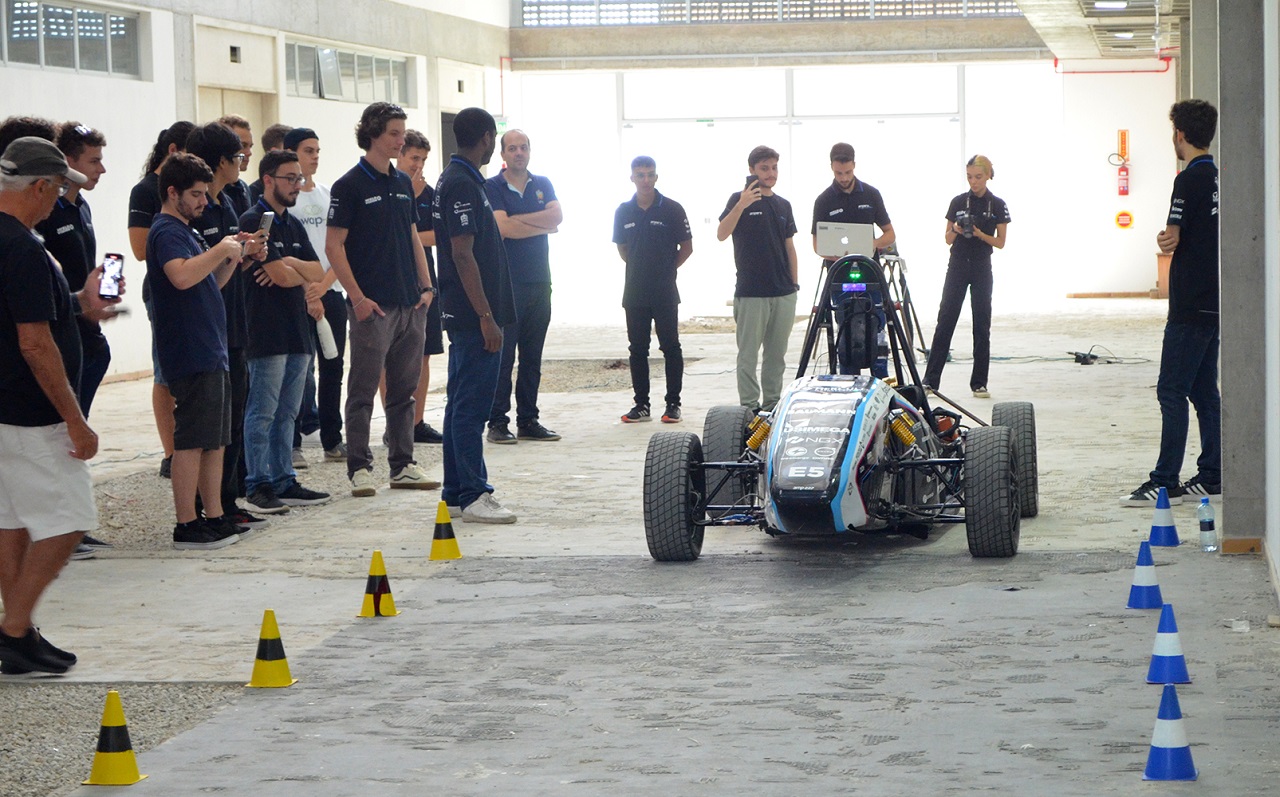
Students From UFSC Develop High-Tech Autonomous Car. The Project Has Been In Development Since 2020 And Already Has Several Sponsors.
It’s not just Tesla, Amazon, and Audi that are working with autonomous cars. Producing a vehicle on a smaller scale, students from the Federal University of Santa Catarina (UFSC) have developed a high-tech project for a self-driving vehicle. The prototype, called ERA-222, was developed by students from the Ampera Racing competition team.
Students’ Autonomous Car Can Identify Information Through Cameras


The model developed by UFSC students features an electric motor developed with advanced artificial intelligence technology, capable of detecting objects in its path and determining a trajectory without requiring human control intervention.
According to explanations from UFSC in a statement, the autonomous car is equipped with a steering actuator that controls the steering wheel, a remote emergency system, and an emergency brake. The model can identify data around it through smart cameras capable of estimating the position of objects and the autonomous car itself.
-
OMODA & JAECOO grows in Europe in 2026 with an integrated strategy of sales, innovation, local production, and technological advancement in the United Kingdom, Italy, and Spain.
-
OMODA & JAECOO expands after-sales service in Brazil with competitive maintenance, a 7-year warranty, and high availability of parts for technological SUVs.
-
OMODA & JAECOO appoints Alessandra Souza as executive marketing director in Brazil and accelerates brand expansion with a focus on innovation, networking, and hybrid portfolio.

-
Jaecoo 7 with super hybrid SHS system exceeds 1,200 km of combined range with a 1.5 turbo engine, high-density battery, and intelligent energy management.

The project began in 2020, with the graduation thesis (TCC) of mechanical engineer Laíza Parizotto, former vice president of Ampera. Her study, which covers cone detection with convolutional networks for SAE Formula autonomous cars, was one of the best theses ever developed at UFSC’s Technological Center, according to engineering student Guilherme Mertens de Andrade.
According to Mertens, developing an autonomous car is already a challenging task, as it is not a project one learns in university and there is no step-by-step guide available online. The student believes the biggest challenge was making the decision to take a risk on this project, which would require a high level of complexity, new knowledge, many hours of work, and financial investment from Ampera.
UFSC Students Work to Enhance Vehicle Performance
The development of the autonomous car was guided by Aldo von Wangenheim, a professor in the Department of Computer Science and Statistics at UFSC, and also received support from the Image Processing and Computer Graphics Laboratory (Lapix), the Software/Hardware Integration Laboratory (Lisha), and the Tutorial Education Program – Metrology and Automation (PET-MA). The statement claims that Ampera members have already begun planning their next autonomous car, which should feature greater investments in sensors.
The new model will include a GPS used by spacecraft and the U.S. military. The team secured the device through a partnership with one of the sponsoring companies. Guilherme asserts that this precision technology will greatly enhance the performance of the next car, but the UFSC students also plan to purchase a long-range LIDAR sensor used to accurately estimate the distance of objects on the track in relation to the autonomous car.
Students Develop Electric Car That Removes And Stores CO2
Students from the Technical University of Eindhoven in the Netherlands developed an electric car last year that, in addition to not polluting the environment, can remove and store CO2 while moving. The chassis of the model was developed using additive manufacturing techniques to reduce waste and generate minimal pollutant emissions, also utilizing recycled plastics that can later be reused for other projects.
Inside, there is pineapple leather, and the windows are made of polycarbonate instead of glass. The electronic and entertainment components are modular and can also be reused. Details about the vehicle’s engine and its power source were not disclosed.









Seja o primeiro a reagir!