





 Portuguese
  English
  Spanish
  4 min of reading
  0 comments


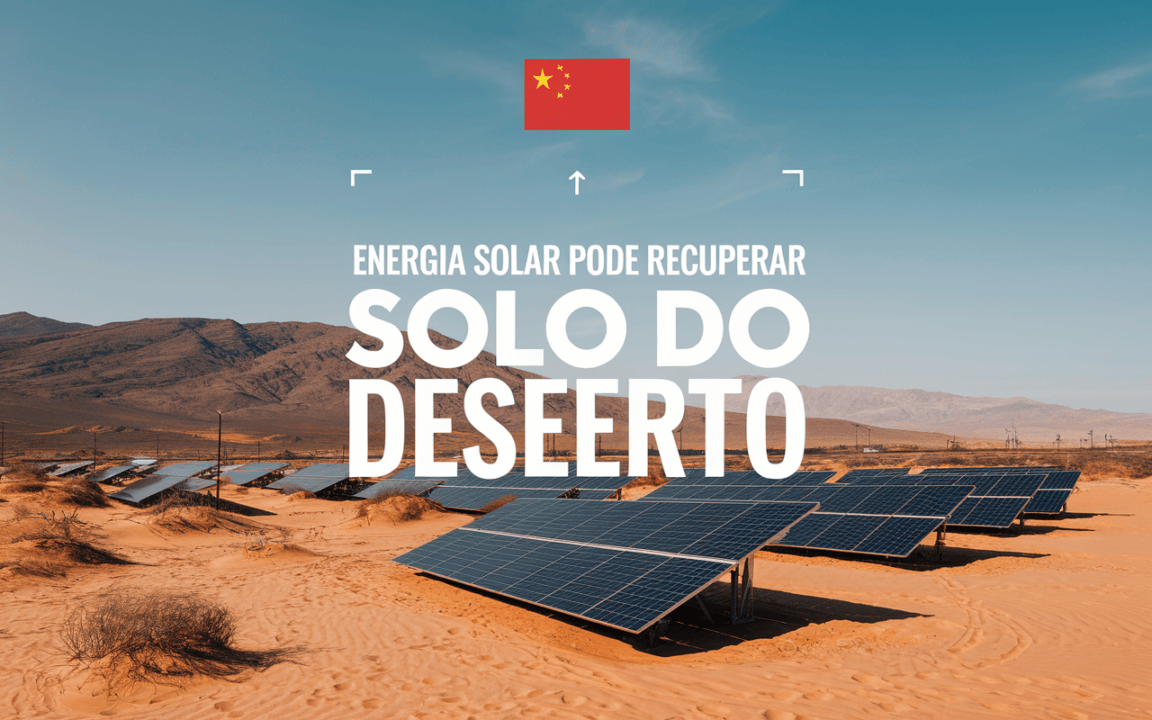
Study Reveals That Solar Panels in the Desert, in Addition to Generating Clean Energy, Help Revitalize Degraded Soil by Reducing Temperature and Increasing Humidity.
Researchers from Xi’an University of Technology, in China, recently released the results of a study that investigated the environmental impacts of installing solar panels in one of the country’s most arid regions. The study was conducted in the Talatan Desert in Qinghai Province, home to the Gonghe Photovoltaic Park, one of the largest solar power plants in the region, with an installed capacity of 1 gigawatt.
The research scientifically assessed how solar panels, by occupying large expanses of desert soil, can alter the environmental conditions. In addition to generating solar energy, the data revealed a potential positive effect: the partial revitalization of the soil in areas under the panels, which previously suffered from degradation, high temperatures, and low humidity.
Shadow of Solar Panels Influences Desert Soil
One of the main effects observed by the scientists is related to the shade generated by the solar panels. This partial cover reduces the direct incidence of sunlight on the soil, which helps lower surface temperatures and decreases the evaporation rate of water present in the sandy desert soil.
-
Renewable energy advances over protected areas in Brazil, and a survey by the Energy Transition Observatory reveals silent impacts that challenge environmental conservation and pressure sensitive traditional territories.

-
Rio Grande do Sul accelerates energy transition: State invests in renewable technologies and consolidates decarbonization strategies and pathways to attract billions in new industrial investments.

-
With 160,000 m² of collectors, an area larger than 20 football fields, Silkeborg, in Denmark, hosts a solar thermal plant that heats 19,500 homes and could become the largest solar heating plant in the world.

-
A study reveals the expansion of renewable energy procurement in Brazil and shows how companies are taking advantage of opportunities to reduce expenses, ensure energy efficiency, and strengthen strategic environmental commitments.


This reduction in moisture loss creates a more favorable microclimate for the growth of hardy vegetation, which can thrive even with little water. The researchers noted an increase in plant cover in areas shaded by the panels, compared to nearby desert areas that do not have this type of structure installed.

Solar Energy and Environmental Revitalization Go Hand in Hand
The study used a scientific model known as DPSIR, which considers indicators such as driving forces, pressures, state, impact, and responses of the environmental system. A total of 57 indicators related to soil, biodiversity, and local climate were analyzed.
The obtained data showed that the presence of solar panels had a direct impact on the balance of the local ecosystem. Areas that received constant shade exhibited more water retention in the soil, lower average temperatures, and the emergence of plant species adapted to the semi-arid environment.
Although the main objective of photovoltaic projects is the production of clean solar energy, the researchers highlight that these changes could represent an additional pathway to combat desertification in some regions of China. The controlled and planned installation of equipment, according to the study, can also be leveraged as an environmental recovery measure.
Gonghe Solar Park Is a Reference in Desert Use
The site selected for the research, the Gonghe Photovoltaic Park, was ideal for the study due to its location in a desert area with minimal human interference. The Talatan Desert possesses characteristics typical of arid regions, with constant winds, extreme temperatures, and a scarcity of native vegetation.
The Gonghe plant operates with solar panels distributed over kilometers of flat terrain, allowing researchers to accurately assess the effects of the installation on different areas of soil and vegetation. The comparison between zones with solar coverage and uncovered areas provided consistent data on the impacts of solar energy usage on the local environment.
China Bets on Solar Energy in Desert Regions
China has been increasing its investments in solar energy, particularly in desert and semi-arid regions. The strategy of this Asian country is to utilize these low agricultural use areas for the installation of large photovoltaic parks. In addition to contributing to a clean energy matrix, these projects are being observed for their potential role in the environmental recovery of degraded soils.
The combination of favorable climatic conditions, such as high solar incidence, with large tracts of available land makes the desert a strategic area for advancing solar energy. At the same time, studies like the one conducted by Xi’an University open new possibilities for sustainable use of these regions.
Researchers Highlight That Further Studies Are Still Needed
The Chinese researchers emphasize that further studies are still needed to understand the long-term effects of this coexistence between solar panels and desert soil. Issues such as vegetation adaptation, conscious area use, and impacts on local fauna still need to be better understood.
Nonetheless, the initial data is considered positive. The research shows that it is possible to combine solar energy generation with environmental conservation practices, especially in regions where the soil is already in an advanced state of degradation.
The expectation is that, with more data and planning, solar energy projects in deserts can be envisioned not only as sources of electricity but also as instruments of large-scale environmental restoration.
Sources: Nature (Scientific Reports)







Seja o primeiro a reagir!