





 Portuguese
  English
  Spanish
  3 min of reading
  0 comments


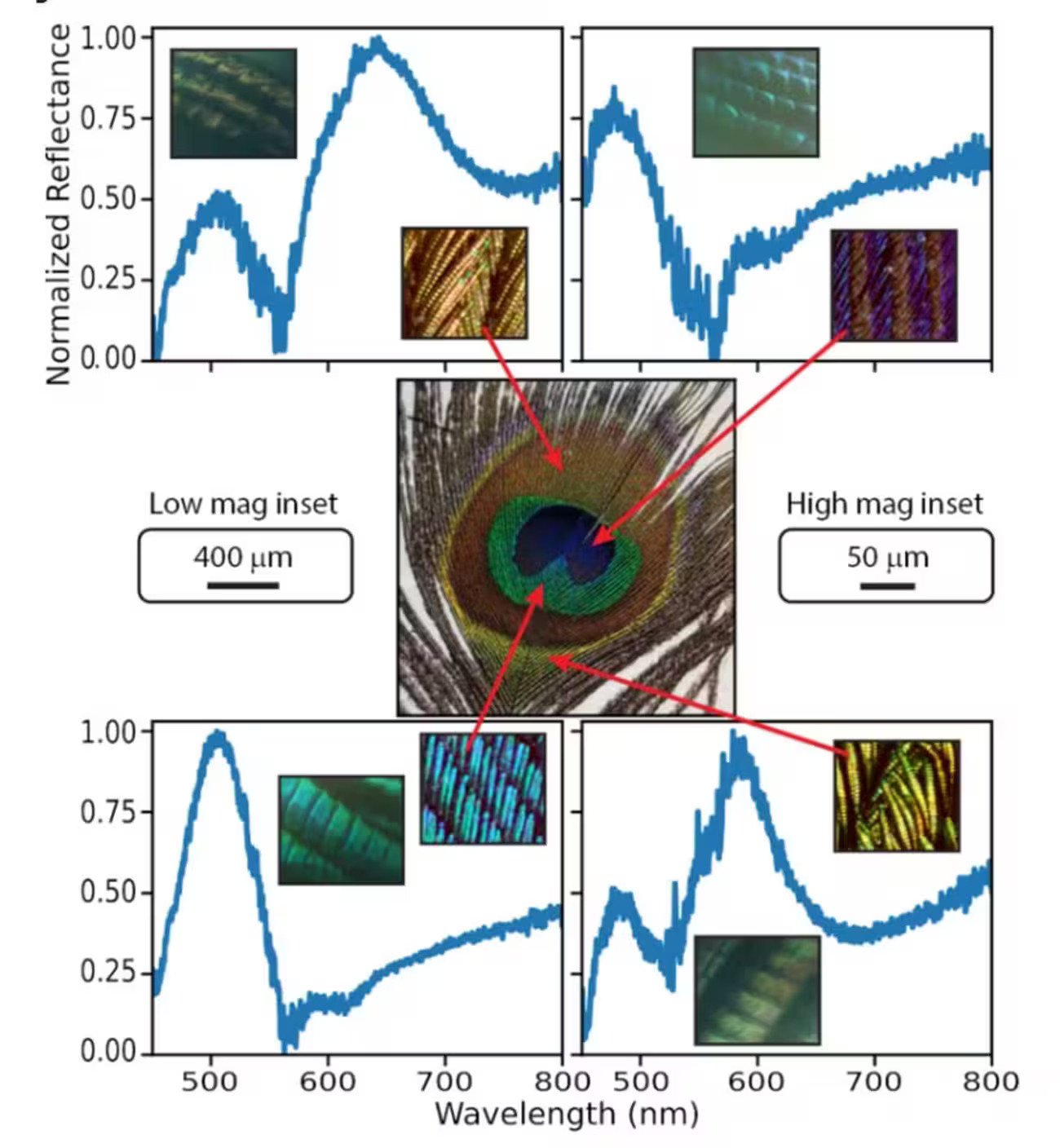
Peacock Feathers Treated with Special Dye Started Emitting Laser Light Beams, Revealing Unprecedented Optical Properties in the Animal Kingdom
Researchers from Florida Polytechnic University and Youngstown State University identified a new property in the tail feathers of peacocks.
According to the study, the colorful feathers contain microstructures that can amplify light and generate a beam similar to that of a laser.
Most importantly, these feathers, when dyed with a special dye and exposed to an external light source, began to emit narrow beams of yellow-green light.
-
Motorola launched the Signature with a gold seal from DxOMark, tying with the iPhone 17 Pro in camera performance, Snapdragon 8 Gen 5 that surpassed 3 million in benchmarks, and a zoom that impresses even at night.

-
Satellites reveal beneath the Sahara a giant river buried for thousands of kilometers: study shows that the largest hot desert on the planet was once traversed by a river system comparable to the largest on Earth.

-
Scientists have captured something never seen in space: newly born stars are creating gigantic rings of light a thousand times larger than the distance between the Earth and the Sun, and this changes everything we knew about stellar birth.

-
Geologists find traces of a continent that disappeared 155 million years ago after separating from Australia and reveal that it did not sink, but broke into fragments scattered across Southeast Asia.

This discovery represents the first known example of a biolaser cavity in the animal kingdom.
Scientists observed the emission of two different frequencies of laser light in various regions of the colorful eyespots on the feathers, reinforcing the potential of the structure.
Laser Emission Process
The experiment used feathers from the Indian peacock, the Pavo cristatus. The researchers applied dye onto the barbules—small structures of the feathers—through repeated cycles of application and drying of the substance.
After treatment, the feathers were illuminated with pulses of high-intensity light, at a wavelength of 532 nanometers. The response was clear: narrow beams of laser light were emitted.
In all analyzed feathers, both in distinct regions of the same feather and in different samples, scientists noted a highly conserved set of wavelengths.
Therefore, the laser emission followed a repeatable pattern. This shows that the biological structure of the feathers maintains consistency in how it reflects and amplifies light.
Specific Regions Generate More Light
The regions with the highest emission were linked to the green areas of the feathers. The laser intensity curve was strongest in these zones.
Even in areas where visible reflection did not coincide with the dye gain region, there was emission at some points. This caught the experts’ attention.
Moreover, the researchers pointed out that the emission only occurred after several rounds of dyeing. The process required patience and precision.
Questions About the Internal Structures
Despite the advances, the study could not accurately identify which parts of the feathers cause the laser effect.
The scientists ruled out melanin-coated rod structures as direct culprits.
Nathan Dawson, one of the authors, suggested that small protein granules or internal structures of the feathers could act as laser cavities.
The team cut excess barbs from the feathers and fixed them onto absorbent substrates. After dyeing and exposing them to light pulses, they measured the results.
Potential Future Applications
Experts pointed out that the search for laser emission in biomaterials may reveal useful structural patterns.
In the medical field, for example, laser behavior could help identify objects with specific geometric shapes, such as certain viruses.
The complete study was published in the journal Scientific Reports.
With information from Interesting Engineering.







-

-

4 pessoas reagiram a isso.