





 English
  Francês
  Alemão
  Italiano
  Japonês
  Norueguês
  Portuguese
  Spanish
  4 min of reading
  0 comments


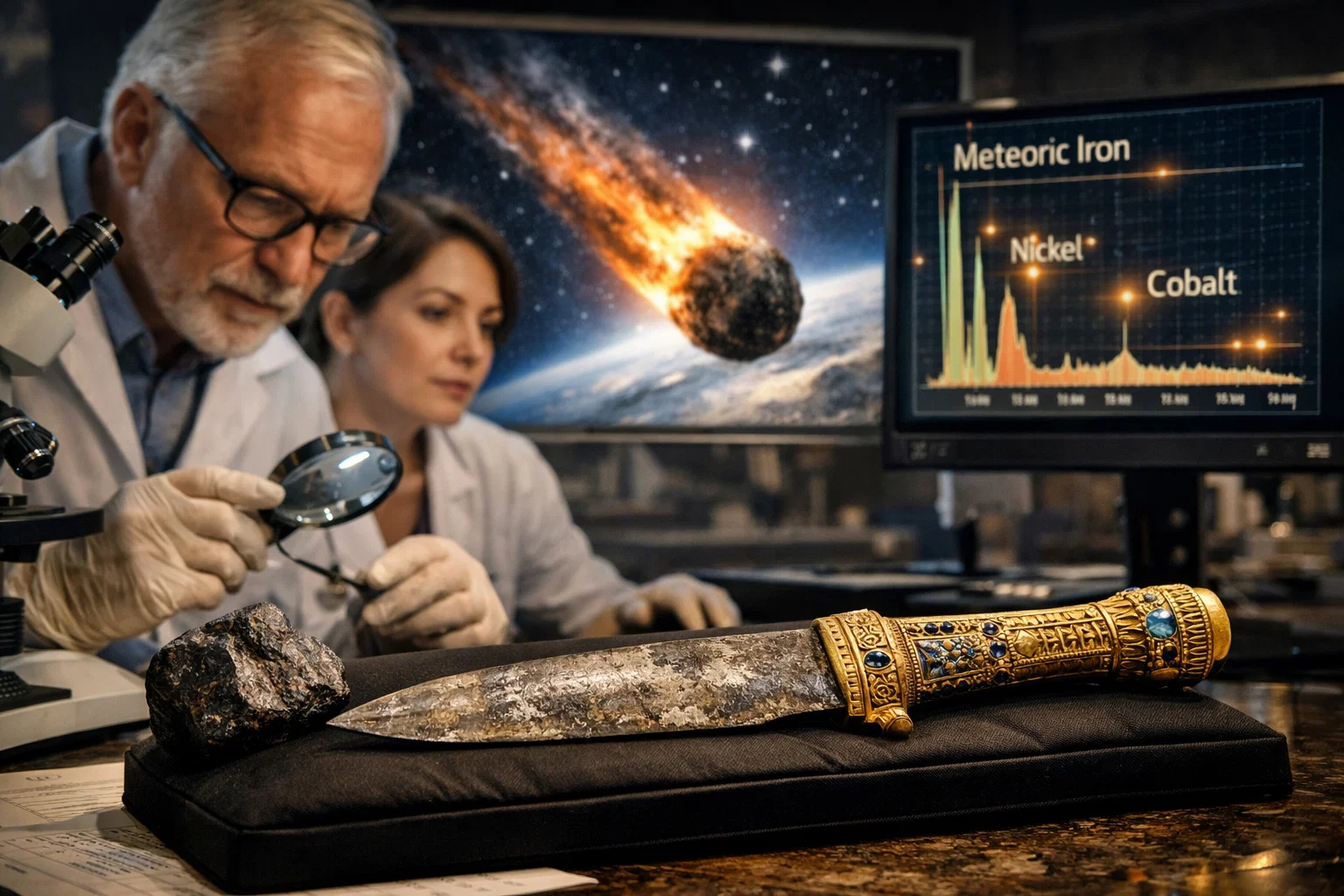
Scientists Discover That Iron Objects Used In The Bronze Age Were Not Made On Earth And Analysis Reveals That The Metal In Ancient Artifacts Such As Tutankhamun’s Dagger Came Literally From Space
For decades, archaeologists have faced a difficult-to-explain mystery. In excavations from the Bronze Age, a period when societies did not yet know how to produce iron, objects made exactly from that metal appeared.
Among them is one of the world’s most famous historical pieces, the dagger of Pharaoh Tutankhamun, found inside his tomb in Egypt.
The question seemed simple, but no one could answer it for sure: where did this iron come from, if at that time there was still no technology to produce it?
-
New shoe factory in Ceará is expected to create 400 jobs and strengthen the local economy.

-
No one imagined it, but a mixture of sawdust with a mineral that fights fires surprises scientists with a result that changes the course of fire-resistant construction.
-
From empty land to a high-end house, wooden construction uses a lightweight system, metal structure for the foundation, ventilated ceramic cladding, and special windows to create an efficient and comfortable living space throughout the year.

-
From vacant land to a high-end house, wooden construction uses a lightweight system, a metal structure for support, ventilated ceramic cladding, and special windows to create an efficient and comfortable living space throughout the year.


The answer began to emerge when scientists decided to analyze the composition of these artifacts using modern techniques.
The Historical Enigma That Confused Archaeologists For Decades About The Presence Of Iron In An Era When Humanity Still Did Not Know How To Produce This Metal
The so-called Bronze Age received its name for a clear reason. During that period, ancient civilizations mastered the manufacturing of bronze, a mixture of metals used to produce weapons, tools, and ornaments.
The problem is that iron requires much higher temperatures to be produced.
According to experts, this process needs to reach around 1538 degrees Celsius, something impossible with the technologies available at that time.
Still, some objects made of iron continued to appear in archaeological excavations.
This detail has always sparked debates among researchers, as it seemed to contradict the entire chronology of the evolution of metallurgy.
Archaeological Treasure Found In Spain Brought An Important Clue To Explain The Mystery Of Iron In The Bronze Age
One of the most intriguing cases emerged in 1963 when archaeologists discovered the so-called Treasury of Villena in Spain.
The collection includes 66 ancient pieces, including objects made of gold, silver, and other precious metals.
Among so many valuable items, two small objects caught attention.
They were made of iron.
These pieces were among artifacts dating approximately from 1400 to 1200 BC, a period when iron had not yet been produced by humans.
This discovery raised an important question among specialists.
Did ancient civilizations already know how to work with iron much earlier than previously thought?
The Chemical Analysis Of The Artifacts Revealed An Impressive Detail That Completely Changed The Interpretation Of Ancient Metallurgy
To resolve the doubt, researchers analyzed the chemical composition of these objects.
The result was surprising.
The iron present in these artifacts has a proportion of elements that is not typically found in metals produced on Earth.
According to the studies, the composition corresponds to the so-called meteoric iron, material that is part of meteorites that fall from space.
In other words, the metal used in these objects was not produced by humans.
It arrived on the planet after space rocks struck the Earth’s surface.
Ancient civilizations simply took advantage of this rare material that was already available.
The Famous Dagger Of Tutankhamun Confirms That Ancient Civilizations Valued The So-Called Sky Iron
One of the most well-known examples of this phenomenon is the dagger found in the tomb of Tutankhamun, a pharaoh who lived in Egypt over three thousand years ago.
Analyses conducted on this object showed that the metal also has characteristics typical of meteorites.
This confirms that the material came from space.
Interestingly, ancient records suggest that the Egyptians already associated iron with the sky.
A term used in hieroglyphic writing to designate the metal literally meant iron of the sky.
Experts believe that this expression may have arisen precisely because ancient peoples recognized the unusual origin of this material.
Scientific Studies Indicate That Most Of The Iron Objects From The Bronze Age May Have Origins In Meteorites That Struck The Earth
In 2017, researchers analyzed various ancient artifacts and compared the ratio of nickel and iron present in these objects.
This comparison helps to identify whether the metal was produced on Earth or came from meteorites.
The results pointed to something curious.
The few known iron artifacts from the Bronze Age exhibit typical characteristics of meteoric iron.
According to experts, this suggests that practically all objects from that period were made from fragments of meteorites.
Only around 1200 BC did humanity begin to develop techniques for producing iron in a controlled manner.
This moment marks the beginning of the so-called Iron Age, when metallurgy made a significant technological leap.
The discovery draws attention because it shows that some of the first iron objects in human history may have literally started with material that fell from space.
This detail helps to explain why these artifacts were so rare and valuable in ancient civilizations.
If you enjoy curious discoveries in science, archaeology, and the history of technology, share your thoughts in the comments. Do you think other ancient objects still hide secrets from space?









Seja o primeiro a reagir!