





 Português
  Inglês
  Espanhol
  4 min de leitura
  37 comentários


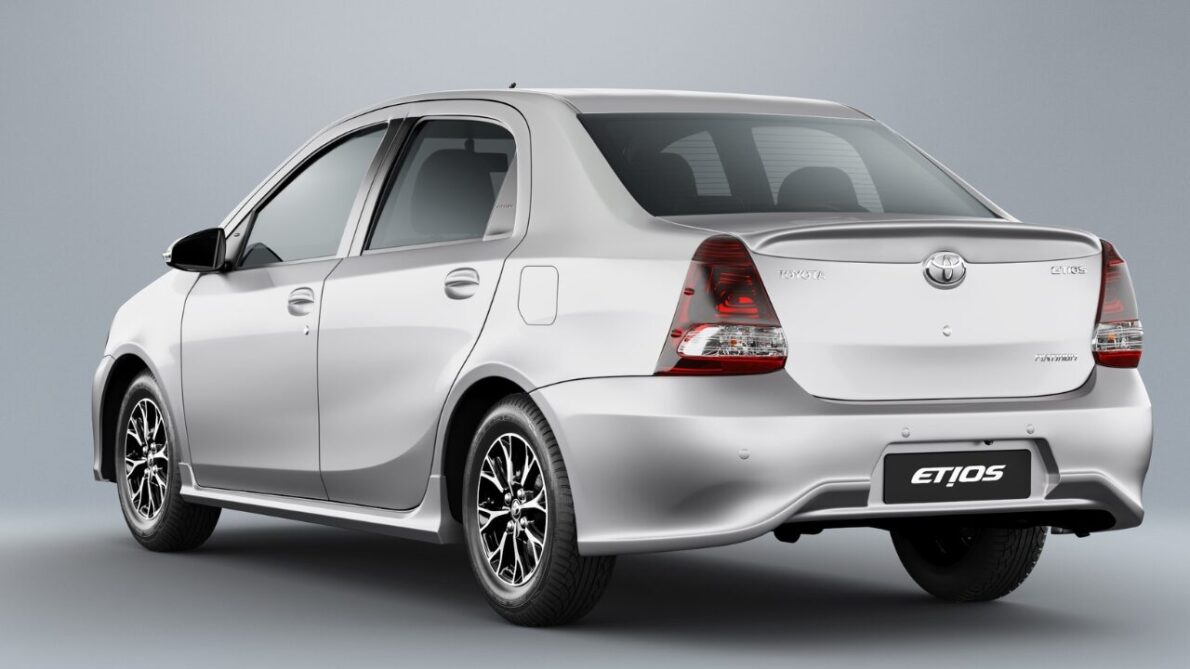

Toyota Etios: Complete Analysis of the Japanese Compact Focused on Design, Mechanics, and Strengths and Weaknesses of the Car (2013–2021).
The Toyota Etios was a compact car that was present in Brazil from 2013 to 2021. It was available in both hatch and sedan versions and was Toyota’s entry model in the national market until it was replaced by the Yaris, a more modern project. In this article, we analyze the main characteristics of the Etios, exploring its strengths and weaknesses.
Meet the Toyota Etios
Originally launched in India in 2010, the Toyota Etios was designed as a low-cost vehicle for emerging markets.
Its lines were anticipated through functional concepts revealed prior to the official launch.
-
OMODA & JAECOO grows in Europe in 2026 with an integrated strategy of sales, innovation, local production, and technological advancement in the United Kingdom, Italy, and Spain.

-
OMODA & JAECOO expands after-sales service in Brazil with competitive maintenance, a 7-year warranty, and high availability of parts for technological SUVs.

-
OMODA & JAECOO appoints Alessandra Souza as executive marketing director in Brazil and accelerates brand expansion with a focus on innovation, networking, and hybrid portfolio.

-
Jaecoo 7 with super hybrid SHS system exceeds 1,200 km of combined range with a 1.5 turbo engine, high-density battery, and intelligent energy management.
The sedan arrived first in the market, followed by the hatch. The production versions kept the design of the concepts, featuring rectangular headlights, a front grille with the Toyota emblem, and bumpers painted in the body color.
In 2016, the Etios underwent a facelift that included black mask headlights, a central grille with a black finish, and new bumpers, giving it a sportier appearance.
Overall, the design was simple, with some sporty touches, but without many bold elements, reflecting the aim of being an affordable car.
The Etios was built on the EFC platform, the same one used in the Toyota Yaris. The model had two options of flex fuel four-cylinder engines, both naturally aspirated.
The first, the 1.3 engine, produced up to 88 horsepower and 13.1 kgfm of torque. This engine was available only for the hatch, with a five-speed manual or a four-speed automatic transmission.
After the 2016 facelift, the manual version changed to six speeds.
Meanwhile, the 1.5 engine available from the 2020 version produced up to 107 horsepower and 14.7 kgfm of torque.
Like the 1.3, the 1.5 also came with manual or automatic transmission options. Both engines provided a comfortable and efficient driving experience, typical of Toyota.
In terms of safety, the Etios followed the standard of the category, with disc brakes on the front wheels and a rear suspension by torsion beam.
The simple and robust mechanics earned the Etios a reputation for being a reliable car.
Car Interior
The interior of the Toyota Etios was designed to be functional and economical. One of the most unusual features was the location of the instrument panel, which was centered on the main dashboard rather than behind the steering wheel.
This choice was made to facilitate the car’s adaptation for countries with right-hand drive, but it was not well received by Brazilian consumers.
Additionally, hard plastic predominated in the interior, reflecting the aim of keeping costs low.
The 2016 facelift brought some improvements, such as the adoption of a digital instrument panel similar to that of the Toyota Prius hybrid, and the inclusion of higher-quality materials in some interior areas.
Still, the finish remained basic and far from sophisticated.
What You Need to Know Before Buying the Car
More advanced features, such as traction and stability controls, only began to be offered at the end of the model’s life cycle, making the Etios less competitive in terms of technology, especially compared to rivals that already offered these systems as standard.
The Toyota Etios has several strengths that made it popular among consumers. Its maintenance cost is one of the biggest attractions, with Toyota providing a good reputation for durability and low maintenance costs.
The Etios is known for its mechanical robustness, fuel economy, and reasonable preventive care costs.
In terms of performance, the Etios, especially in the versions with the 1.5 engine, offers a comfortable and solid driving experience, suitable for daily use.
Interior space is also a positive point, with the sedan offering a trunk of 562 liters, larger than many medium sedans, and satisfactory accommodations for passengers.
However, the Etios has its weaknesses. The interior finish has often been criticized for its simplicity, with the predominant use of hard plastic and the unusual location of the instrument panel in the center of the car.
The cheaper versions of the model lacked basic comfort items, and even the more complete versions did not offer many advanced technological features.
Additionally, the Etios’s design was considered personalityless and unappealing, reflecting its aim of being a low-cost car, but not fully meeting consumer style expectations.
Is It Worth Buying the Toyota Etios?
The Toyota Etios faced strong competition in the Brazilian market. Among its main rivals were the Volkswagen Gol, Fiat Palio, Chevrolet Onix, Hyundai HB20, Ford Ka, Fiat Argo, and Volkswagen Polo.
These models, especially in the more recent versions, offered more technology and superior finishes, making the competition fierce.
The Toyota Etios was a car that carved out its space in the Brazilian market, particularly for its mechanical reliability and low maintenance cost.
However, its limitations in terms of design, technology, and interior finish led it to lose ground to more modern models.
Still, the Etios is remembered as a robust and economical car, characteristics that have always been associated with the Toyota brand.










Tenho um Etios, é muito bom,me adaptei rápido ao painel de instrumentos no centro. Confortável e para o tamanho dele é econômico.
Tive um etios 1.5 sx sedan 2018. Carro a toda prova. Vendi com km187 mil, motor zerado.. agora peguei um corolla hybrido. Toyota é Toyota!
Etios, já tive um sedam 1.5, carro incrível, rodei 396 mil km e o vendi depois de um acidente que quase perdi a vida , desde então não encontrei vantagens em nenhum outro carro, mas ainda quero adquirir outro Etios e rodar 1.000,000,000,000de km nele .😁