





 Portuguese
  English
  Spanish
  4 min of reading
  0 comments



U.S. Advances in Semiconductors with Impressive Energy Efficiency Position the Country to Challenge China in the Technology Sector
The advancement of data storage technology is a central theme in semiconductor material research, and a recent discovery promises to transform this field.
Researchers from the University of Pennsylvania, the Massachusetts Institute of Technology (MIT), and the Indian Institute of Science (IISc) developed a technique that amorphizes indium selenide using an electric current, drastically reducing the energy energy consumption of this process.
What Is Phase Change Memory (PCM)
Phase Change Memory, known by the acronym PCM (from English Phase Change Memory), is a promising technology in data storage that explores the ability of certain materials to change their state between amorphous and crystalline.
-
A “silent skill” is allowing Brazilians to earn up to R$ 22,000 per month without a degree and become indispensable for companies that rely on millions of data to survive.

-
Researchers at the Toyota Research Institute found that if a human uses robotic arms to flip a pancake 300 times in an afternoon, the robot learns to do it on its own the next morning, and this is currently the most promising method to solve the biggest bottleneck in modern robotics.

-
Goodbye iron: a common item in households is starting to lose space to technology that smooths clothes in minutes without an ironing board and with less energy consumption.

-
Antarctica reveals an unusual clue high in the Hudson Mountains, and what appeared to be just an isolated rock began to expose a secret hidden under the ice for ages.


This phase change allows information to be stored in a binary form, much like an on/off system, similar to the binary data system used in computers.
Currently, PCM is applied in devices such as mobile phones and computers, but it still faces large-scale challenges due to the high energy consumption required to change the phase of materials.
This process is typically performed through melting and quenching, a method that requires rapid cooling after the material is heated to a liquid state, preventing the formation of crystals.
Bella Ciervo
Semiconductors! The Researchers’ Discovery: Reduction in Energy Consumption
In a recent collaboration between India and the U.S., researchers discovered that it is possible to perform a phase change with a billionth of the energy required in efficient methods, using indium selenide (In₂Se₃).
The use of this environmentally friendly material heralds a new era for data storage capabilities, especially in low-power devices.
The amorphization process, which transforms the material into an amorphous phase, is typically achieved through extreme heat.
However, the group led by Ritesh Agarwal from the University of Pennsylvania stated a decade ago that electric pulses could achieve the same effect in germanium-, antimony-, and tellurium-based materials.
More recently, the study expanded to include indium selenide, a semiconductor with unique properties.
Unique Properties of Indium Selenide
Indium selenide (In₂Se₃) possesses ferroelectric and piezoelectric characteristics, meaning it can polarize spontaneously and generate electric current in response to mechanical stress. These properties facilitate the amorphization process with lower energy consumption.
To better understand the process, Agarwal sought samples of the material from Professor Pavan Nukala at the Indian Institute of Science (IISc).
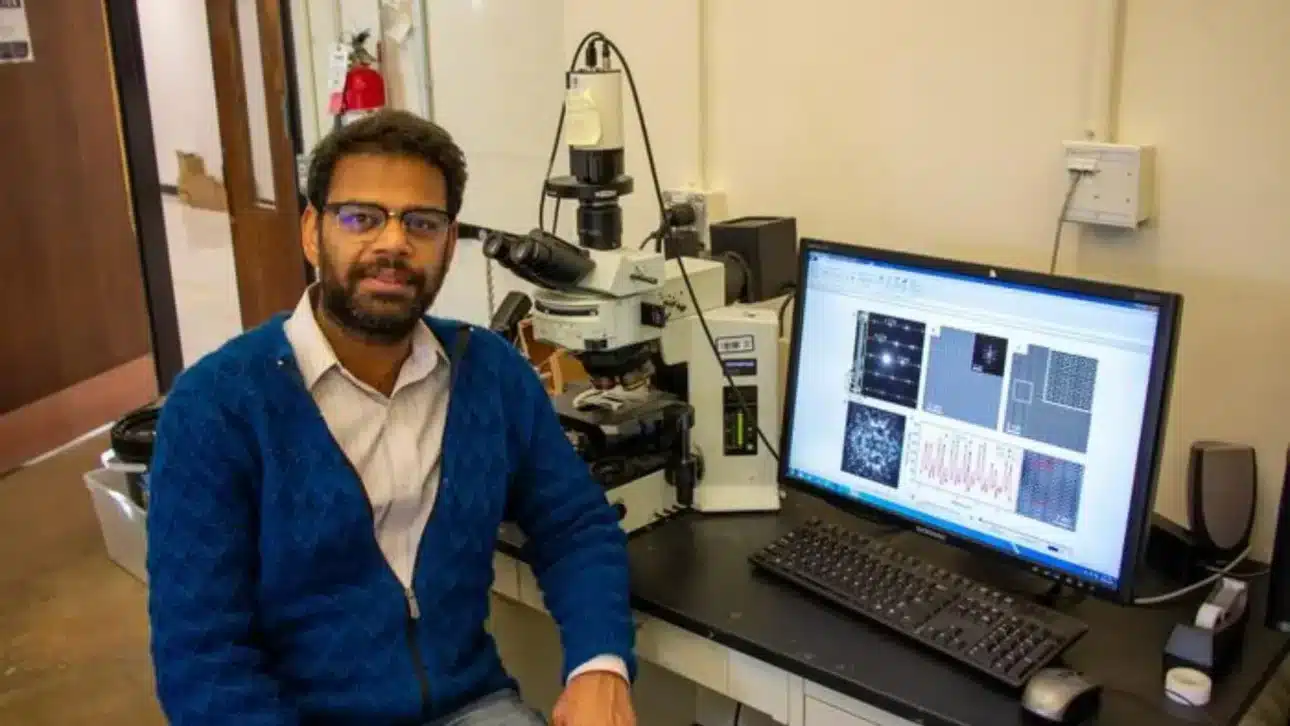
Nukala and his team used a suite of advanced in-situ microscopy tools to observe the characteristics. Scientists noted that the amorphization process in In₂Se₃ occurs similarly to an earthquake or avalanche.
The Avalanche and Earthquake Phenomenon in the Material
During the application of an electric current, small regions of indium selenide, measuring just a billionth of a meter, began to amorphize.
The piezoelectric properties and structure of the material generate instability, causing portions of In₂Se₃ to shift, similar to the movement of snow on a mountain about to collapse.
When the deformation reaches a critical point, the material undergoes a chain propagation of changes, akin to the seismic waves that occur during an earthquake. These waves create new amorphous areas, like an avalanche.
It is at this point that energy is utilized most efficiently, as the process self-reinforces.
Impact and Future of PCM Technology with Indium Selenide
The discovery opens new possibilities for developing low-power memory devices. Shubham Parate, a PhD student at IISc and part of the study, describes the experience as “breathtaking” while observing all these characteristics interacting across various scales.
Professor Agarwal emphasizes that the discovery opens new horizons in the area of structural transformations of materials.
From these combined properties, it is possible to design memory devices with significantly reduced energy consumption, which could benefit everything from small mobile devices to large data processing centers that require high efficiency.
However, there are still challenges to be faced for PCM with indium selenide to reach the market widely. A complete understanding of the interactions between the piezoelectric and ferroelectric properties of In₂Se₃ is crucial for enhancing the efficiency of the process and its predictions on industrial scales.
Conclusion
The study conducted by researchers from the University of Pennsylvania, MIT, and IISc indicates a promising future for data storage in low-energy consumption devices.
By using electric currents to amorphize indium selenide, it was possible to drastically reduce the energy consumption of the phase change process.
This technological innovation could be a key to solving one of the biggest problems of PCM, providing more efficient and sustainable storage.







Seja o primeiro a reagir!