





 Portuguese
  English
  Spanish
  4 min of reading
  0 comments


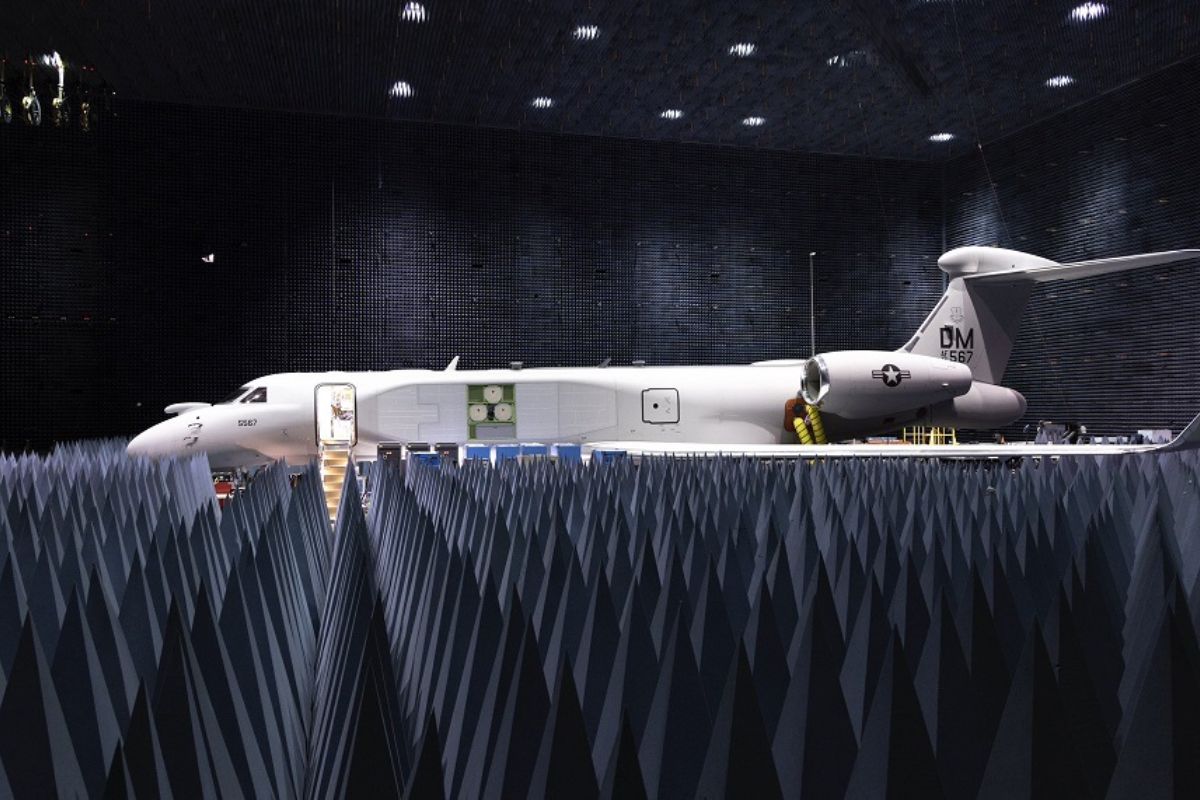
Based on the Gulfstream G550, the EA-37B Compass Call electronic warfare aircraft landed on January 26 in Ramstein, Germany, opening the Pentagon itinerary through Spangdahlem and RAF Mildenhall. Developed by L3Harris and BAE Systems, it promises to neutralize enemy communications, navigation, and command, elevating allied informational superiority in European NATO
The dispatch of the electronic warfare aircraft EA-37B Compass Call to Europe marked the first appearance of the more modern version of the Compass Call platform before NATO operators, landing on January 26 at Ramstein Air Base in Germany.
The presence of the EA-37B occurs within a Pentagon “roadshow,” with scheduled stops in Spangdahlem also in Germany and at RAF Mildenhall in the United Kingdom, in a move that repositions the aircraft as an operational showcase for conducting modern conflicts on the continent.
What the EA-37B Compass Call Was Doing in Ramstein

The EA-37B landed in Ramstein, Germany, as the inaugural stop of a traveling presentation aimed at interlocutors and allied forces.
-
A “silent skill” is allowing Brazilians to earn up to R$ 22,000 per month without a degree and become indispensable for companies that rely on millions of data to survive.

-
Researchers at the Toyota Research Institute found that if a human uses robotic arms to flip a pancake 300 times in an afternoon, the robot learns to do it on its own the next morning, and this is currently the most promising method to solve the biggest bottleneck in modern robotics.

-
Goodbye iron: a common item in households is starting to lose space to technology that smooths clothes in minutes without an ironing board and with less energy consumption.

-
Antarctica reveals an unusual clue high in the Hudson Mountains, and what appeared to be just an isolated rock began to expose a secret hidden under the ice for ages.


The visit was described as the first time the newest version of the Compass Call is showcased directly to NATO operators in Europe, enhancing visibility of capabilities that operate outside the scope of kinetic combat.
According to Lieutenant Colonel Ronnie Smith, deputy chief of the U.S. Air Force’s future operations division in Europe, the aircraft raises the level of contemporary combat.
“As it enters operational service, this aircraft will deliver decision dominance across all domains”, he stated.
Why the Electronic Warfare Aircraft Draws Allies’ Attention

The EA-37B is described as a mission system that goes beyond “radar and radio.”
The electronic warfare package enables long-range electromagnetic jamming, with the capability to neutralize enemy air defenses, interrupt communications, affect navigation systems, degrade intelligence gathering, and pressure command and control networks.
In practice, the aircraft is presented as capable of disrupting the adversary’s “attack chain,” which integrates sensors and weapons across multiple domains.
The cited scope involves the air, land, sea, space, and cyber domains, with a focused effect on delaying decisions and reducing operational coordination.
Platform Gulfstream G550 and the Sensor Package

The EA-37B is based on a modified Gulfstream G550 business jet, a solution that combines the range and flight envelope typical of executive aircraft with a mission set dedicated to electronic warfare.
Experts attribute the development to L3Harris, in partnership with BAE Systems, responsible for components of the Compass Call system.
The project’s logic, as described, is to deliver jamming at a distance, without relying on entering the same type of “risk bubble” as fighters executing direct suppression of enemy air defenses.
The goal is to create a strategic layer of protection, reducing the exposure of allied forces while the adversary loses communication quality and coordination.
Replacement of the EC-130H and the History of the Compass Call
The EA-37B replaces veteran EC-130H Compass Call aircraft, based on the C-130 cargo plane.
These models are cited as decisive in the Iraq War, interfering with insurgent communications and even triggering improvised explosive devices.
In total, 14 EC-130H aircraft are in the process of retirement, making way for a leaner and more technologically advanced fleet of the new standard.
The transition also indicates a generational change and mission architecture, moving from a cargo platform to a modified business jet, promising greater operational efficiency and integration with networked combat scenarios.
Delivery Schedule, Base in Arizona, and Expected Fleet
The new version began to be delivered to the U.S. Air Force in 2023. The first operational unit entered service in 2024, at Davis-Monthan base in Arizona.
The current plan envisions a total fleet of 10 aircraft, a number that reinforces the idea of highly selective and strategically valuable employment.
Captain Tyler Laska, pilot of the EA-37B, summarized the operational effect sought with the aircraft:
“Every second of hesitation we can impose on the adversary increases the survival of our forces across all domains.”
The statement reflects the goal of imposing delay, friction, and uncertainty, without necessarily having to physically destroy the opposing system.
NATO Effect and the Italian Purchase of Up to Four Units
The impact of the EA-37B extends beyond the U.S. Italy signed a contract for US$ 300 million to acquire at least two units, with authorization to purchase up to four aircraft.
The move is presented as a reinforcement of technological integration within NATO, suggesting convergence of doctrine and electronic warfare tools among allies.
In this framework, the EA-37B is described as a complementary alternative to high-risk fighters: it operates at a distance and expands the informational “umbrella,” creating space for maneuver and reducing the adversary’s ability to coherently connect sensors, communications, and weapons.
Do you think the arrival of this electronic warfare aircraft in Europe changes NATO’s deterrence balance, or is it more of a symbolic demonstration than a real operational turning point?







-

-

2 pessoas reagiram a isso.