





 Portuguese
  English
  Spanish
  4 min of reading
  0 comments


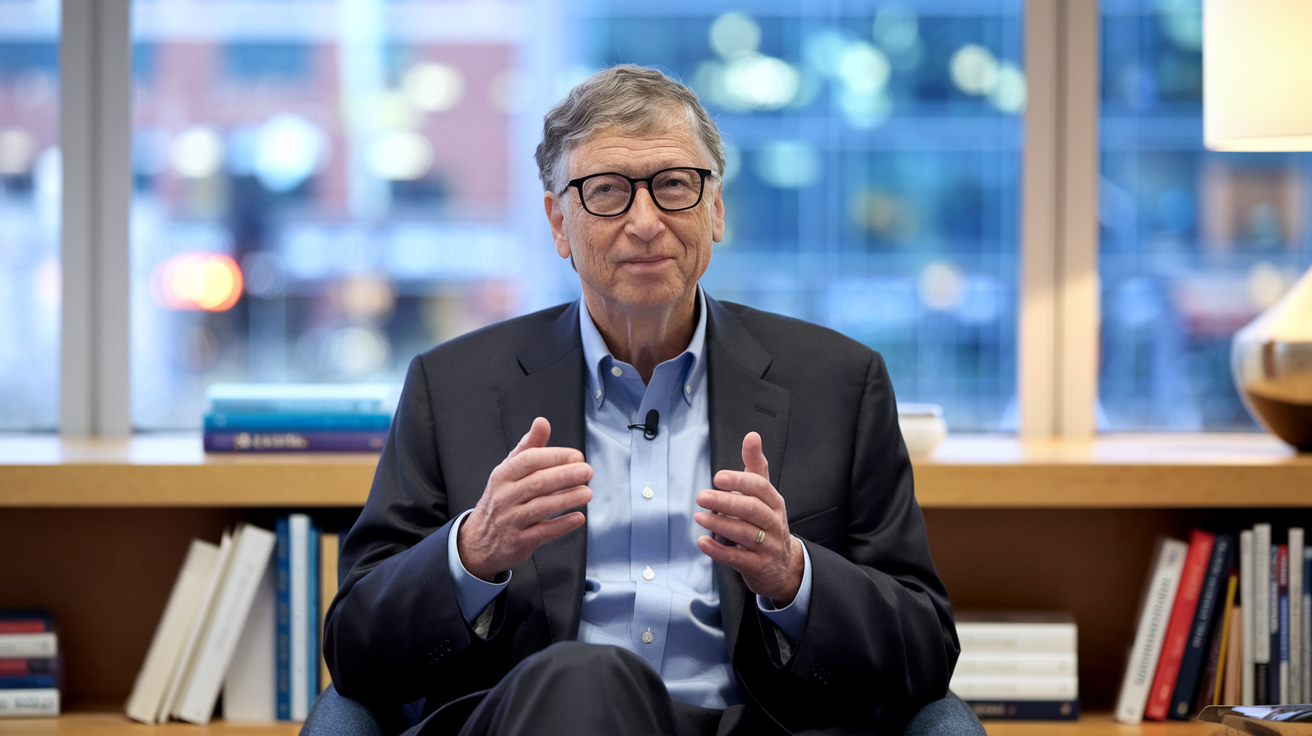
Bill Gates Lists Professions That Will Survive Artificial Intelligence: Understand the Impact of AIs on the Job Market
Artificial intelligence (AI) is revolutionizing the job market at an accelerated pace, raising concerns and expectations worldwide. However, some professions seem to be more secure in the face of this technological advance. This is asserted by none other than Bill Gates, co-founder of Microsoft and one of the most influential voices when it comes to the future of technology and innovation. In an interview on The Tonight Show with Jimmy Fallon on March 29, Gates pointed out professional areas that, according to him, are likely to resist total replacement by AI in the coming decades. The statement came during his world tour to promote the book “Source Code: My Beginnings”, where he shares experiences and visions about the future of humanity amid the digital revolution and the professions that will survive artificial intelligence.
Areas That Should Resist Artificial Intelligence
According to Bill Gates, three main sectors tend to maintain — and even expand — their demand for human professionals: health biosciences, alternative energies, and the development of artificial intelligence itself.
1. Biosciences and Medical Research
The biosciences sector, especially in medical research and diagnostics, is one that requires creativity, intuition, and critical thinking — human traits that are still not replicable by machines. Although AI is becoming increasingly present in exams and diagnostics, such as X-rays and lab tests, it still cannot propose complex or innovative hypotheses with the same level of human sensitivity.
-
Volcanic lava transforms into threads as fine as human hair that travel over 30 kilometers by wind and fall like cutting rain on roofs and backyards in Hawaii and Iceland.

-
Son of a seamstress from the rural area of Ceará who did not speak English wins a scholarship of over 2 million reais at Williams College, one of the top 10 universities in the United States, covering everything including dormitory, meals, and annual trips to Brazil.

-
Bill Gates revealed that the true secret behind every great achievement is not a brilliant leap but rather small improvements repeated over the years, and the data from his own career and the fight against climate change prove that he is right.
-
NASA issues a warning for the feared Godzilla El Niño that could change the planet’s climate in 2026 with extreme warming of the Pacific capable of causing devastating droughts in some regions and historic floods in others simultaneously.


According to Gates, the role of the scientist will remain fundamental, both in developing new therapies and in understanding more sophisticated biological mechanisms. The development of vaccines, personalized treatments, and the study of rare diseases, for example, still require human reasoning that goes beyond mere data analysis.
2. Renewable Energies and Energy Transition
Another sector mentioned by Gates is alternative energies, which is undergoing a global transformation with the transition from fossil fuels to clean sources, such as solar, wind, and nuclear energy. This transition requires not only technological innovation but also the ability to adapt to different regulatory, environmental, and cultural contexts — tasks in which human judgment is essential.
The billionaire emphasizes that, although automation can optimize processes, the formulation of creative solutions, the management of energy public policies, and the development of sustainable infrastructure still depend on unique human skills.
3. The Development of Artificial Intelligence Itself
Interestingly, the third area that should survive AI is… AI itself. This is because technology, no matter how advanced, still requires human knowledge to be created, maintained, adjusted, and improved. Activities such as debugging, training algorithms, and developing new natural language models are deeply dependent on human involvement.
According to Gates, AI still lacks the ability to solve problems autonomously at deep levels, which requires data science professionals, software engineers, technology ethics specialists, and others to ensure its proper functioning and safe evolution.
The Global Impact of Artificial Intelligence on Work
Although some professions are more protected, the overall outlook for the job market is one of deep transformations in the coming years. A study by Goldman Sachs estimates that 300 million jobs worldwide will be impacted by artificial intelligence, whether by partial or total replacement or restructuring of roles.
Meanwhile, the report “Future of Work 2023” from the World Economic Forum indicates that 41% of companies worldwide expect to reduce or reorganize part of their workforce due to automation and the adoption of AI-based technologies. The scenario is similar in Brazil: a survey by the International Monetary Fund (IMF) predicts that at least 41% of professional activities in the country will be affected in the coming years.
Free Education and Medical Diagnosis?
During the interview, Bill Gates also shared a bold prediction: in the next 10 years, AI could provide free high-quality medical diagnosis and personalized education services. According to him, excellent medical advice and private lessons, currently restricted to a few, could be accessible to anyone with an internet-connected device.
This represents a remarkable advance, but it also imposes a new challenge: the continuous adaptation and qualification of professionals. The trend is that, instead of competing directly with machines, workers develop skills that complement AI, such as emotional intelligence, strategic thinking, and the ability to solve complex problems.
What to Do to Survive the Age of AI?
For Bill Gates, the key to survive — and thrive — in the age of artificial intelligence lies in two fundamental factors:
- Cautious Choice of Field: Invest in sectors where creativity, ethical judgment, and human interaction are irreplaceable.
- Continuous Learning: Stay updated on new technologies, develop digital skills, and understand how AI can be an ally, not a threat.
Although the advancement of artificial intelligence represents a revolution in the job market, it also opens doors to new opportunities. Professions based on creativity, innovation, critical thinking, and empathy tend to resist and gain even more value. The future will require adaptation, continuous training, and strategic choices — and, as Bill Gates says, this is the perfect time to prepare.







-

Uma pessoa reagiu a isso.