





 Portuguese
  English
  Spanish
  4 min of reading
  5 comments


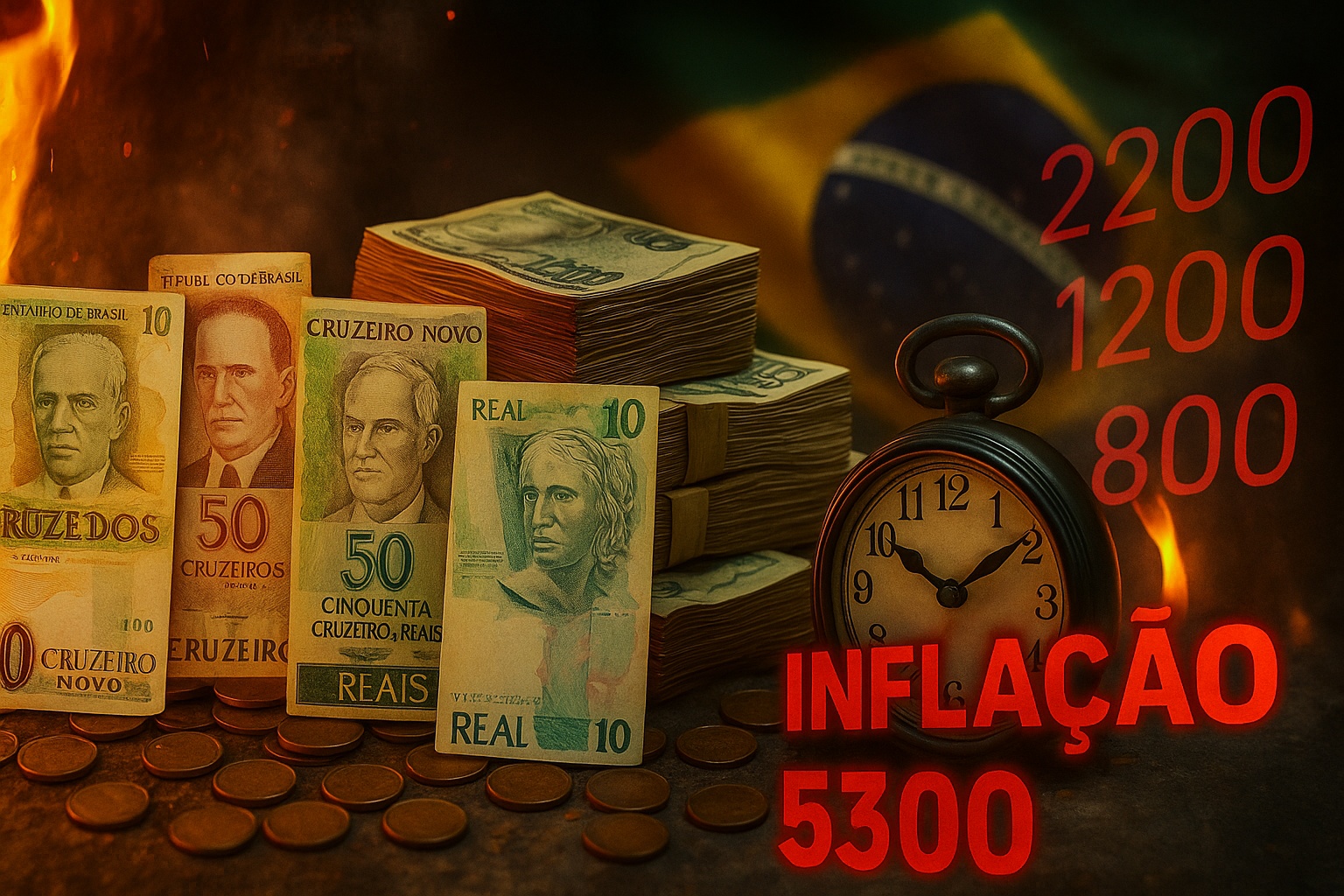


Between 1986 and 1994, Brazil switched five currencies and faced historic hyperinflation — a period remembered as the greatest monetary instability in modern times.
“Brazil experienced the highest inertial inflation in the world,” stated Ibrahim Eris, former president of the Central Bank, who led the institution in 1986 during the launch of the Cruzado Plan. Between 1986 and 1994, the country changed its currency five times, in a succession of failed attempts at stabilization.
The changes — Cruzado, Cruzado Novo, Cruzeiro, Cruzeiro Real, and Real — occurred amid annual rates that frequently exceeded 1,000%, eroding salaries and savings. For the former leaders of monetary policy, this period was the “greatest monetary instability ever recorded in a large economy.”
Cruzado (1986): Freezing and Short Hope

The Cruzado Plan, launched by the Sarney government in 1986, replaced the Cruzeiro with the Cruzado (Cz$). The package included price and salary freezes, elimination of monetary correction, and a cut of three zeros from the currency.
-
Unemployment rises again to 5.8% at the beginning of 2026, raising alarms about the end of temporary positions and its impact on the Brazilian job market.

-
Document organization can cut invisible costs in small businesses, a simple step that prevents waste, rework, and losses in daily operations.

-
Chinese giant worth nearly R$ 4 billion that manufactures cables for electric cars, solar energy, and robotics wants to open a factory in SC.

-
Many employers do not know, but the law guarantees domestic workers a 25% increase in salary during trips, 50% for overtime, 20% for night shifts, and 17 additional benefits that can lead to labor lawsuits if not paid.


Initially, there was euphoria: inflation, which exceeded 200% per year in 1985, plummeted. But the absence of fiscal adjustment undermined the results. In less than a year, prices soared again. Ibrahim Eris, then president of the Central Bank, would later say that “society believed that inflation could be fought without discipline in public accounts, but soon reality proved otherwise.”
Cruzado Novo (1989): New Cut of Zeros
With inflation once again out of control, the government created in 1989 the Cruzado Novo (NCz$), eliminating three more zeros from the currency.
Francisco Gros, who took over the Central Bank in 1987 and returned in 1991, would recognize years later that these changes “merely disguised the problem without addressing its origin.”
Cruzeiro (1990): Confiscation of Savings
With Fernando Collor taking office in 1990, Brazil returned to the Cruzeiro (Cr$). This was also when the controversial Collor Plan I, which confiscated bank deposits exceeding a certain limit, came into force.
Ibrahim Eris, again in charge of the Central Bank, defended the measure as “an inevitable shock in the face of hyperinflation,” but admitted that the social impact was devastating. The effect was also short-lived: after months of decline, inflation skyrocketed again in 1991.
Cruzeiro Real (1993): Transition Currency
In 1993, under the government of Itamar Franco, the Cruzeiro Real (CR$) was born, designed as an intermediate step for a broader plan.
Gustavo Loyola, president of the Central Bank at that time, stated that “hyperinflation eroded the currency to the point that it had lost its essential function as a store of value.” In 1993, inflation exceeded 2,400%, confirming the chaos.
Real (1994): The Definitive Turnaround
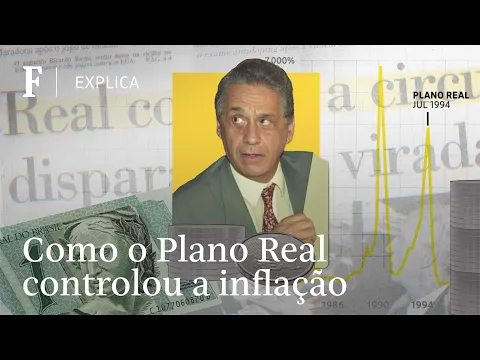
In July 1994, with Fernando Henrique Cardoso as Minister of Finance, Brazil launched the Real Plan. The project created the URV (Unit of Real Value) as a transitional currency, aligned prices, and finally introduced the Real (R$).
Gustavo Loyola remained at the Central Bank until 1995 and was one of those responsible for consolidating the new monetary regime. He recalls that “the Real was a watershed: not just a currency, but a complete reorganization of expectations and the credibility of the State.”
Pedro Malan, Minister of Finance starting in 1995, would reinforce the social dimension: “inflation is the most perverse tax, as it hits the poor the hardest.”
The Social Drama of Hyperinflation
During this period, Brazilians lived under a cruel logic: racing to the supermarket on payday to stockpile products before prices rose. Rent, contracts, and even salaries had to be adjusted monthly, sometimes weekly.
The IBGE estimates that, between 1980 and 1994, the official price index accumulated a variation of over 13 trillion percent. Few countries have experienced such monetary erosion over such a long period.
International Comparisons
The Brazilian case is often compared to episodes of hyperinflation such as that of Germany in the 1920s or Zimbabwe in the 2000s. However, according to scholars from the IMF, what distinguishes Brazil is the longevity of the crisis and the succession of currencies in an economy that was already one of the ten largest in the world.
For former presidents of the Central Bank, the period left clear lessons:
- Without fiscal balance, there is no stable currency.
- Nominal currency changes do not solve problems without institutional credibility.
- Inflation destroys more than the economy: it undermines social trust.
The Real, which has been in circulation for three decades, is remembered as a symbol of victory against instability. But the statements from Loyola, Eris, and Malan reinforce that the achievement of stability requires constant vigilance.
Between 1986 and 1994, Brazil changed its currency five times, experienced annual hyperinflation in the thousands of percent, and witnessed a succession of failed economic plans.
It was, as Gustavo Loyola said, “a laboratory of mistakes and successes that cost the population dearly, but left as a legacy the awareness that stability is a public good.”
The memory of this period, made by former presidents of the Central Bank, serves as a warning: preserving confidence in the currency is preserving the very foundation of economic development.










Faltou citar o autodenominado pai do Real, Ciro Gomes, e sua importância no momento econômico do Brasil….
A mudança nao deveria ser feita na moeda e sim nesses políticos incompetentes ,que só querem o poder ,e a economia que se exploda .
O real que Fernando Henrique criou com maestria e muito êxito, lembro que o real chegou durante um curto período a ficar mais valorizado que o dólar. Mas que a partir de 2003 um **** assumiu a presidência e daí a economia foi só ladeira abaixo
Fazendo uma pequena correção cronológica:
A adoção do câmbio flexível foi oficialmente anunciada em 18 de janeiro de 1999. Em fevereiro, o dólar já batia R$ 2 pela primeira vez, na chamada “maxidesvalorização do real”