





 Portuguese
  English
  Spanish
  6 min of reading
  0 comments


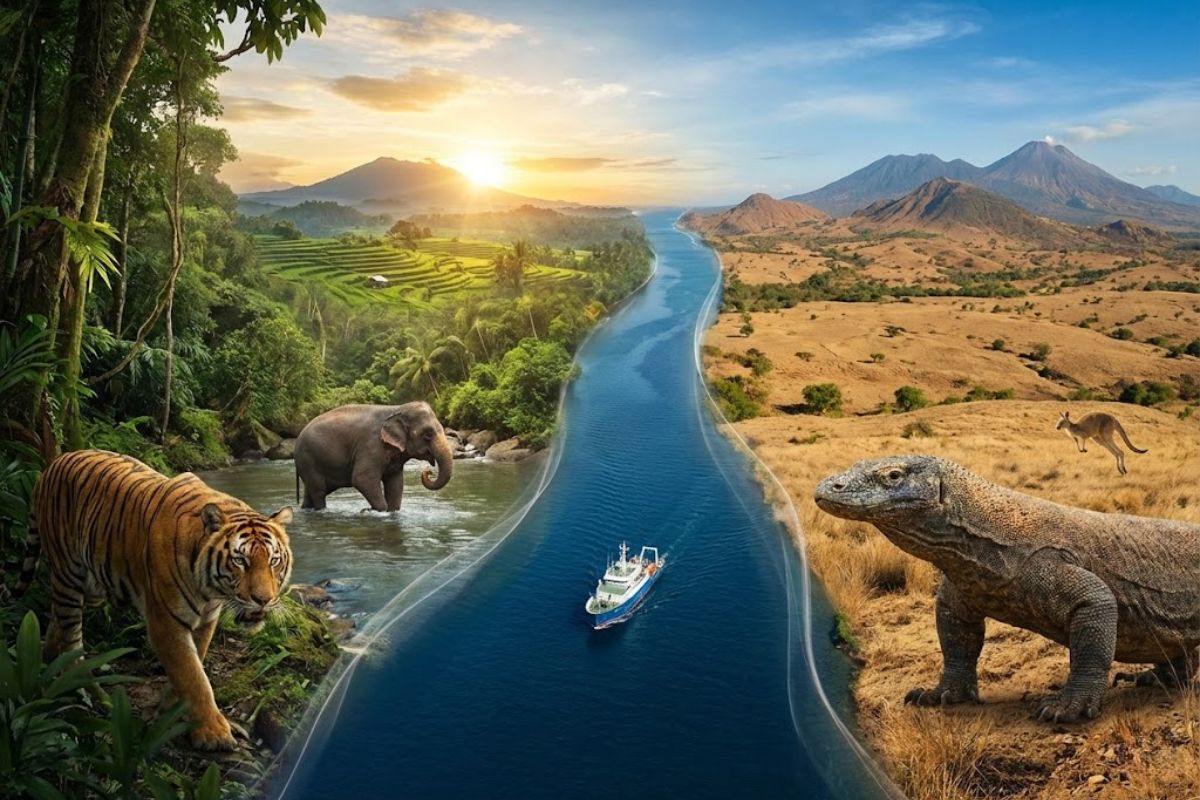
Between Bali and Lombok, Indonesia, a Strait of 32 Kilometers Marks the Shortest Point of the Wallace Line, a Biogeographical Boundary Between Asian and Australian Fauna. On One Side, Tigers and Elephants Emerge; on the Other, Marsupials and Komodo Dragons. Geology, Deep Currents and Tectonics Explain This to This Day
The Indonesian archipelago hosts one of the planet’s most intriguing natural divisions: an invisible biogeographical boundary that abruptly changes which animals appear on either side of islands separated by a short stretch of sea. In just 32 kilometers between Bali and Lombok, the composition of the fauna stops following the Asian pattern and starts to display elements typical of another evolutionary world.
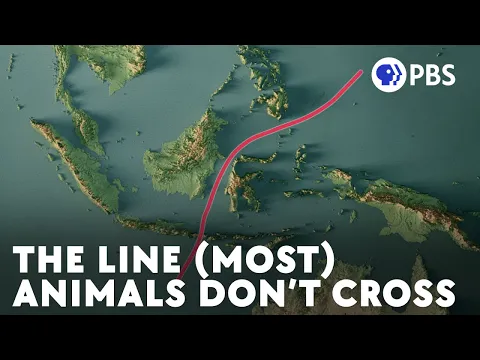
The phenomenon became known as the Wallace Line and runs through the Malay Archipelago, the largest collection of islands on the planet, creating a contrast that seems impossible for those looking at the map. What changes is not the landscape that the eye sees, but the geological history beneath, with deep seas, strong currents, and a tectonically complex region that blocked crossings and separated lineages for long enough for the biodiversity to split in two.
What Is the Wallace Line and Why Does It Seem “Real” Without Being Visible in Indonesia

The Wallace Line in Indonesia is described as a biogeographical boundary, a meeting point between two highly distinct biodiversity regions. It is “real” because it manifests in species distribution, but it is “imaginary” because it does not exist as a continuous physical barrier, like a wall or a mountain range.
-
Buried under China, a colossal machine weighing 20,000 tons began operating as the largest neutrino detector on the planet and, in just 59 days, surpassed results that science took half a century to achieve.

-
Iran enters the center of a climate alert after the war emitted 5.6 million tons of CO2 in two weeks, surpassing the annual pollution of entire countries.

-
Lunar exploration may change after a Chinese probe finds a “cavity” of radiation that reduces the impact on astronauts by up to 20% at certain times on the Moon.
-
Artemis 2 sends four astronauts on a historic mission to the Moon after 50 years, with a launch on April 1 and a record flight to the far side of the Earth’s natural satellite.

On the western side, the fauna is characteristic of Asia, with examples like rhinoceroses, elephants, tigers, and woodpeckers. Crossing to the eastern side, the list changes drastically: marsupials, cockatoos, honeyeaters, and Komodo dragons appear, while many common species from the Asian side simply do not emerge.
The Bali and Lombok Shock: 32 Kilometers That Separate Two Worlds

The most emblematic section in Indonesia occurs between Bali and Lombok, where the narrowest point of the Wallace Line coincides with a 32-kilometer canal. The proximity creates the expectation of a gradual transition of fauna, but what is observed is a sharp break.
This type of contrast fueled the idea: in Java and Bali, certain birds were abundant, but they did not exist in Lombok. Among the cited examples are the yellow headed weaver, the coppersmith barbet, and the Javanese three-toed woodpecker, absences that cannot be explained by coincidence when they are repeated in mammals and even in many insects.
Alfred Russel Wallace and the Origin of the Line in 1859

The Wallace Line was first sketched in 1859 by Alfred Russel Wallace, a British naturalist and co-discoverer of natural selection. The perception arose during an eight-year journey through the Malay Archipelago, during which he hopped from island to island observing and collecting species.
Wallace noticed that the change in fauna when moving from Bali to Lombok was sudden and distinct, and he considered the difference between the two islands more striking than that between England and Japan. From this observation, he consolidated his name as a central reference in biogeography, the field that studies how living beings are distributed in space.
The Geological Clue: Why Some Islands Were Once “Continents” in Practice

Wallace concluded that the current proximity of the islands was not enough to explain the boundary. He began to consider that geological history shapes present biology: the current distribution of species reflects ancient events and can reveal chapters from the planet’s past.
The central hypothesis was that the islands on the western side would have been connected to each other and to the Asian continent during periods of lower sea level when more water was trapped in ice. This would explain how large animals, like tigers and rhinoceroses, reached islands that are now separated by a stretch of open sea too wide for natural crossings of that scale.
Strong Currents and Deep Seas: The Barrier That Continues to Function
Wallace’s idea also includes the existence of deeper waters and stronger currents between the two regions, capable of preventing species from crossing even when the sea level was lower. This condition acts as a persistent filter and helps maintain the separation to this day, even with the islands relatively close.
The effect is not limited to large mammals. The observation includes birds and insects that also “obey” the line, suggesting that for many species, stretches of open ocean remain an effective barrier, even for organisms capable of flying.
The Modern Explanation: Plate Tectonics and the Complete Puzzle
The missing piece to complete the model was plate tectonics, a concept that only became widely accepted in the late 1960s, more than half a century after Wallace’s death. Through this lens, the Wallace Line comes to be understood, at its core, as the result of a tectonic encounter in one of the most complex regions of the planet, with multiple plates interacting.
The modern interpretation points to two semisubmerged paleocontinents during the glacial eras: Sunda to the west and Sahul to the east. Sunda relates to the Asian continental shelf; Sahul encompassed Australia, Tasmania, New Guinea, and the Aru Islands. Even though they now seem like neighbors, these blocks were separated for long enough for the faunas to evolve along very distinct trajectories.
Sunda, Sahul and the Deep Clock: 20 to 25 Million Years of Approaching
Sahul only approached the Sunda platform about 20 to 25 million years ago, at the end of the Oligocene or the beginning of the Miocene, as a result of the slow movement of the Australian plate northward. This movement, over tens of millions of years, carried with it a unique set of birds, reptiles, and marsupials.
Thus, when the two worlds finally came close together, the encounter was recent in evolutionary terms. The current geographical neighborhood does not erase the fact that the species on each side had “too much time” to differentiate, and occasional “bridges” were not enough to mix everything homogeneously.
Wallacea: The Islands That Were Never Anyone’s and Became a Natural Laboratory
Immediately to the east of the line, plate tectonics created a chain of new oceanic islands known as Wallacea. They differ from the continental islands on the sides because they were never connected to Sunda or Sahul, functioning as spaces that needed to be filled by biological colonization.
In this scenario, the Wallace Line acts as a filter: Asian species find greater resistance to moving eastward, while the composition that arrives tends to more strongly reflect the biological “pool” from the Australian side, reinforcing the mosaic of fauna observed on the current map.
Komodo Dragons: An Example of Delayed and Limited Dispersion
The Komodo dragon, a large monitor lizard that lives today on some islands in eastern Indonesia, serves as an illustrative case of this story. The oldest fossils associated with the group appear on the Australian continent over 3 million years ago, during the Pliocene.
The arrival at the current set of islands in the Wallace region is much more recent, around 1 million years ago. Even afterward, the deep waters and strong currents, including the strait between Lombok and Bali, continue to limit the dispersion of many species, preserving differences that would be smoothed out if the crossings were easy.
The invisible line in the Indonesian archipelago is not a geographical risk, but a portrait of deep time: deep seas, strong currents, and a complex tectonic architecture separated animal communities, brought paleocontinents together in stages, and created islands that were never connected to the large blocks. The result is a biogeographical boundary that, even without existing physically, continues to organize the distribution of tigers and elephants on one side and marsupials and Komodo dragons on the other.
If you were in Bali looking at Lombok, would you bet that the fauna would be almost the same simply because they are so close, or would you already suspect that Indonesia hides a real biological divide on the map of life?






-

-

-

4 pessoas reagiram a isso.