





 Português
  Inglês
  Espanhol
  7 min de leitura
  0 comentários


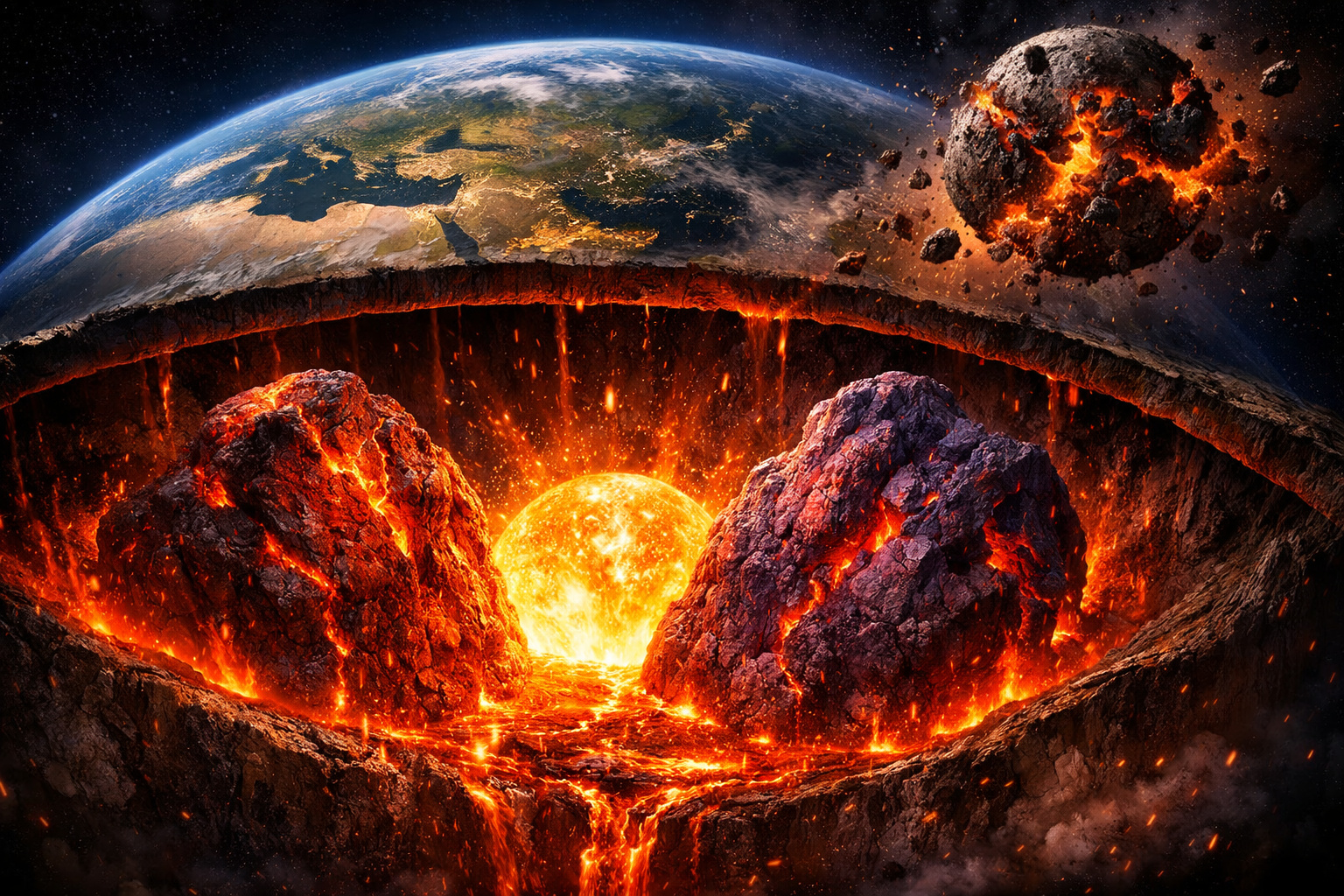
Scientists Detected Two Giant Structures in the Earth’s Mantle, 2,900 km Deep; They May Be Remnants of the Planet Theia That Collided with Earth.
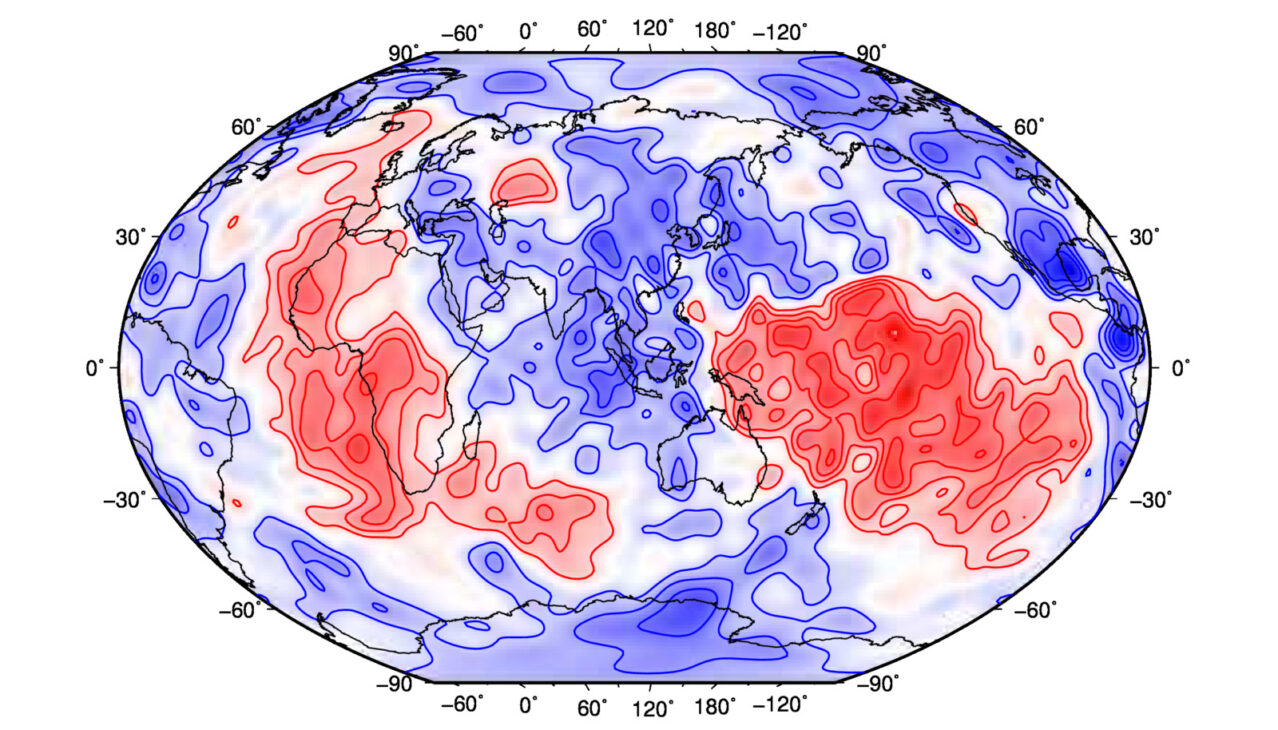
At two specific points in the lower mantle of the Earth, about 2,900 kilometers deep, immediately above the molten outer core, seismic waves slowed down anomalously. Something in that region had different physical properties from the rest of the mantle. And that something was gigantic.
LLSVPs: The Largest Structures Ever Detected in the Earth’s Mantle
Scientists began to call these structures Large Low-Shear-Velocity Provinces (LLSVPs). In 2011, geologist Kevin Burke proposed names for the two main structures, honoring two pioneers of plate tectonics.
-
A bright yellow mushroom imported from Asia escaped from a cultivation farm in the United States in 2010 and is now aggressively spreading across 25 states, destroying entire communities of native fungi in American forests.

-
Buried under China, a colossal machine weighing 20,000 tons began operating as the largest neutrino detector on the planet and, in just 59 days, surpassed results that science took half a century to achieve.

-
Iran enters the center of a climate alert after the war emitted 5.6 million tons of CO2 in two weeks, surpassing the annual pollution of entire countries.

-
Lunar exploration may change after a Chinese probe finds a “cavity” of radiation that reduces the impact on astronauts by up to 20% at certain times on the Moon.

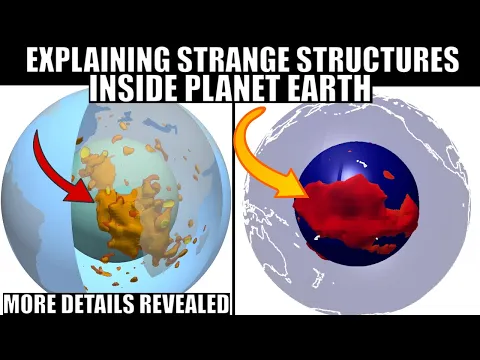
The structure located beneath Africa was named Tuzo, in honor of geophysicist J. Tuzo Wilson. The other, located beneath the Pacific Ocean, was called Jason, in reference to geophysicist W. Jason Morgan. The dimensions of these structures are hard to imagine.

Each of them has a lateral extension of thousands of kilometers, comparable to the size of entire continents. Additionally, they rise up to 1,000 kilometers above the boundary between the mantle and the Earth’s core. For comparison, Mount Everest is about 8.8 kilometers high. The Tuzo and Jason structures are approximately 100 times taller.
Together, the two LLSVPs occupy between 3% and 9% of the Earth’s total volume, making them some of the largest known internal structures on any rocky planet.
What Seismic Waves Reveal About the LLSVPs in the Earth’s Mantle
Seismic tomography clearly shows that seismic waves travel through the LLSVPs more slowly than they do through the surrounding mantle. This behavior may indicate two main possibilities.
The first is that the material in these regions is hotter than the rest of the mantle. The second is that it is chemically different, with a distinct mineral composition. Many researchers believe that both conditions occur simultaneously. Temperature alone, however, does not fully explain the observed data.
If the LLSVPs were just pockets of hot rock, they would be less dense than the surrounding material and would tend to rise in the form of mantle plumes — exactly what happens in volcanic hotspots like Hawaii. However, the structures have remained relatively stable for at least 500 million years, possibly much longer.
Studies based on earth tides and the normal modes of planet vibration indicate that the bottom of these structures is about 0.5% denser than the surrounding mantle. This value may seem small, but in structures with continental dimensions, it represents a colossal amount of additional mass.
Recent Studies Indicate That the LLSVPs Are Extremely Old
A study published in January 2025 by Utrecht University provided new clues about the nature of these deep structures. The researchers analyzed the damping of seismic waves within the LLSVPs and found that the minerals present in these regions have much larger grains than those found in the surrounding areas.
In regions where subducted tectonic plates accumulate, mineral grains tend to be smaller due to constant deformation. Larger grains indicate mineral growth over extremely long periods.
The conclusion of the study was that the LLSVPs are very old structures — at least 500 million years, possibly much older.
This result suggests that, contrary to what many simplified representations indicate, the Earth’s mantle is not completely mixed, maintaining distinct chemical regions over enormous geological timescales.
The “Tectonic Plate Graveyard” Hypothesis
One of the oldest explanations for the origin of the LLSVPs is relatively simple. According to this hypothesis, the structures would be a gigantic graveyard of subducted oceanic plates. Over billions of years of plate tectonics, oceanic plates have continuously sunk into the Earth’s mantle in the so-called subduction zones.
The oceanic crust has a basaltic composition and is denser than the surrounding peridotitic mantle. When it sinks to great depths, under extremely high pressures and temperatures, it becomes even denser.
In this model, the LLSVPs would be the final accumulation of this recycled material, formed by oceanic plates that sank over hundreds of millions of years and accumulated at the base of the mantle, near the core. This hypothesis also explains the position of the structures.
Tuzo and Jason are located precisely where mantle circulation models predict that dense material should accumulate. Additionally, they are positioned antipodally, that is, approximately on opposite sides of the planet — a configuration representing a dynamic equilibrium point for large masses within a spinning planet.
Geochemical Evidence That Challenges The Recycled Crust Hypothesis
Despite being plausible, the graveyard hypothesis faces a significant problem. Basalts from oceanic islands formed over mantle plumes, such as the volcanoes of Hawaii and the island of Réunion, exhibit isotopic signatures that do not correspond to recycled oceanic crust.
Geochemical data indicate that the material feeding these volcanoes has a much older and distinct composition, incompatible with the material that should result from the subduction process. This has led some researchers to consider an even more radical hypothesis.
The Hypothesis That Fragments of Another Planet Are Buried in the Earth’s Mantle
In 2021, geodynamicist Qian Yuan, then a PhD student at Arizona State University, was studying moon formation models when he noticed something intriguing. The most widely accepted theory for the origin of the Moon is the giant impact hypothesis.
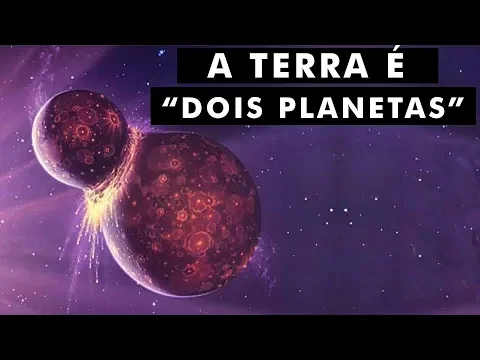
According to this model, about 4.5 billion years ago, a Mars-sized protoplanet called Theia collided with primitive Earth. Most of the debris ejected into orbit eventually coalesced to form the Moon.
The metallic core of Theia would have sunk toward the Earth’s core. But the fate of Theia’s mantle remained an open question. Yuan realized that the estimated dimensions and density of the LLSVPs were compatible with what fragments of Theia’s mantle could produce after the impact.
His study was initially rejected multiple times for lacking detailed impact modeling. Subsequently, he collaborated with experts in astrophysical simulations and published an expanded version of the work in Nature in November 2023.
Simulations Suggest That Fragments of The Planet Theia May Have Sunk into the Earth’s Mantle
The simulations showed that if Theia’s mantle were enriched in iron oxide, it could be 2% to 3.5% denser than the Earth’s mantle.
In this scenario, fragments of this material would not completely mix with the Earth’s mantle after the impact. Instead, they would sink through the global ocean of magma formed by the collision and eventually accumulate in the lower mantle.
Over geological time, these fragments could cluster and form two massive stable clusters, located in approximately opposite positions within the planet. The positions would coincide with the regions currently occupied by the Tuzo and Jason structures.
How the LLSVPs Influence Volcanoes and The Earth’s Magnetic Field
The LLSVPs are not just deep geological curiosities. They influence processes that reach up to the Earth’s surface. The edges of these structures coincide remarkably well with regions where large igneous provinces formed, giant volcanic events that released enormous volumes of lava throughout geological history.
These events have been associated with some mass extinctions. The hypothesis is that the edges of the LLSVPs function as regions where mantle plumes form. The heat from the core accumulates in these areas and eventually generates upward columns of hot rock that reach the surface.
Hotspots like Hawaii are situated directly above the Jason structure, while the island of Réunion in the Indian Ocean is located above Tuzo.
About 80% of African kimberlites, volcanic rocks that carried diamonds from the deep mantle to the surface over the past 320 million years, emerged above the edge of Tuzo.
The structures may also influence the Earth’s magnetic field. As they alter the heat flow between the core and the mantle, they affect the dynamics of liquid iron in the outer core — the process responsible for generating the planet’s magnetic field.
The South Atlantic Magnetic Anomaly, a region where the magnetic field is weaker, is located directly above the edge of the Tuzo structure.
What Recent Research Indicates About The Future Of These Deep Structures
In March 2025, researchers from Durham University published new high-resolution mantle circulation simulations. The results indicate that the LLSVPs may be about 2% denser and up to 100 times more viscous than the surrounding mantle.
This greater viscosity would cause the flow of the mantle to be diverted vertically around the structures, creating precisely the conditions where mantle plumes and volcanic hotspots tend to form.
Even with recent advances, the central question remains open. The LLSVPs may be extremely stable anchors of mantle circulation, structures that have organized the planet’s interior for billions of years.
Or they may be slowly evolving geological formations that could someday fragment and reorganize the pattern of volcanism and tectonism on the Earth’s surface. The answer to this question remains hidden almost 2,900 kilometers deep, in one of the most inaccessible regions of the planet.







-

-

-

-

-

-

209 pessoas reagiram a isso.