





 Portuguese
  English
  Spanish
  4 min of reading
  0 comments


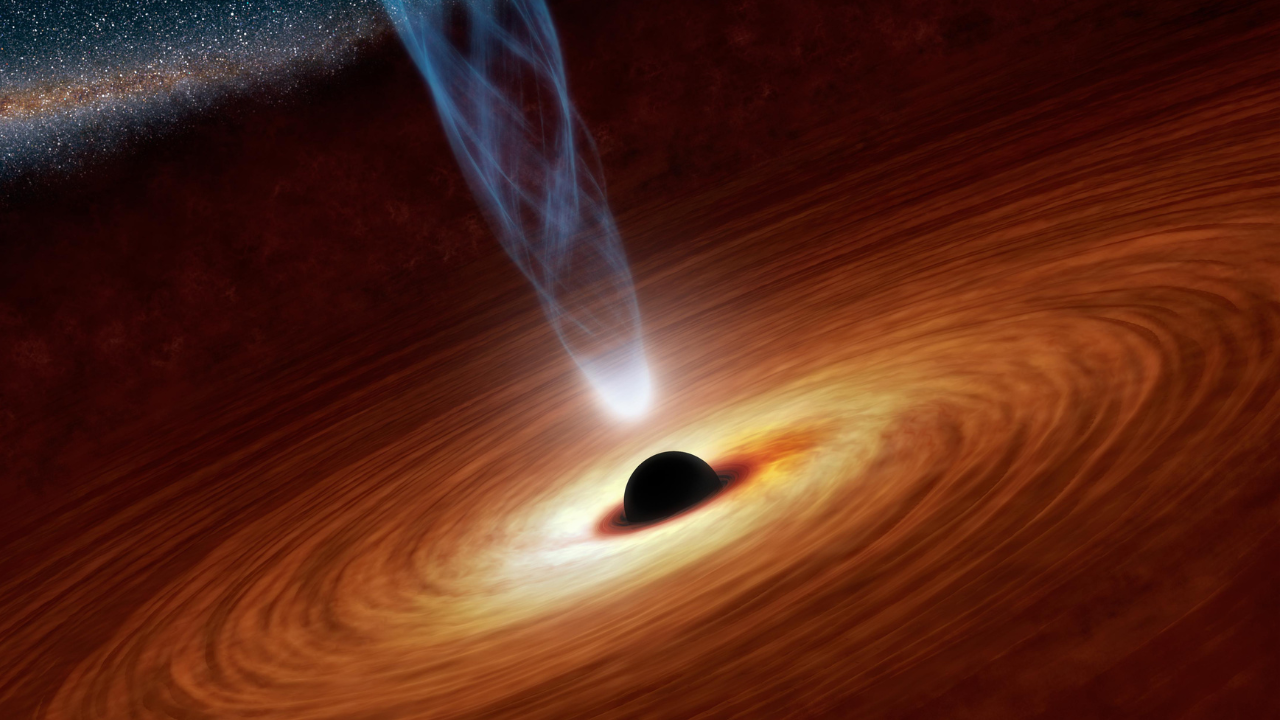
Astronomers Capture For The First Time A Plasma Jet Being Ejected From A Supermassive Black Hole At 1/3 The Speed Of Light.
In a historic discovery that promises to revolutionize studies on black holes, an international team of astronomers observed, for the first time, the formation of plasma jets being ejected from a supermassive black hole at 1/3 the speed of light.
The feat was accomplished by scientists using an advanced astronomical observation technique known as VLBI (Very Long Baseline Interferometry), which combines data from multiple radio telescopes located around the world.
The First Observation Of Plasma Jets In Real Time
The discovery occurred in 2023, when the astronomers, led by Eileen Meyer, a professor at the University of Maryland in the United States, were monitoring a distant galaxy called 1ES 1927+654, located in the constellation Draco, about 270 million light-years from Earth.
-
Millions of people have been eating yam for centuries without knowing that this humble tuber contains a compound called diosgenin, which scientists have now discovered can improve memory and help control blood sugar levels.

-
Scientists from an international project drill 1,800 meters of ice in Antarctica using hot water and discover details about one of the most intriguing places on planet Earth.

-
Seen from space, a colossal volcano nearly 5,000 meters high in Russia has released 1,600 km of smoke over the Pacific, forming “devil’s horns” of lava and revealing the brutal force of the Ring of Fire.

-
Expedition 501: Scientists drill into the ocean floor and discover a giant reserve of fresh water hidden beneath the sea, extracting nearly 50,000 liters and revealing an invisible system that could reshape the map of water scarcity.

This galaxy is considered an “active galactic nucleus” (AGN), meaning it harbors a supermassive black hole at its center.
The supermassive black holes, known for consuming material on a large scale, are known to emit plasma jets, a form of highly ionized matter.
These jets, which move at speeds close to that of light, have been observed by astronomers for decades, but until now, it had never been possible to observe the formation and movement of a jet in real time.
The phenomenon was described by Meyer as a “great explosion,” with a dramatic increase in radio, optical, ultraviolet, and X-ray activity from the black hole.
Starting in 2018, the black hole began to emit a radiation amount 100 times greater, surprising astronomers, who expected changes in a black hole to occur over much larger time scales.
The Plasma Jets And Their Impacts On Galaxies
The data obtained by the VLBI radio telescopes allowed scientists to see, in detail, the formation of plasma jets expanding at an impressive speed.
Meyer and her team were able to observe the acceleration of these jets, which were moving at an estimated speed of 20% to 30% of the speed of light, which is about one-third of the maximum speed that light can reach in space.
“These jets have a huge impact beyond their galaxy of origin,” Meyer explains.
“Understanding how they work is crucial to understanding how the universe is evolving and how galaxies form and transform over time.”
Furthermore, astronomers discovered that the jets from 1ES 1927+654 are significantly smaller than the jets from other supermassive black holes and may represent a new class of jets called “compact symmetric objects” (CSOs).
According to Meyer, this discovery may indicate the birth of a new type of CSO, which is fueled by the ingestion of a star or gas cloud, feeding the jet for up to a thousand years.
The Importance Of The Discovery For The Study Of Black Holes
The co-author of the study, Sibasish Laha, also from the University of Maryland, highlights the importance of the discovery.
“This study gives us, for the first time, the rare opportunity to understand how a supermassive black hole interacts with its host galaxy,” Laha says.
This type of interaction, never before observed in such detail, opens new possibilities for studying the behavior of these mysterious objects and their influences on the galaxies around.
Meyer notes that although there are still many theoretical challenges to overcome in order to fully understand what has been observed, astronomers now have an unprecedented amount of data to continue research.
“We are at the beginning of a new chapter in the exploration of black holes and their influence on the cosmos,” she concludes.
This research was recently published in the renowned journal Astrophysical Journal Letters and promises to bring new insights into the internal mechanisms of black holes and their effects on the surrounding galactic environment.
The Future Of Black Hole Observations
The discovery of plasma jets being ejected from a black hole at relativistic speeds opens new possibilities for understanding black holes and their internal dynamics.
With advanced observational tools such as VLBI, astronomers can now study these phenomena in more detail and in real time, offering crucial clues about the evolution of the universe and galaxies.
The future of research in astrophysics looks promising, with new discoveries waiting to be made.









Seja o primeiro a reagir!