





 Portuguese
  English
  Spanish
  4 min of reading
  0 comments


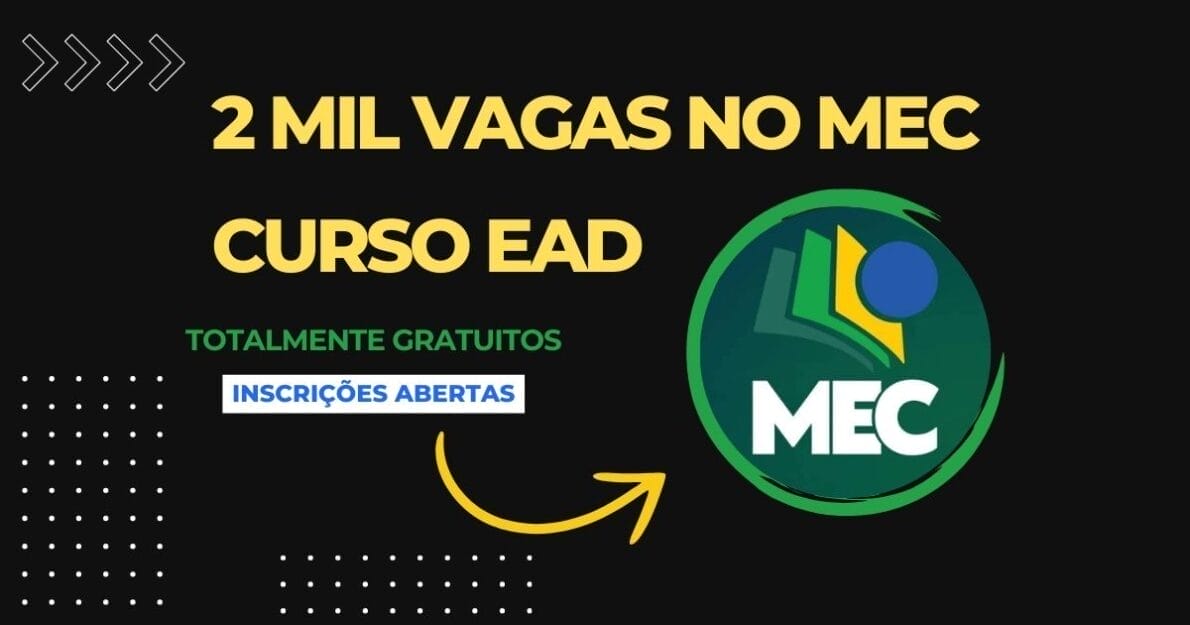
MEC Opens Enrollment for a Free 120-Hour Course on Student Empowerment. Completely Online, with Certification, the Course Is Aimed at Educators and Offers 2,000 Slots on the AVAMEC Platform. Enrollment Is Now Open!
If you are an educator looking for an innovative way to impact your students, the Ministry of Education (MEC) has an incredible solution.
A special training program of 120 hours, completely online and free, promises not only to enrich your teaching practices but also to revolutionize the way student empowerment is addressed in the classroom.
And the best part? You can become an even more qualified and updated professional without leaving home, with certification recognized by the MEC.
-
USP opens 10,000 spots in a free 100% online course lasting 110 hours in areas such as nutrition and health, with registrations until April 15 and classes on diabetes, obesity, and educational public policies.
-
Excel dominates job openings even in the era of artificial intelligence: analysis reveals high demand and highlights 5 courses to move beyond the basics and advance in the job market.
-
Senai launches free technology courses in Amapá and creates a strategic opportunity for those seeking quick qualification, entry into the job market, and professional growth in areas with high digital demand.

-
Take a free course at the Federal University: UFPR calls 200 candidates for intensive preparation for master’s and doctoral programs.

But what makes this course so special? Read to the end and discover everything about this opportunity that is shaking up the education sector.
Student Empowerment in Focus at MEC
Student empowerment has become a central piece in discussions about the future of education, and MEC, through the AVAMEC platform, has decided to offer 2,000 spots for a course entirely dedicated to the development of this theme.
The course “Training in the Development of Student Empowerment” is a unique opportunity for educators who want to transform their classrooms into spaces of greater engagement and active participation from students.
With a total of 120 hours of content divided into six modules, it has been carefully structured to align them with the socio-emotional competencies of the National Common Curriculum Base (BNCC), empowering teachers to foster autonomy and empowerment from the early years of schooling.
Content Adapted for Each Stage of Education
Each module of the course has been designed to meet the specificities of different phases of basic education, covering from early childhood education to youth and adult education (EJA).
Thus, participants can learn to implement effective strategies to promote empowerment at each of these stages.
In the early years of elementary school, the focus is on hands-on activities and active methodologies, such as integrating technologies and teaching sequences that encourage the student to lead their learning process.
Meanwhile, in the final years, the course addresses the transition between stages and how digital tools can strengthen the students’ leading role.
In high school, empowerment is explored in a deeper context, where students begin to work on the Life Project and develop a leading identity.
In EJA, the proposal is to value the life stories of students, encouraging active participation in their educational journeys, considering their cultural and social peculiarities.
Didactic-Pedagogical Reflection and Conceptual Markers
The course is not limited to theoretical content.
Each of the modules also includes practical reflections on how these concepts can be directly applied in the classroom, promoting a dynamic learning environment where the student is at the center of the educational process.
Socio-emotional competencies, such as self-knowledge, empathy, and resilience, are addressed to ensure comprehensive training for both educators and students.
This set of pedagogical strategies, as described by MEC, aims not only at academic development but also at the personal formation of students.
Extracurricular activities, debates, and educational technologies are some of the tools that assist in this process, creating a more inclusive and participative scenario.
Empowerment at Every Stage: From Childhood to EJA
Each phase of education requires a differentiated approach, and MEC’s course addresses this in depth.
In early childhood education, the methodologies are aimed at stimulating active involvement from an early age, always highlighting the importance of socio-emotional competencies for building protagonists.
In the early and later years of elementary education, teachers will learn to adapt their practices to the different demands of this age range, using innovative tools that make learning more participative and meaningful.
In high school, the course goes even further, focusing on the development of youth and the students’ Life Project, helping them build an academic and personal trajectory in a leading manner.
The Education of Youth and Adults (EJA), in turn, is treated with respect to its particularities, considering the different cultural and social profiles of students and offering specific pedagogical activities to promote empowerment.
How to Enroll in MEC’s Course
If you have made it this far, you must be curious to know how to secure your spot.
The enrollment for the course “Training in Student Empowerment” is now open and can be done directly on the AVAMEC platform.
There are 2,000 spots available, with no selection process. After enrollment, access to the content is immediate, allowing you to start studying as soon as you wish.
Take advantage of this opportunity and become a protagonist in education!








Seja o primeiro a reagir!