





 Portuguese
  English
  Spanish
  4 min of reading
  4 comments




Free Training in Industrial Artificial Intelligence Offers 500 Spots for Low-Income Public, with Online Classes, Four-Month Duration and Focus on Python, Machine Learning and Computer Vision Applied to Industry 4.0, as Well as Certification at the End of the Course.
The DigiTech Reference Center for Information and Communication Technology at Firjan SENAI has opened 500 free spots for an online Basic Qualification course in Industrial Artificial Intelligence, with registrations until February 27, remote classes, a duration of four months, and a certificate at the end.
Aimed at low-income individuals, the training starts on March 9 and has been structured for those who want to apply Artificial Intelligence in the industrial environment, especially in data analysis and computer vision, combining introductory content and tutor-guided activities.
Program Content and Focus on Industrial Applications
Throughout the class period, the program is divided into five modules, covering the fundamentals of Python for AI, data science, machine learning, computer vision, and a capstone project designed to integrate what has been covered and turn knowledge into applied delivery.
-
Federal Institute opens over 700 vacancies in free technical courses in Civil Engineering, Mechanics, Electrotechnics, Computer Science, and Nursing; see how to enroll and study at IFPB.
-
Become a professional in logistics, mechanics, computer science, chemistry, or gastronomy at the Federal Institute: Ifes opens more than 1,000 spots in free technical courses with selection without an exam.

-
Take a 100% online and free course at Itaú: Foundation releases 156 options with certificates, registrations open for all of Brazil, unlimited access, areas such as technology, education, and management, and a flexible schedule without tutoring.

-
Senai will pay up to R$ 700 per month for those who take free technical courses: there are 12,000 open positions across Brazil and training with access to the technology market.
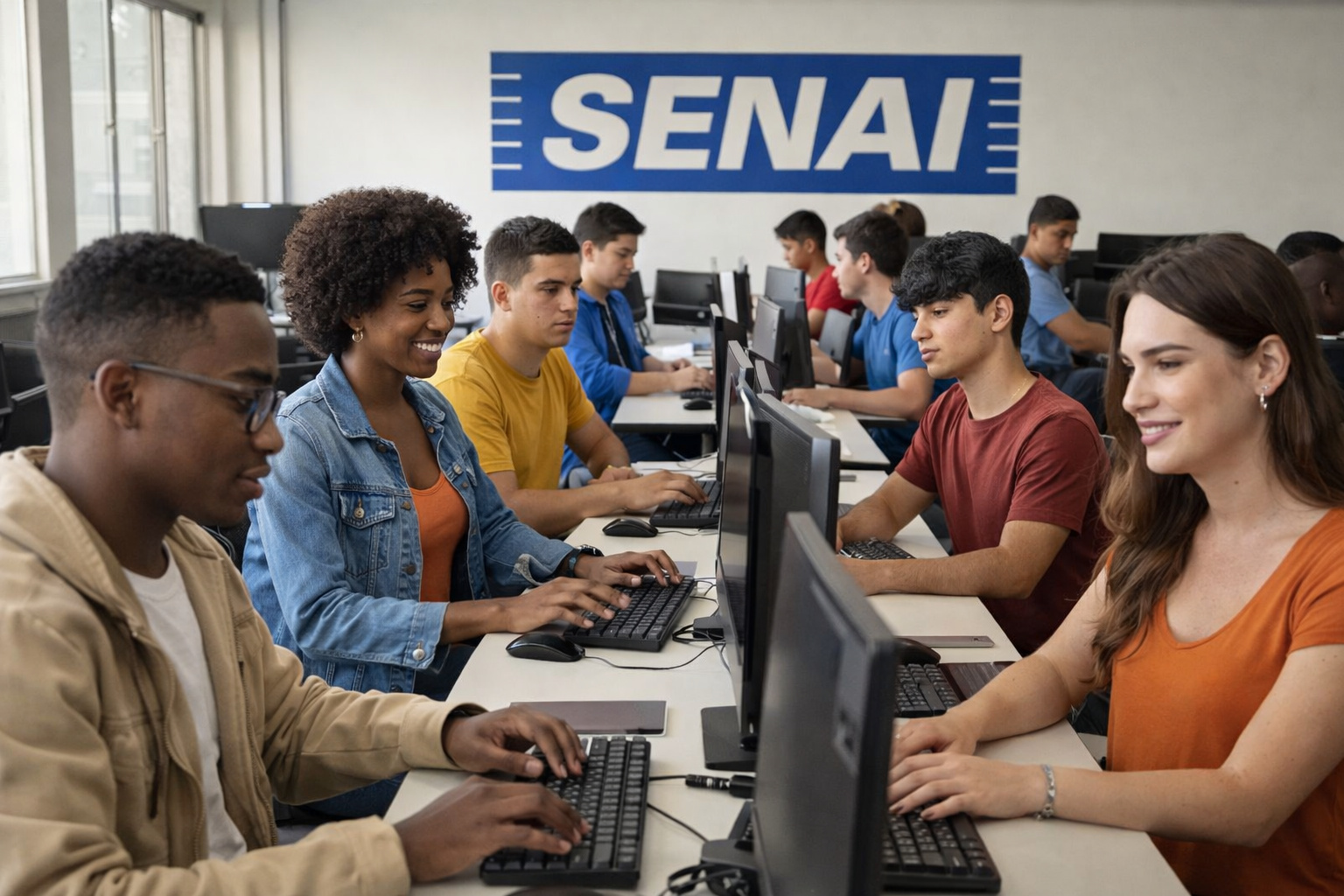
Instead of focusing solely on theory, the course includes programming exercises to automate tasks and organize databases, as well as routines for analyzing and processing information, a step considered essential before training models aimed at real-world problems.
In the models section, students will be exposed to machine learning techniques used to predict failures and identify patterns in data sets, a type of application common in predictive maintenance and industrial monitoring routines.
The computer vision module works with methods of reading and interpreting images and videos, an approach associated with tasks such as inspection and quality control, when automated systems help point out irregularities and reduce rework on production lines.
Final Project and Development of Real Solution
At the end of the course, each participant must present a solution of Artificial Intelligence applied to the industry, which transforms the capstone project into a central part of the proposal and tends to require integration between programming, data analysis, and model development.
This format puts the student in front of choices that make a difference in the outcome, such as defining the problem and the dataset, designing the processing flow, and how to evaluate performance, always within an industrial context compatible with the track.
In addition to the technical aspect, the course structure aims to bridge language and routines used in digital transformation projects, where data, automation, and image analysis connect to operational and productivity decisions, without relying on generic solutions.
DigiTech and SENAI Industrial AI Program
The opening of the spots marks the first free course from DigiTech, a Firjan SENAI unit focused on information and communication technology, and the initiative was announced as part of the effort to qualify individuals to work with AI applied to the industrial sector.
According to the institution, the course fits into the Industrial AI Program, which encompasses diagnosis, training, and practical application of Artificial Intelligence to support digital transformation in companies, with tracks aimed at both workers and organizations.
Within this strategy, the national program describes stages that combine immersion, maturity assessment, and guidance for technology adoption, and the logic of the free course follows the same direction by prioritizing applied learning and the construction of a final delivery.
In the course announcement, the Professional Education Manager of Firjan SENAI, Edson Melo, stated that “AI is no longer a trend” and presented the training as a pathway to expand professional activities in industrial projects with data.
Requirements to Participate in the Free Course
The spots are intended for individuals with monthly family income per capita of up to 1.5 federal minimum wage, a condition self-reported, and the audience must be at least 16 years old, be enrolled in high school, and have a computer and internet.
A basic knowledge of programming logic is also required, since the course starts with Python and progresses to data science, machine learning, and computer vision, topics that depend on minimal notions to follow the proposed activities.
For those who do not yet have this foundation, SENAI itself recommends a free online Programming Logic course on the Futuro Digital platform, an alternative suggested as preparation before entering the industrial Artificial Intelligence track.
How to Register for the Industrial Artificial Intelligence Course
Registrations are open until February 27 and, according to Firjan SENAI, must be made through the institution’s free notices portal, with spots filled up to the announced limit, respecting income, age, and other requirements.








INSCRIÇÕES FORAM ENCERRADAS LEIAM O EDITAL ANTES DE PUBLICAR. FICA A DICA ALISSON FICHER….
INSCRIÇÕES FORAM ENCERRADAS LEIAM O EDITAL ANTES DE PUBLICAR. FICA A DICA ALISSON FICHER.
quero saber qual é o adolescente que tem menos de 16 anos que tem conhecimento basico em logica de programação, isso não existe kkkk
Pelo menos 16 anos , abaixo disso não e acima disso sim.
Mas realmente quem nessa idade tem conhecimento básico em lógica de programação.