





 Portuguese
  English
  Spanish
  7 min of reading
  24 comments


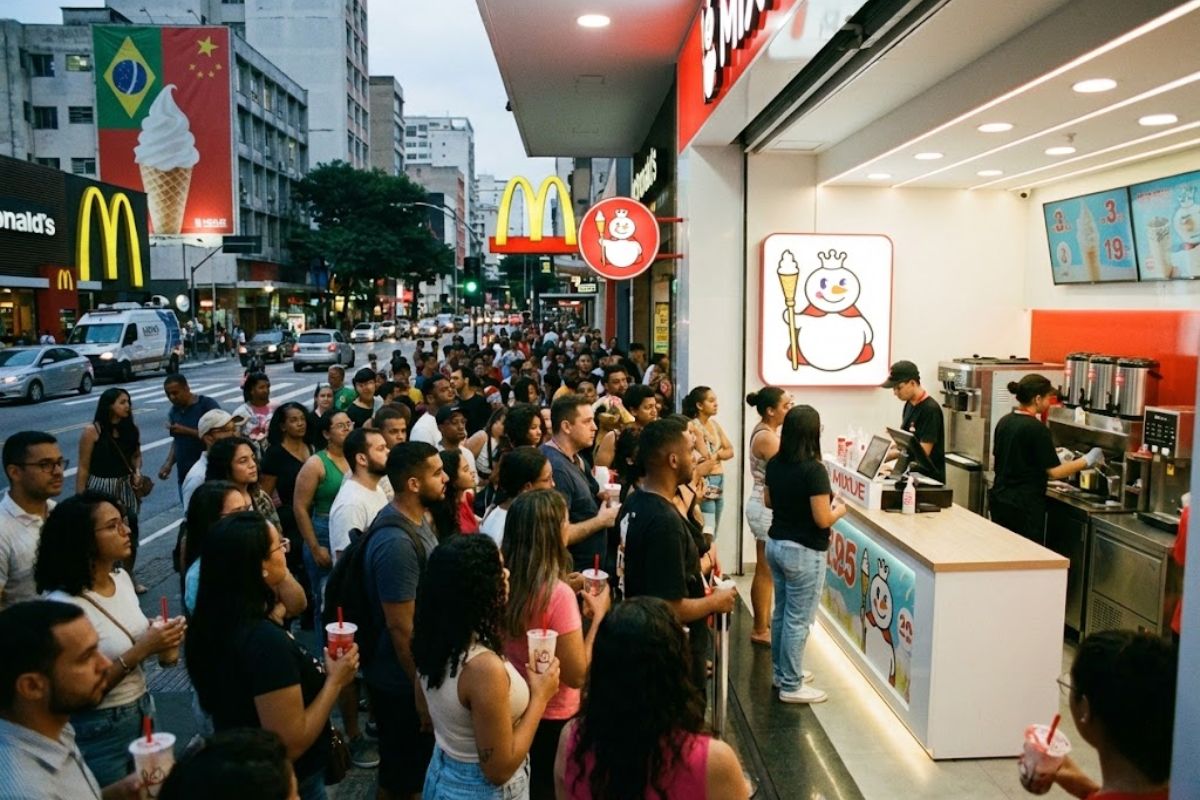


A Chinese Fast-Food Chain That Has Already Surpassed McDonald’s and Starbucks in Number of Units Opened Its First Store in Shopping Cidade São Paulo. The Debut Triggers an Expansion of R$ 3.2 Billion, Promises Up to 25,000 Jobs by 2030, Sells Ice Creams and Bubble Tea, and Targets Classes C+ and B in Brazil.
The Chinese fast-food chain Mixue has started operations in Brazil with the opening of its first store in São Paulo at Shopping Cidade São Paulo. The brand arrives in the country with an estimated expansion plan of R$ 3.2 billion and reinforces a growth strategy supported by franchises and low prices.
The movement occurs against an economic and diplomatic backdrop mentioned in the announcement: the investment was announced during President Luiz Inácio Lula da Silva’s visit to China, in a context of commercial rapprochement between the two countries. At the same time, the chain states its goal to create up to 25,000 jobs by 2030, linking the expansion to job generation.
Where It Took Place and What Was Inaugurated in São Paulo

The debut took place in the city of São Paulo, with the first store located in Shopping Cidade São Paulo. The location was chosen as the entry point to establish a physical presence in the country, marking the beginning of the Brazilian operation of a chain that presents itself as larger than McDonald’s and Starbucks in terms of store count.
-
With an investment of R$ 612 million, a capacity to process 1.2 million liters of milk per day, Piracanjuba inaugurates a mega cheese factory that increases national production, reduces dependence on imports, and repositions Brazil on the global dairy map.

-
Brazilian city gains industrial hub for 85 companies that is equivalent to 55 football fields.

-
Peugeot and Citroën factory in Argentina cuts production by half and opens a layoff program for more than 2,000 employees after Brazil drastically reduced purchases of Argentine vehicles.

-
A Brazilian city gains a factory worth R$ 300 million with the capacity to process 200 thousand tons of wheat per year, a mill of 660 tons/day, silos for 42 thousand tons, and an industrial area of 276 thousand m².

The opening at Shopping Cidade São Paulo serves as a first traction test in a high-consumption environment, with constant foot traffic and high competition. Practically speaking, the store inaugurates direct contact with the Brazilian public and will function as a showcase of the positioning that the Chinese fast-food chain upholds: a limited and repeatable variety, speed of service, and price as the central decision factor.
The Global Size of Mixue and Why It Matters for Its Entry in Brazil

Mixue claims to have over 45,000 units in 12 countries, a volume that helps explain how the company has become a reference for scale in fast food. When a chain operates with tens of thousands of points, the efficiency logic changes: what matters is not only the performance of an isolated store but the ability to repeat the same standard many times and reduce costs at each step of the process.
In this scenario, international presence becomes a negotiation and standardization tool. For a Chinese fast-food chain betting on low prices, scale means purchasing power, predictability of supplies, and operational consistency, factors that become even more relevant when the company decides to enter a competitive market like Brazil.
The Investment of R$ 3.2 Billion and the Promise of Up to 25,000 Jobs by 2030


The publicized plan foresees R$ 3.2 billion in investment as the axis of expansion in Brazil. The figure is presented as a basis for a structured entry, not just as a one-off opening of a unit. The chain also associates the strategy with a promise of impact on the job market: up to 25,000 jobs by 2030.
The connection between investment and jobs typically materializes in complementary fronts, especially in franchise operations: hiring in stores, hiring in logistics and support, the need for training and standardization, as well as activities related to supply. In the specific case of the Chinese fast-food chain, the company itself highlights a component that directly influences this type of chain: the construction of a local supply structure.
The Supply Factory and Cost Control to Keep Prices Low
Mixue states that it will invest in the construction of a supply factory. This point is strategic because it shifts part of the cost control into the brand’s own system, reducing dependence on third parties and helping to ensure a standard of supply. In large-scale models, having a local supply base tends to facilitate supply regularity, standardization of ingredients, and expansion planning.
In market discourse, this type of structure serves as a foundation to support what the chain places at the center of its proposal: affordable prices. A Chinese fast-food chain that promises “rock-bottom prices” needs to reduce cost variations and avoid bottlenecks, especially when it begins to spread units across a large territory with complex logistics chains.
The Franchise Model as an Expansion Driver in Brazil
The chain indicates that its differentiator lies in the franchise model, where the company provides supplies at reduced costs to franchisees. This dynamic shifts part of the competitive advantage to the supply stage: by providing cheaper supplies, the brand helps the franchise to operate with a lower final price and a margin compatible with the business.
For the Brazilian market, this means that expansion can follow a typical franchise layout: accelerated growth through the multiplication of local operators, with standardized processes and menus. The sensitive point of this model is the balance between scale and consistency, because franchises require strict repetition of standards to maintain the consumer experience similar across different locations.
What Mixue Sells and How the Menu Positions Itself
The Chinese fast-food chain highlights ice creams and bubble tea on its menu, presenting these items as part of its price appeal. This is a combination that typically favors high frequency, impulse buying, and quick consumption, especially when price becomes the main argument.
Ice creams are frequently rotating products in high-traffic environments, and bubble tea serves as a beverage item with its own identity and differentiation space. By anchoring its menu in these products, the brand tries to occupy a clear position: a low-cost consumption option, with strong repeat appeal and potential for viral spread through format, variations, and combinations.
The Declared Target: Classes C+ and B and the “Average Brazilian” as Central Competition
The mentioned strategy primarily targets classes C+ and B, with competitive pricing as bait to attract volume. This definition points to an audience that tends to balance consumption desire with price sensitivity, seeking more economical alternatives without giving up convenience and predictability.
In practice, the Chinese fast-food chain signals that it wants to enter the routine: transforming simple products into habits, and habits into scale. When the goal is to win over the average Brazilian’s wallet, the differentiator is rarely luxury; it’s repetition, accessibility, and constant presence, especially in large centers like São Paulo, where the competition for attention is intense.
The Adaptation to the Brazilian Palate as a Decisive Test
Mixue recognizes the challenge of adapting its menu to the Brazilian palate, described as diversified. Historically, foreign food companies often make adjustments to incorporate local preferences, whether in flavors, combinations, or consumption formats.
Here lies an operational tension: adapting without losing the logic of standardization that supports costs. The further a Chinese fast-food chain strays from the original standard, the greater the complexity of supply and training, which can pressure the low-price model. The performance in Brazil, therefore, depends on how the brand balances product identity with adaptation to local tastes.
Why the Debut in São Paulo Holds Symbolic and Operational Weight
São Paulo functions as a showcase and laboratory. The city concentrates a diverse audience, high competition, and consumption behavior capable of quickly testing whether a model can sustain real demand. By starting at Shopping Cidade São Paulo, the company chooses an environment where performance is measured daily: foot traffic, repetition, price perception, and menu acceptance.
At the same time, the debut reinforces the narrative of structured expansion. The Chinese fast-food chain is not just opening a store but signaling its intention to build an operation based on franchises, a local supply chain, and scale, tied to clear numerical goals such as investment and jobs by 2030.
What to Observe from Now On in Brazil
With the disclosed information, the next relevant steps to measure the effectiveness of the plan focus on three fronts: maintaining a low-price positioning, the ability to replicate the franchise model consistently, and advancing the supply structure, including the announced factory.
It will also be crucial to monitor how the brand adjusts its offerings for Brazilian consumers without losing speed, standards, and cost. In the fast-food segment, price attracts the first purchase, but repetition and consistency decide who stays, especially when competition is vast and consumers easily compare alternatives.
The entrance of the Chinese fast-food chain Mixue in Brazil took place in São Paulo at Shopping Cidade São Paulo, with a declared expansion plan of R$ 3.2 billion, a goal of up to 25,000 jobs by 2030, a focus on franchises, a promise of rock-bottom prices, and a menu centered on ice creams and bubble tea, targeting classes C+ and B. The case combines global scale, cost strategy, and a practical test of adaptation to local tastes in a market where price and repetition define winners.
If you follow this type of expansion, it’s worth observing how the Chinese fast-food chain will sustain low prices while maintaining standardization while trying to please the Brazilian palate.
In your opinion, will the Chinese fast-food chain Mixue win over the average Brazilian with its price, or will it need to make substantial changes to the menu to really succeed?








Parabéns e que seja um sucesso. Deveríamos ter inteligência e exportar o Bob’s
Só **** acredita e espalha fake news, o negócio ajuda muito a termos opções sem falar na geração de emprego… acho q estão preocupados pq a matéria prima são bovinos kkkk.
Espero que dê certo chega desse monopólio americano de fast food, chega de burguer king e McDonald’s.