





 Portuguese
  English
  Spanish
  5 min of reading
  1 comment


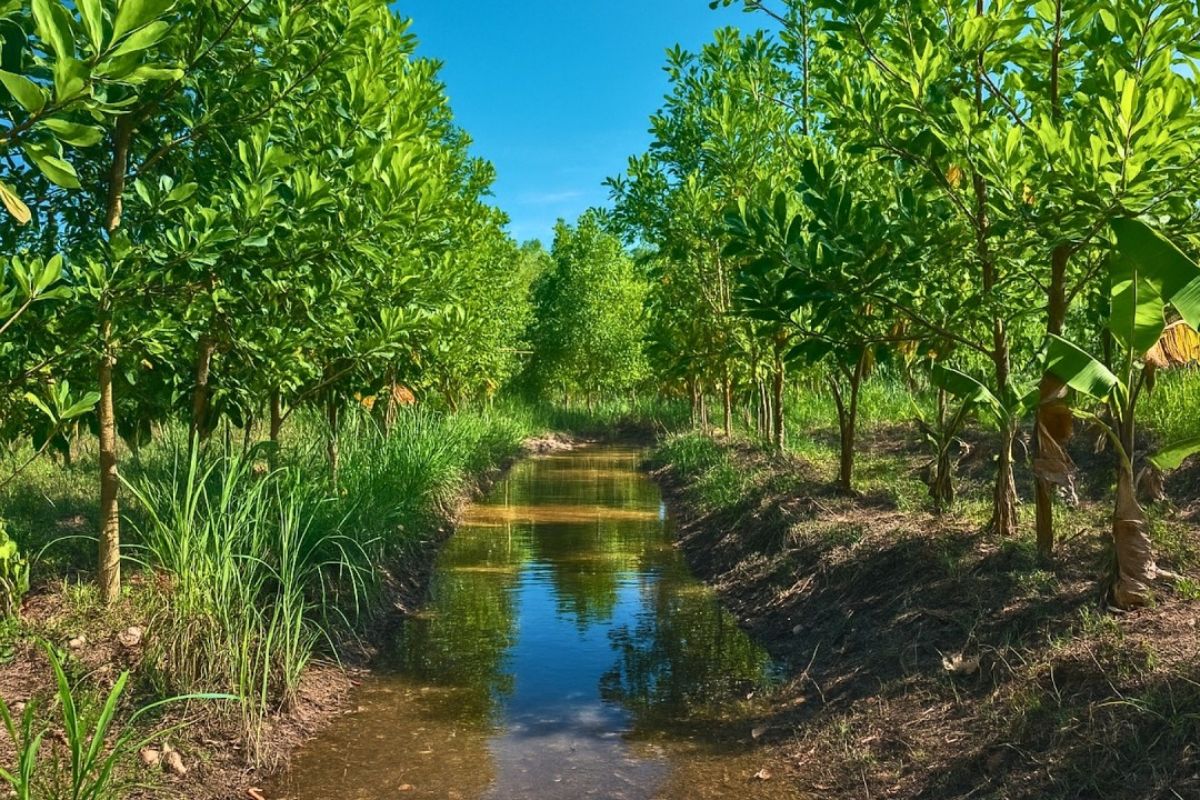


Farm In Thailand Shows How Biomass, Elephants, Biochar, Agroforestry, And Regenerative Management Allow For More Food To Be Produced, Spending Less Money And Surviving In A Climate With Up To Nine Months Straight Of Extreme Drought
The farm in Thailand, located in the north of the country, operates in one of the most challenging climatic conditions in Southeast Asia. The region faces only two to three months of concentrated rainfall, followed by up to nine months of dry season, with temperatures that can exceed 40 degrees Celsius. In this extreme scenario, conventional agricultural production relies heavily on artificial irrigation, chemical fertilizers, and pesticides, increasing costs and degrading the soil over time.
Even so, the farm in Thailand has achieved productivity surpassing conventional agriculture in its first harvest, eliminating synthetic fertilizers, drastically reducing operational costs, and building an agricultural system capable of retaining practically all rainwater that falls on the land.
Land Planning To Capture Every Drop Of Water

The physical design of the farm in Thailand was conceived to address a central problem of the region: extremely intense rains in short periods, followed by long months with no precipitation at all. Instead of allowing water to quickly run down the mountain, the land was shaped with contour lines, infiltration ditches, and planted mounds positioned precisely along the natural contours of the landscape.
-
With only 1% of Brazil’s territory, Santa Catarina has built one of the most competitive industrial parks in the country, with 64,000 companies, nearly 1 million jobs, and a growth rate of 5.3% while the national industry is practically stagnant.

-
Brazil has just secured a secret route through Turkey to save agribusiness exports that were threatened by the closure of the Strait of Hormuz amid violent clashes in the Middle East.

-
JBS, founded by the Batista brothers, continues to conquer the world: the entrepreneurs built a ‘factory in the desert’ with 3,000 jobs.
-
With only 1% of Brazilian territory, Santa Catarina has built one of the most competitive industrial parks in the country with 64,000 companies, nearly 1 million jobs, and a growth of 5.3% while the national industry is practically stagnant.

These structures slow down the flow of water during storms, creating temporary accumulation zones. Water slowly infiltrates the soil, recharging deep layers and forming real underground reservoirs. No drop of water leaves the property, ensuring enough moisture for plants to survive throughout the dry season.
Living Soil Replaces Industrial Fertilizers

The central point of the farm in Thailand is not only water retention but the complete rebuilding of life in the soil. The area started with extremely low levels of organic matter, about 0.2%, a condition typical of degraded lands subjected to years of conventional practices.
Instead of correcting the soil with chemical inputs, the system prioritized biomass, living roots, and microorganisms. The constant decomposition of leaves, grasses, trunks, and plant residues feeds a complex biological network made up of bacteria, fungi, protozoa, and other soil organisms.
These microorganisms work in direct symbiosis with plant roots, releasing nutrients continuously and in a balanced manner. The nutrients provided are complex and highly assimilable, making the use of chemical fertilizers unnecessary.
Biochar Transforms Poor Soil Into Nutrient Reservoir

Another fundamental element of the farm in Thailand is the use of biochar produced from agricultural residues, especially rice leftovers. The material is burned in low-oxygen environments, resulting in an extremely porous structure rich in stable carbon.
Biochar does not act as a direct fertilizer but functions as a physical and biological sponge, capable of storing water, nutrients, and microorganisms in its microscopic pores. In poor soils, this material accelerates the recovery of fertility and significantly increases water retention capacity.
Regenerative Rice Surpasses The Conventional System

In rice cultivation, the farm in Thailand adopted a completely biological system. The seeds are pre-germinated, coated with living compounds, and planted with controlled spacing using simple drum seeders that facilitate management without herbicides.
This proper spacing reduces competition between plants, improves air circulation, and allows for manual or mechanical removal of weeds. Even without pesticides, the plants have shown superior growth, sturdier stems, and greater productivity, surpassing conventional crops in the first harvest.
Elephant Manure As Biological Engine
A unique feature of the farm in Thailand is the use of elephant manure in composting. The animals live a few kilometers from the property and feed on diverse natural vegetation, producing highly fibrous manure, rich in microorganisms and free from industrial waste.
Mixed with leaves, shredded wood, and plant residues, the manure undergoes controlled thermal cycles, reaching temperatures between 55 and 75 degrees Celsius. After about 20 days, the result is a biologically active compost capable of inoculating life in the soil with minimal amounts per hectare.
Syntragric Agroforestry Creates Long-Term Stability
The farm in Thailand also operates under the principles of syntragric agroforestry, combining pioneer trees, fruit trees, grasses, and legumes in high density. Species like acacia, banana, elephant grass, moringa, and citrus create successive layers of shade, accumulate biomass, and protect the soil from extreme heat.
As the system matures, the need for human intervention decreases. Pruning generates continuous mulch, moisture remains stable, and fertility increases year after year, creating a nearly self-sustaining system.
Liquid Composting And Vermicomposting Increase Efficiency
In addition to solid composting, the farm in Thailand uses liquid compost extracts to re-inoculate microorganisms directly into the soil and on the leaves. Small amounts are sufficient to stimulate biological activity, reduce diseases, and strengthen plant metabolism.
Vermicomposting complements the system, producing an even richer fertilizer in natural hormones and microorganisms, without odors or environmental risks.
Less Cost, More Food, And Climate Resilience
By eliminating chemical fertilizers, pesticides, and intensive irrigation, the farm in Thailand drastically reduced its production costs. At the same time, it increased productivity, diversified crops, and built a system capable of withstanding prolonged droughts, heat waves, and extreme weather events.
The result is an agricultural model that produces more food with less money, restores degraded soils, and offers food security in one of the most climate-vulnerable regions on the planet.
Given such consistent results, the inevitable question arises: if a farm in Thailand can produce more without fertilizers, without irrigation, and with regenerated soil, what still prevents this transformation from spreading to the rest of the world?








OUTSTANDING!!! Finally someone understands regenerative agriculture.