





 Portuguese
  English
  Spanish
  6 min of reading
  0 comments


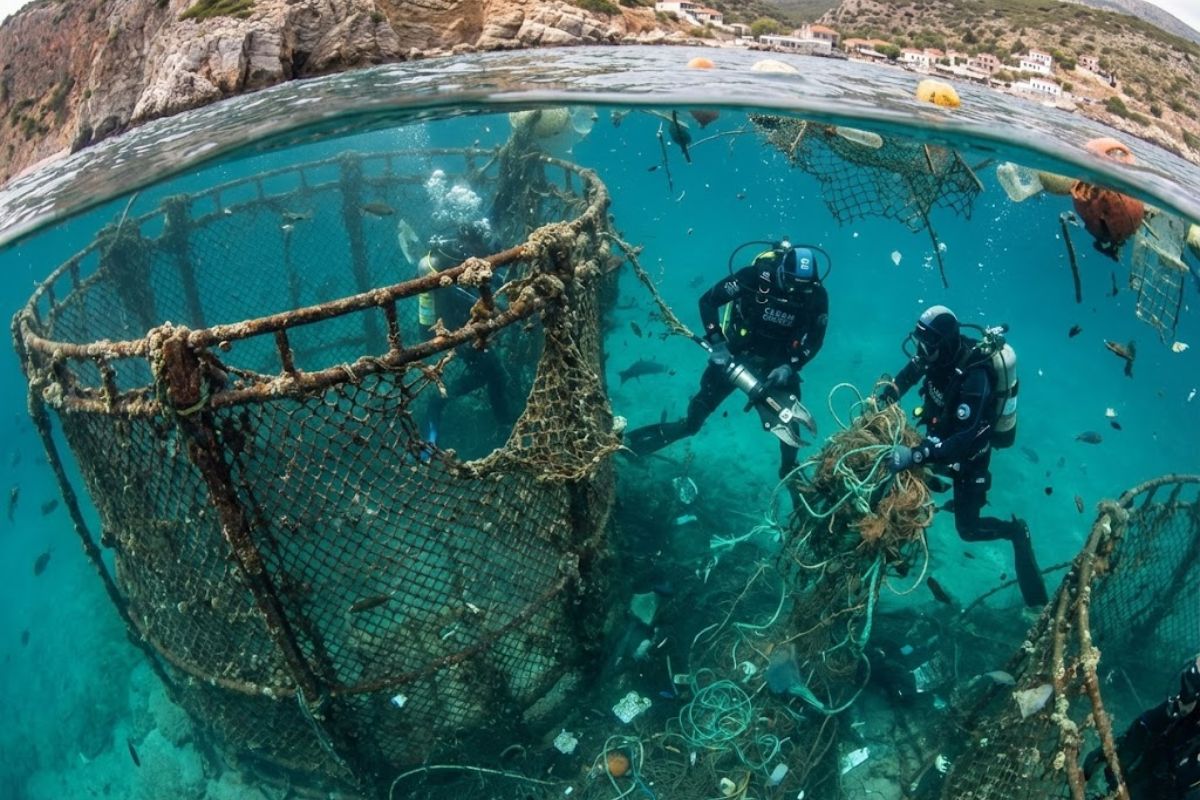
On The Greek Coast, Abandoned Fish Farms Become Continuous Sources Of Polystyrene, Nets, And Buoys That Break And Travel With Currents. In Methana, Near Athens, Activists And Divers Face An Underwater Maze Of Up To 40 M, While Licenses, Bankruptcy, And Lax Supervision Extend The Mess For Years To Come.
“Ghost” fish farms do not attract attention from afar, but the impact appears when looking closely at the water and the shoreline. What Seems Like A Stagnant Structure Becomes A Factory Of Fragments, With Parts That Come Loose, Spread Out, And Reappear On The Sand, Rocks, And Open Sea.
In places like Methana, a few hours from Athens, abandonment is not just a backdrop; it is an ongoing problem. There are those who dive to dismantle nets and buoys, there are owners who escape responsibility, and there is a state that takes time to react, even when the damage becomes visible over miles.
What Are Ghost Fish Farms And Why Do They Continue In The Sea

When talking about “ghost” fish farms, it is not a mystery, but a void of responsibility.
-
The sugar-energy sector advances with agricultural technology, but agricultural productivity still raises concerns.

-
The eggshell that almost everyone throws away is made up of about 95% calcium carbonate and can help enrich the soil when crushed, slowly releasing nutrients and being reused in home gardens and vegetable patches.

-
This farm in the United States does not use sunlight, does not use soil, and produces 500 times more food per square meter than traditional agriculture: the secret lies in 42,000 LEDs, hydroponics, and a system that recycles even the heat from the lamps.

-
The water that almost everyone throws away after cooking potatoes carries nutrients released during the preparation and can be reused to help in the development of plants when used correctly at the base of gardens and pots, at no additional cost and without changing the routine.



They are aquaculture facilities that cease operation and remain in the environment as if they still existed: cages, rings, ropes, nets, buoys, and plastic components remain trapped in place or adrift. The “ghost” Is The Absence Of Those Who Should Be Responsible, Not The Nonexistence Of The Structure.

In Methana, one of these farms began operating in 1993 and was said to have raised seabass and gilt-head bream. Starting in 2011, licensing problems arose; then, the activity stopped. The decisive point is that the closure did not come accompanied by dismantling, and what was left behind became an environmental liability. Activists report that such abandonment can occur due to insolvency, licensing hurdles, or other reasons, creating a mosaic of cases difficult to quickly resolve.
How The Plastic From Farms Turns Into Persistent Pollution Along The Coast

Seen from above, these farms may look like small marks in the sea, with subtle impact. Up close, and especially beneath the surface, the picture changes: the installations reach depths of up to 40 m and, for the most part, are made of plastic.

As This Material Ages And Breaks, Pollution Does Not “Disappear”; It Multiplies Into Pieces, Spreading Through Currents And Weather Events, Reappearing On Beaches And Coastal Areas.

A recurring example in the field report is polystyrene that breaks loose from the buoys. When the buoys break, part of the content is lost to the sea and turns into light fragments, easy to transport and difficult to collect.


For fish, this plastic may seem like food, creating a silent path to contamination. Along a coastal route, a beach about 5 km away may also accumulate this material, showing how pollution shifts without needing great distances to become visible.
Nets, Tangles, And The Domino Effect On Marine Life

The damage is not limited to loose plastic. Abandoned nets tangle and can entrap wild fish, trapping and killing them.

The carcasses attract other animals, feeding a cycle that can extend for a long time. It Is A Trap That Does Not Stop On Its Own, Because The Structure Remains Active In The Ecosystem Even Without Any Human Operation: Ropes Remain Taut, Nets Remain Present, Parts Continue Degrading.
Over time, the round cages can break or detach. Parts come loose and start to circulate, posing risks to wildlife as well as to those navigating or diving.
In such situations, the problem ceases to be merely “trash in the sea” and becomes a set of simultaneous threats: accidental capture, material fragmentation, coastal spreading, and, ultimately, residues small enough to traverse the entire food chain.
Who Locates, Who Dives, And Why Cleaning Is Slow, Expensive, And Dangerous
There is background work before diving begins. Tasos Filippides, affiliated with an NGO, reports the use of satellite imagery to locate potentially abandoned farms.
He claims to have identified over 130 potential locations and confirmed at least 22 as “ghost” farms. This Mapping Changes The Game, As It Helps Separate Rumors From Verifiable Cases And Points Out Where The Risk Might Be Greater.
Once in the water, the riskiest part begins. Divers describe the scenario as an underwater puzzle: when pulling nets, visibility can vanish; structures may be covered by sediments and marine life, forming a confusing maze.
The work involves collecting nets, separating ropes that hold cages to the bottom, attaching lift balloons, and bringing everything to the surface in stages. In the final phase, huge rings are slowly dragged to a specialized ship for recovering marine debris.
This Type Of Operation Requires Trained People And Planning, Because Improvisation, In This Context, Leads To Accidents.
Responsibility, Supervision, And The Impasse That Allows Abandonment To Continue
The question of “who is responsible” arises all the time because the answer is rarely simple. From a legal standpoint, there is the idea that there is a responsible owner and that they should bear the cost of removal.
The problem described by activists is the lack of effective control: in practice, the system does not always enforce, does not always supervise, and when it reacts, it often reacts late. Without Consistent Accountability, Abandonment Becomes A Repeated Model, And The Sea Becomes A Dumping Ground.
The friction can reach the courts. There is a report of a case where representatives of initiatives like Healthy Seas and partners were sued by the owner of another abandoned facility, accused of damaging equipment valued at half a million euros. This illustrates a paradox: even when a structure is abandoned, interfering with it can trigger disputes over ownership and damages, impeding removal.
Additionally, operations depend on formal approvals; in Methana, it took more than a year to obtain a state commission because, without that document, the team could be accused of removing an “operational” facility. Bureaucratic Slowness Becomes Part Of The Environmental Problem, Not Just An Administrative Detail.
A Problem That Is Not Just In Greece And What Remains After The Structure Disappears

Activists insist that this is not an isolated case: there are mentions of similar occurrences in Canada and Chile, suggesting a pattern associated with abandoned aquaculture farms in different regions. The repetition of the scenario points to the same dilemma: when the activity ends without dismantling, the liability continues, and each place carries years of silent pollution.
The impact also becomes easier to imagine when considering scale: if damage is already visible with dozens of operations scattered, the trail tends to increase as the number of installations grows.
Even when a “ghost” farm disappears from the map, the legacy does not disappear along with it. Microplastics and residues remain that can be transported by fish and currents, persisting much longer than any human cycle of management, business, or public mandate.
Cleaning Removes What Is Large And Visible, But Does Not Erase What Has Already Fragmented. And That Is Exactly Why Prevention, Supervision, And Accountability Matter As Much As The Diving Effort.
Before All This Becomes “Normal” On The Coast, It Is Worth Considering What You Would Accept To See On Your Own Shore: If A Private Structure Rotting In The Sea For Years, Who Should Pay The Bill And How Long Should This Be Resolved? And, Looking At Beaches You Know, Have You Ever Encountered Broken Buoys, Pieces Of Styrofoam, Or Nets On The Sand, And What Did You Do At The Moment: Ignored, Collected, Reported, Documented?









-

3 pessoas reagiram a isso.