





 Portuguese
  English
  Spanish
  7 min of reading
  1 comment


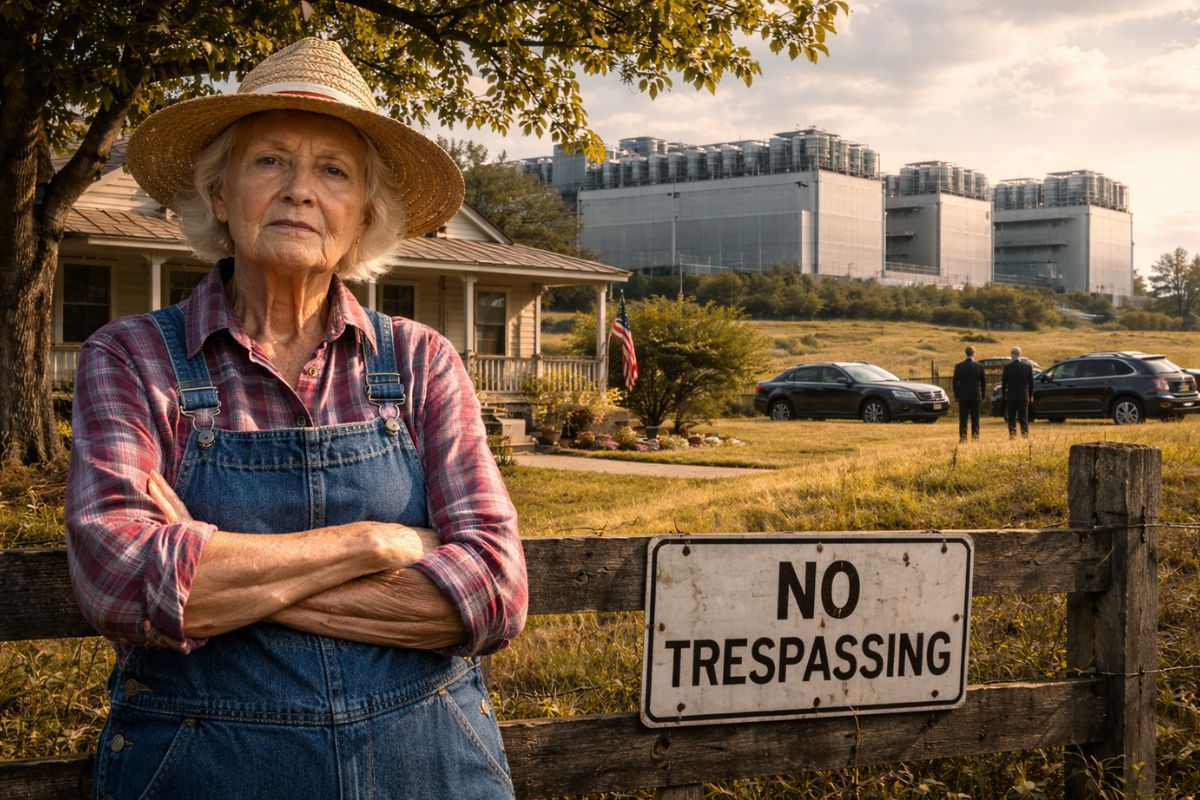


Farmer Ida Huddleston Received Offer With Confidentiality Clause To Sell 260 Acres In Mason County, But Responded “I’m Not For Sale.” Neighbors Uncovered Requests For 2.2 Gigawatts At The Local Power Company And Linked It To Plans For An AI Data Center That Could Take Up 2,000 Acres Entirely
82-year-old farmer Ida Huddleston heard an offer of over US$ 33 million to hand over the farm in Kentucky that has sustained her family for generations and responded without negotiation: “you don’t have enough money to buy me”. The message was as direct as an imaginary sign on the door: not for sale.
The farmer became a character in a larger conflict that does not depend on opinions about technology. According to The Guardian, companies are racing to establish data centers that power artificial intelligence and, to do so, need land, energy, and water on an industrial scale. In rural areas like Mason County, this dispute encroaches on the pasture fence and transforms identity, routine, and family heritage into the fine print of a contract.
The Visit At The Door, The Confidentiality Contract, And The “Address” That No One Wanted To Sign

When two men knocked on the farmer’s door in May of the previous year, they brought a contract and a typical script for aggressive negotiation: the buyer would be an unidentified Fortune 100 company, the use of the land appeared as unspecified “industrial development,” and to find out what it was, she would need to sign a confidentiality agreement.
-
Motorola launched the Signature with a gold seal from DxOMark, tying with the iPhone 17 Pro in camera performance, Snapdragon 8 Gen 5 that surpassed 3 million in benchmarks, and a zoom that impresses even at night.

-
Satellites reveal beneath the Sahara a giant river buried for thousands of kilometers: study shows that the largest hot desert on the planet was once traversed by a river system comparable to the largest on Earth.

-
Scientists have captured something never seen in space: newly born stars are creating gigantic rings of light a thousand times larger than the distance between the Earth and the Sun, and this changes everything we knew about stellar birth.

-
Geologists find traces of a continent that disappeared 155 million years ago after separating from Australia and reveal that it did not sink, but broke into fragments scattered across Southeast Asia.

This requirement shifts the weight of the decision.
The farmer was not just refusing money; she was refusing to sell without understanding the full project.
Signing confidentiality before understanding the project pushes the resident to make a decision in the dark, and this explains why more than a dozen neighbors, according to reports, received the same visit and began seeking answers outside the private conversation.
Public Records, 2.2 Gigawatts, And The Type Of Clue That Reveals A Data Center
Neighbors searched public records and found a sign that often speaks volumes in any rural area: a project request for 2.2 gigawatts with the local power plant, nearly double the annual generation capacity mentioned in the database.
A jump of that size does not match “any industry”; it matches heavy computing infrastructure.
That’s how the community concluded that the plan was for a data center.
The farmer, who saw streams and pastures, began to confront an alternate reality: executives looking at the same territory and seeing fragile zoning, relatively cheap energy, and availability of water.
The “address” that AI needs is not a pretty street; it is a set of physical conditions that do not always show up in marketing.
Why So Much Land Became A Priority And Why The Countryside Is On The AI Radar

The race is described as global: it is estimated that 40,000 acres of prepared land will be needed for data center developments over the next five years, double what is currently in use.
This number is the type of pressure that pushes prospecting out of big cities because rural areas offer large lots, less real estate competition, and, often, fewer organized neighborhood barriers.
In this context, the farmer from Kentucky is not an isolated exception; she is an example of what happens when the digital economy meets physical limits.
AI does not run on air: it relies on warehouses, cables, substations, water, and a constant supply of energy.
Rejections turn into an uncomfortable reminder that infrastructure has boundaries, and that not every boundary is willing to be bought.
Offers That Seem Unreal And Rejections That Also Seem
The database lists cases sequentially: in Pennsylvania, a farmer rejected US$ 15 million for land cultivated for 50 years; in Wisconsin, another turned down US$ 80 million in the same month; and there are owners who received offers above US$ 120,000 per acre, amounts described as unimaginable a few years ago.
In Mason County, at least five neighbors of the farmer said “no” categorically, including one who was suggested to “name any price.”
This is the point where the discussion becomes uncomfortable for those who see life as a spreadsheet. The farmer and the neighbors do not deny that the money is significant; what they contest is the exchange.
“Money does not compensate for giving up the lifestyle” emerges as a summary, and this explains why the case does not resolve with the question “how much is it worth?”. For some, the question becomes “what is left afterwards?”.
Four Generations In The Same Field And The Identity That Does Not Fit In The Contract
The database describes the historical weight of four generations watching the world change from the same spot: tobacco at the start of the American Civil War, wheat during World War I and the Great Depression, childhood marked by beans, broccoli, and potatoes in soil ravaged by wind and dust.
The farmer says her whole life boils down to the land and remembers the cabin built by her husband with local wood and stones.
This kind of detail explains why the farmer does not “need” an ideological narrative to resist.
Identity Comes From Possession And Care: knowing where the stream runs, where the cattle go, where the family works. Money offers an escape, but it also closes a cycle. And for those who live the land as continuity, closing the cycle is the real cost.
The Other Side Of The County, Jobs, Taxes, And The Promise Of A “New Direction”
Local officials argue that a data center could benefit future generations with tax revenues and jobs, and this dispute has appeared in public hearings.
Mason County would have lost about 10% of its population since 1980, linked to the decline of the manufacturing industry.
Developers assert that the project would create 1,000 construction jobs, but could generate only 50 full-time operational jobs.
This difference between peak construction and operational routine is crucial.
The farmer and the neighbors see permanence in the land; the data center promises an intense construction cycle followed by a lean operation.
In places like Loudoun County, Virginia, referred to as “Data Center Alley,” tax revenue from data centers would almost equal the entire operational budget of the county, an argument that weighs heavily when the municipality is shrinking.
What Can Happen When “No” Becomes A Power Struggle
The refusal does not eliminate the risk of institutional pressure.
The database points out that some farmers fear that the utility company may invoke eminent domain, and mentions that Dominion Energy has already used this tool against a farmer in Virginia in April of the previous year.
This is where the choice stops being just private and becomes a conflict between infrastructure, public interest, and property rights.
The county is also not unanimous.
Not everyone resists; some would agree to sell if the project moves forward, and one neighbor acknowledges that it is hard to blame those who accept “10 million” for a farm.
This creates a typical social rift: the farmer who stays becomes a symbol of resistance, while those who sell become targets of judgment, even making a rational decision for their own family.
Land, Water, Power Grid, And Fears That Go Beyond Nostalgia
Part of the resistance is not just emotional. There are concerns about impacts: data centers can overload power grids, deplete local water resources, contaminate soil, and fragment wildlife habitats, according to the database.
The farmer’s daughter puts it succinctly: “you can’t produce bread from a data center”.
There is also a sensory and daily dimension. The daughter, with significant vision impairment, reports that she connects with the land through sound: bird songs and the murmur of the stream.
She fears the constant hum of a data center. This fear is not poetry; it is a way of saying that the project changes the environment and that the farm would cease to be a physical reality to become a memory.
The 82-year-old farmer refused US$ 33 million because, for her, the farm is not an asset; it is origin, routine, and continuity. The case exposes the contradiction of the AI era: technology promises to transcend limits but relies on physical limits, prepared land, water, energy, and power grids.
Between a request for 2.2 gigawatts, a plan for 2,000 acres, and offers reaching into the tens of millions, the question that remains is not only “how much does it cost?”, it is “what does money not buy?”.
Now I want personal answers, not generic: if a multimillion-dollar proposal came to your family, would you resist like this farmer for the sake of history and identity, or would you sell to ensure financial security? And, in your opinion, should an AI data center prioritize rural areas or should it be located near urban centers, even if it costs more?








Parabéns a o fazendeiro.
Não comemos dados, nem vivemos sem água.
A natureza é muito melhor que qualquer futilidade humana!