





 Portuguese
  English
  Spanish
  6 min of reading
  0 comments


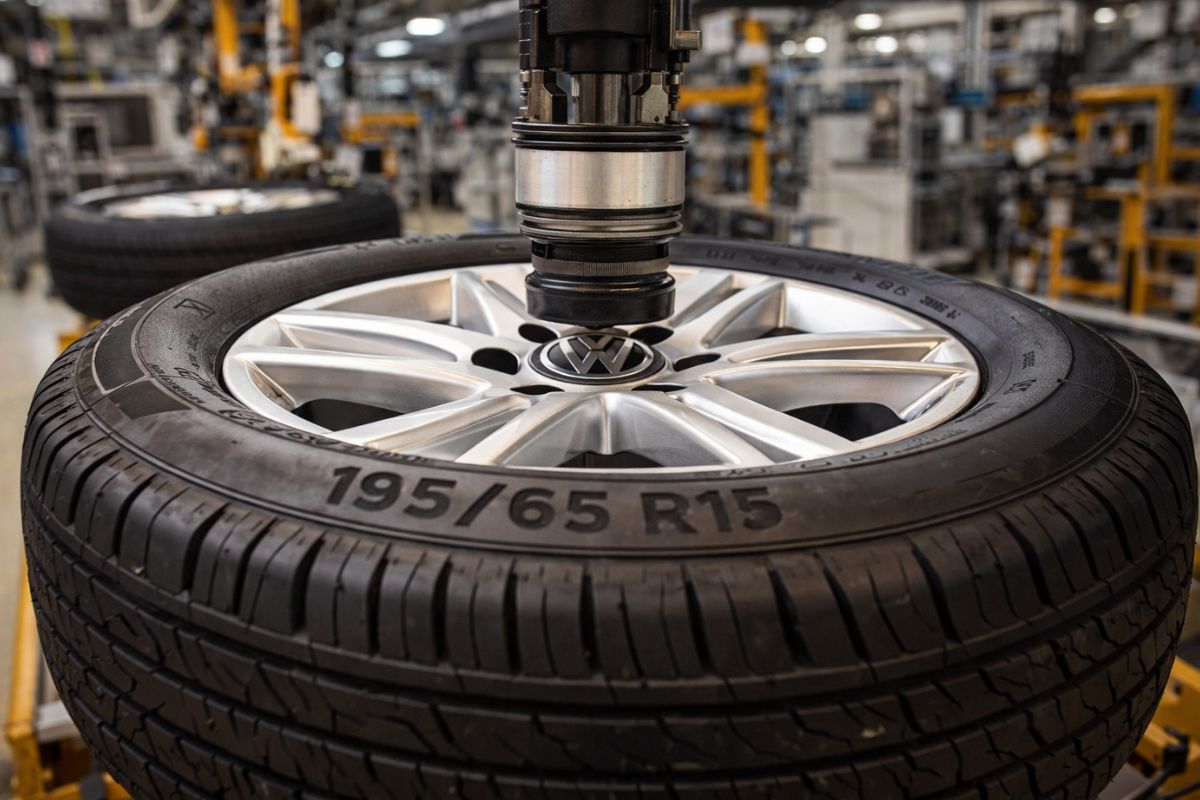
Ferdinand Piëch, grandson of Ferdinand Porsche and president of Volkswagen between 1993 and 2002, decided that the tire 195/65 R15 would be used in almost all cars of the VAG Group. The tire standardization strategy allowed negotiating giant volumes with suppliers, reducing costs at scale and helping Volkswagen to get out of billion-dollar losses to record profits.
For years, millions of cars from Volkswagen rolled off the production lines with exactly the same tire: the 195/65 R15. From the compact Golf to the sedan Passat, including the Audi A3, Skoda Octavia, and SEAT León, the standardization was visibly apparent to anyone paying attention. The person responsible for this decision had a name and surname: Ferdinand Piëch, grandson of Ferdinand Porsche and one of the most influential executives in the history of the automotive industry. Piëch led the Volkswagen Group from 1993 to 2002 and transformed a company that was accumulating billion-dollar losses into a global powerhouse with net profits exceeding 1.5 billion euros (about R$ 9 billion).
The logic behind the choice was simple yet brilliant. The more models from the Volkswagen Group that used the same tire, the greater the volume of purchases negotiated with suppliers and, consequently, the lower the cost per unit. The result was a scale economy that no competitor could replicate at the time. The volume of R15 tires ordered by Volkswagen was almost ten times higher than that of rivals like Mercedes-Benz.
Who was Ferdinand Piëch and why did he change Volkswagen forever

Ferdinand Piëch was born into the automotive royalty of Europe. Grandson of Ferdinand Porsche, the creator of the original Beetle, Piëch grew up surrounded by engineering and competition. Before becoming president of the Volkswagen Group, he served as technical director and then CEO of Audi during the 1970s and 1980s.
-
An irregular parking case gains attention after a Mercedes Classe A was removed in such a strange way that it even raised doubts about damage to the car.

-
Costing R$ 16,000, the new Yamaha features a 125 cc hybrid engine with electric assistance, delivers 8.3 hp, includes ABS, optimized fuel consumption, Y-Connect connectivity, 25 liters of storage space, and a surprising 4-year warranty in the urban segment.

-
OMODA & JAECOO grows in Europe in 2026 with an integrated strategy of sales, innovation, local production, and technological advancement in the United Kingdom, Italy, and Spain.
-
OMODA & JAECOO expands after-sales service in Brazil with competitive maintenance, a 7-year warranty, and high availability of parts for technological SUVs.

It was under his leadership that Audi ceased to be a secondary brand and began to compete on equal footing with BMW and Mercedes-Benz. This experience shaped his obsessive management style, where every technical detail was taken to the extreme.
When he took command of the Volkswagen Group in 1993, Piëch found a company in financial crisis. The losses were in the billions, and the cost structure was out of control. His response was a brutal overhaul of processes, and the standardization of components became the central pillar of the strategy.
The tires were just the most visible example of a philosophy that extended to platforms, engines, electrical systems, and even screws. In Piëch’s view, every shared part among Volkswagen, Audi, Skoda, and SEAT models represented millions of euros saved.
How it all began: the Audi 100 and the 15-inch tires
The story of standardized tires began even before Piëch arrived at Volkswagen. Still as CEO of Audi, he developed the third generation of the Audi 100, which used 15-inch wheels in the higher-end versions.
This size was the same preferred by BMW and Mercedes-Benz, Audi’s two main competitors at the time. Piëch realized that adopting the same wheel diameter created a negotiation opportunity that went far beyond aesthetics.
With the launch of the new Audi 100 in 1991, Piëch chose to equip the model with 195/70 R15 tires. They were narrow enough to reduce rolling resistance and improve fuel efficiency, but wide enough to maintain good dynamic performance.
From then on, almost all Audis began to use 15-inch tires, except for the sports versions and the Audi A8. By concentrating the purchase volume on a single size, Piëch negotiated with suppliers and secured R15 tires that cost 15% less than the R14 used previously on models like the Audi 80.
The leap to the Volkswagen Group: one tire to rule them all
In 1993, upon taking the presidency of the Volkswagen Group, Piëch decided to replicate the strategy that had already worked at Audi. However, instead of keeping the series 70 tires, he opted for the series 65. The chosen tire was the 195/65 R15.
In addition to reducing costs, Piëch wanted to improve the handling of Volkswagen cars: with the slightly more compact series 65 profile, the steering response became more precise and the cornering behavior more predictable.
The list of models that adopted the 195/65 R15 is impressive. At Volkswagen, the Golf and Passat were the first. At Skoda, the Octavia and Superb. At SEAT, the León and Toledo. At Audi itself, the A3, A4, and A6.
Even the sporty Audi TT was equipped with winter tires in this size. All these models were bestsellers in their segments, which meant that millions of units rolled off the production lines with the same tire. The accumulated order volume of the Volkswagen Group was almost ten times higher than that of any German competitor.
The mathematics behind the savings: how Volkswagen won the negotiation
The economic principle behind Piëch’s decision is straightforward: the larger the purchase volume, the greater the bargaining power. By unifying the tire across dozens of models, Volkswagen became the largest individual buyer of 195/65 R15 tires in the world.
No supplier could afford to lose this contract. The result was a negotiation where each tire cost significantly less than the price paid by the competition, which purchased in much smaller volumes and in varied sizes.
To understand the scale of the savings, just consider that Volkswagen produced millions of cars per year in the 1990s. Each vehicle requires four tires, plus a spare. Under Piëch’s leadership, Volkswagen went from billion-dollar annual losses to net profits exceeding 1.5 billion euros.
Tire standardization was not the only factor, of course. The sharing of platforms among group brands also played a decisive role, as did the reduction of suppliers and the optimization of assembly lines. But the single tire became the most visible symbol of Piëch’s philosophy.
What the tire 195/65 R15 means: numbers that explain the choice
For those unfamiliar with the nomenclature, the measurement 195/65 R15 carries precise technical information. The first number (195) indicates the tire’s width in millimeters, that is, the contact area with the ground.
The second (65) is the aspect ratio, calculated as a percentage of the width, resulting in a sidewall height of 126.75 mm. The letter R indicates radial construction, the standard of modern industry. And the 15 refers to the rim diameter in inches.
This combination offered an ideal balance between comfort and performance. The width of 195 mm was sufficient to ensure grip in corners without generating excessive rolling resistance.
The 65 profile provided superior impact absorption compared to lower tires, without compromising steering precision. It was a versatile tire enough to perform well on a compact like the Golf and a sedan like the Passat. Exactly what Piëch needed to justify the standardization across Volkswagen.
The legacy of Piëch and the strategy that Volkswagen carries today
Using the same tire across dozens of models was not the only factor that transformed Volkswagen into the largest automaker in Europe. But it was a fundamental part of a mindset that Piëch instilled and that survives to this day: the obsession with sharing components among brands to reduce costs without sacrificing quality.
The MQB platform, launched in 2012 and used in models ranging from the Polo to the Tiguan, is a direct heir to this philosophy. And the electric MEB platform follows the same logic.
Piëch passed away in 2019, but the structure that Ferdinand Porsche’s grandson created within Volkswagen remains the foundation of the group. Optimizing costs to maximize profits is the basic rule of any company. The difference is that Piëch found a way to do this that was as simple as it was brilliant: starting with the tires.
And the fact that millions of Volkswagen cars have run for decades on the same 195/65 R15 is proof that, in the automotive industry, great results do not always come from revolutionary inventions. Sometimes, they come from a tire.
Did you know that the Golf, Passat, and Audi A3 used the same tire? Do you think this Volkswagen strategy was brilliant or simply too economical? Tell us in the comments what you think about Piëch’s philosophy.









Seja o primeiro a reagir!